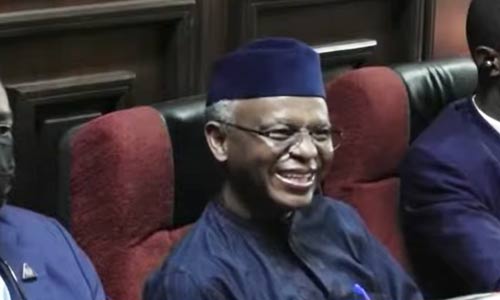
The Federal High Court sitting in Abuja on Thursday granted an application by the Independent Corrupt Practices and Other Related Offences Commission (ICPC) to play part of the closed-circuit television (CCTV) footage from its facility in the ₦10 billion suit filed by former Kaduna State Governor Nasir El-Rufai.

Justice Chigozie Onah, in a ruling on separate motions filed by the ICPC and El-Rufai, declined the former governor’s prayer to have the over six-hour video recording played in full in open court.
Justice Onah, who granted both parties 20 minutes each to play any part of the footage in open court, said the court could not be turned into a viewing centre.
The judge said the court did not have the luxury of time to watch the full footage, which spans over six hours.
He also agreed with the argument of the ICPC’s counsel, Yetunde Mosunmola, that the video contained some sensitive information that might expose the commission’s facility to a security breach if the full clip were played in open court.
He further agreed that if such a video must be played in full, it should be done in the judge’s chamber.
Justice Onah refused El-Rufai’s prayer seeking an order for the two ICPC officials who deposed to the affidavits in the commission’s processes to be produced in court for cross-examination.
The judge, who observed that fundamental rights enforcement procedures are sui generis, said the relief could not be granted on the ground that fundamental rights cases are determined by affidavit evidence.
He also refused to grant other reliefs sought by the former governor in his application.
“Both parties only have 20 minutes each to play part of the footage at 1 p.m. in open court,” Justice Onah said, noting that most lawyers and litigants would have left the court by then.
The judge then adjourned the matter until November 3 at 1 p.m. for definite hearing of the substantive applications.
The former governor had instituted the suit against the ICPC, its Chairman, Musa Aliyu, SAN, and the Attorney-General of the Federation (AGF) as first to third respondents, respectively.
El-Rufai, in the originating motion marked FHC/ABJ/CS/1852/2026 and filed by Ubong Akpan on August 13, sought ₦10 billion in damages for allegedly preventing him from having access to his wife, Aichatou Asabe, and son, Abba El-Rufai, while in custody.
The former governor, who alleged that his wife and son were denied access to him, sought nine reliefs.
He prayed the court to declare that his fundamental human rights guaranteed under Part IV of the 1999 Constitution, as amended, remain inviolable and in force notwithstanding his detention by the commission and should be honoured.
Responding in a joint counter-affidavit filed by the ICPC and its chairman but deposed to by John Uche, a Chief Anti-Corruption Assistant in the Internal Security Support Unit, they said that many paragraphs in El-Rufai’s affidavit in support of his suit were false.
Uche averred that El-Rufai was in the lawful custody of the commission by an order of the Federal High Court, Kaduna Judicial Division, in charge number FHC/KD/73C/2025.
He said that on July 7, in compliance with the order of the Kaduna Federal High Court permitting access to El-Rufai’s personal physician, the commission facilitated a medical visit to his personal physician, accompanied by its officers and his wife, Asabe.
He said that shortly after the hospital visit, the ICPC received reports that the medical visit was turned into a political meeting in breach of its security protocol, demonstrating that the existing access-control environment was vulnerable.
He said that against this background, the commission adopted a temporary access-control measure restricting non-essential access to the former governor because unrestricted access presented a continuing risk until the vulnerability was understood and adequately mitigated.
The officer said that while this was happening on July 7, El-Rufai’s son came to their office requesting to visit his father and approached him at his desk.
He said that after Abba was prevented from gaining entry into the building, he lay in the gutter and repeatedly rubbed his leg against the edge of the gutter.
Uche said the commission had CCTV cameras installed at various strategic locations within and around its office premises for security and monitoring purposes, which also recorded activities and events occurring within their respective fields of view.
He said that the contents of the storage system, including the CCTV recordings, remained accurate and were not altered or tampered with during the material period.
Uche said that following a second security breach on July 7, the ICPC determined that its existing access arrangements were no longer adequate, warranting an urgent review.
The officer said that during the review, the commission uncovered another security breach involving Asabe.
He said that Asabe was allegedly smuggled into the ICPC’s premises on Saturday, July 4, at about 7:35 p.m., after official visiting hours, with the alleged connivance of some officers of the commission who are currently facing disciplinary action.
He said that based on Asabe’s repeated disregard for access-control protocols, the commission determined that her continued access posed a specific security risk.
According to the officer, her visiting access to El-Rufai was therefore temporarily suspended pending the completion of the security review and implementation of appropriate mitigation measures.
Against El-Rufai’s allegations, the ICPC and its chairman filed a motion on notice on August 3 seeking two reliefs.
They sought an order permitting them to demonstrate or play before the court the contents of Exhibit ICPC B, being the CCTV footage contained in the USB storage device annexed to their counter-affidavit, particularly the portions identified in the schedule, for the purpose of enabling the court to properly appreciate and determine the facts in issue.
The commission and its chairman also sought an order permitting them to use appropriate computer and audio-visual equipment for the purpose of demonstrating or playing the footage.
The commission and its chairman, in the affidavit attached to the motion and deposed to by David Efut, a litigation officer in the ICPC’s Legal Services Department, said they had prepared a counter-affidavit for filing in opposition to El-Rufai’s suit, to which a USB drive containing relevant CCTV recordings was attached and marked Exhibit ICPC B.
Efut said the exhibit contained three CCTV video recordings, portions of which were material to the determination of the facts in issue in the application.
He said the specific portions of the recordings they sought to have demonstrated before the court were identified in the schedule annexed and marked Annexure A.
The officer said that the portions identified in the schedule were material because they depicted the events in question contemporaneously and would enable the court to properly assess the sequence of events, the persons present and the conduct of the persons depicted, which were disputed in the affidavit evidence before the court.
He said it was necessary, in the interest of the proper determination of the case, that the identified portions of the recordings be played or displayed in open court.
Efut, who said it was in the interest of justice to grant the application, added that none of the parties would be prejudiced by the granting of the application.
The commission divided the schedule of the footage into three parts, which it called “The Scuffle,” “The Son Being Whisked Away” and “Unauthorised Entry.”
However, El-Rufai, in his motion on notice filed on September 9, sought the production of the complete CCTV record.
The former governor sought an order directing the ICPC and its chairman to produce before the court, within such time as the court might fix, the complete, unedited CCTV recordings from the cameras covering the premises of the commission.
The first was June 7, from about 7 p.m. to 11 p.m., covering the applicant’s arrival and the arrival of his wife, Asabe, at about 10:30 p.m.; and July 4, from about 6 p.m. to 9 p.m., covering the period of the alleged “smuggling” of Asabe.
Others were July 7, from about noon to 6 p.m., covering the continuous recording of that afternoon and not merely the three clips exhibited as Exhibit ICPC B and titled “The Scuffle,” “The Son Being Taken Away” and “Unauthorised Entry.”
He sought an order directing the first and second respondents to produce the visitor registers, entry and exit records, and any other contemporaneous record of visits by Asabe and other members of the applicant’s family from June 7, 2026, to the date of the order.
He also sought an order granting him leave to require the attendance of Sadiq Baba, who certified Exhibit ICPC B, and John Uche, who swore to the commission’s counter-affidavit, to be questioned on how the three clips on Exhibit ICPC B were selected, copied and certified.
The former governor also wanted the officers to be questioned about whether the recordings of June 7, July 4 and the rest of July 7 existed and why they had not been produced.
He equally wanted them to be questioned on the events of July 7 deposed to by Uche and the alleged incident of July 4, including the so-called “back door.”
El-Rufai further sought an order that any footage produced pursuant to Relief 1 be played in open court in the presence of the parties and their counsel.
He prayed the court for an order that if the commission and its chairman failed to produce the recordings and records directed under Reliefs 1 and 2, the court should presume, under Section 167(d) of the Evidence Act, 2011, that the withheld material would, if produced, be unfavourable to them.
In his arguments, El-Rufai contended that Exhibit ICPC B comprised three titled clips, which did not prove that what was selected was all that was recorded.
He said the commission controlled the cameras, storage, visitor registers and entry and exit records.
“It has produced none of the recording of June 7, none of the recording of July 4 and only extracts of July 7.
“The omitted portion of July 7 at about 14:53 shows the applicant’s son being dragged, and his leg trapped in the gutter.
“The clip at about 14:54:55 shows the officer falling at a ditch. Those images contradict the account in the counter-affidavit,” he said.
According to him, the recording of June 7 would show that the first respondent invited Asabe onto the premises on the first night of detention.
“The recording of July 4 was the only independent means of testing the allegation that she was ‘smuggled’ in. If the court is to attach weight to Exhibit ICPC B or to the certificate, the makers ought to be available to be tested. The Fundamental Rights (Enforcement Procedure) Rules, 2009 permit the court to receive oral evidence and to require a deponent to attend.
“Section 36(3) of the Constitution requires that proceedings be held in public. In DICKSON V. SYLVA (2017) 8 NWLR (Pt. 1567) 167, the Supreme Court directed that a video exhibit be demonstrated in open court.
“Section 167(d) of the Evidence Act, 2011 permits the court to presume that evidence which could be, and is not, produced would, if produced, be unfavourable to the person who withholds it,” he argued.
The ICPC, however, disagreed with El-Rufai’s submissions in a counter-affidavit filed in October.
The commission urged the court to reject the former governor’s prayers to have the video recordings played in full on the ground that certain information in the clips was sensitive and might expose its facility to danger if demonstrated in open court.
The ICPC argued that if the court was inclined to grant El-Rufai’s reliefs, the full footage could be played in the judge’s chamber.
[A MUST HAVE] Evidence Act Demystified With Recent And Contemporary Cases And Materials

Available now for NGN 40,000 at ASC Publications, 10, Boyle Street, Onikan, Lagos. Beside High Court, TBS. Email publications@ayindesanni.com or WhatsApp +2347056667384. Purchase Link: https://paystack.com/buy/evidence-act-complete-annotation
______________________________________________________________________ “Enhance Legal Practice With Authoritative Reports” — Alexander Payne Offers Comprehensive Law Reports, Spanning Over A Century Of Nigerian Jurisprudence Interested buyers are encouraged to place their orders and enquiries via:
0704 444 4777, 0704 444 4999, 0818 199 9888
Website: www.alexandernigeria.com