By Dave Ajetomobi
IT should be noted that the incapacity to consummate must be specific. If it sterility that is, where the party cannot procreate (for a man, he cannot impregnate the wife) this does not amount to incapacity, neither does use of contraceptives or withdrawal method amount to incapacity, this is the decision in the English case of Baxter V. Baxter.
The lack of capacity to consummate must exist at of time of the marriage and during the hearing of the petition. Moreover, Section 36 of the Act states that a decree of nullity cannot be made on this ground until the court is satisfied that at the time of hearing of the petition: the incapacity is not curable, or the respondent refused to submit for a medical examination to determine whether it is curable or not and/or the respondent refused to submit for proper treatment if the incapacity is curable.
It is noteworthy that by the provision of section 35 of the Act, a party suffering from the incapacity to consummate cannot file a petition in this regard unless he or she is not aware of the incapacity at the time of the marriage.
Similarly, Section 36(2) of the Act also provides that the decree shall not be made if the petitioner is aware of the incapacity at the time of the marriage or by the conduct of the petitioner, he or she has condoned it, or time to complain elapse lapse of time, public interest, where it would be harsh and oppressive to the respondent or for any other reason.
It is noteworthy, that the party must be incapable of consummating the marriage and is not wilfully and persistently refusing to do same which is a ground for the dissolution of marriage.
Unsound Mind, Mental Disorder/ instability and Regular Attacks of Insanity or Epilepsy: where either party suffers from any of these, a decree can be sought to nullify the marriage. The insanity need not be total, it can also be in form of inability to understanding easily. Section 5(2) of the Act defines mentally defective as one owing to an arrested or incomplete development of mind due to inherent cause, induced by disease or injury which requires oversight thus making the party unfit for the responsibilities of marriage.
Section 37 of the Act states that for a petitioner to file a petition under this ground, he/she must be ignorant of the fact at the time of the marriage, must have filed a petition for decree of nullity not later than 12 (twelve) months after the date of the marriage and sexual intercourse must not have occurred after discovering the fact relied on.
Venereal Disease: A marriage is voidable where either party is suffering from a venereal disease in a contagious form. This ailment must have existed at the time of the marriage. Such diseases include HIV, Hepatitis B, etc. The disease can be established in court by calling medical evidence.
By the provision of section 38 of the Act, a decree of nullity of a voidable marriage has the effect of annulling the marriage from and including the date on which the decree becomes absolute, but it does not render illegitimate a child of the parties born since or legitimated during the marriage.
A petition for a decree of nullity of marriage is to be filed in accordance with Form 6 provided for in the Matrimonial Causes Rules, wherein details of the petitioner and respondent, their marriage, children, grounds for the petition are stated and any other evidence or witnesses that can be used to prove the existence of facts relied on. The action is can be commenced at any State High Court
It should be noted that only statutory marriages (i.e. marriages under the Marriage Act) are entitled to any of the matrimonial reliefs under the Matrimonial Causes Act. However, they must comply with the prescribed form provided by the law.
Interestingly, an interested party may bring a petition for a decree of nullity of a void marriage upon the death of either party, but in a voidable marriage such cannot be filed as it remained valid till the death, it does not deprive the surviving party of any rights he/she may have under the law vis-a-vis the marriage.
To be continued
 Interested buyers are encouraged to place their orders and enquiries via:
0704 444 4777, 0704 444 4999, 0818 199 9888
Website: www.alexandernigeria.com
Interested buyers are encouraged to place their orders and enquiries via:
0704 444 4777, 0704 444 4999, 0818 199 9888
Website: www.alexandernigeria.com

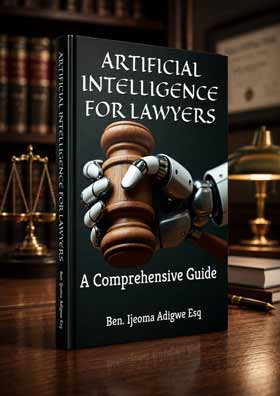 The book also examines Nigeria's legal ecosystem, focusing on the LPELR and NBA AI Guidelines. As a bonus, every purchase comes with a FREE eBook titled: How to Use the AI Features in LegalPedia and LawPavilion.
Ohio Books Ltd praises the publication, stating:
"....this is the only Nigerian book I know of on the topic."
How to Order:
📞 Call, Text, or WhatsApp: 08034917063 | 07055285878
📧 Email: benadigwe1@gmail.com
🌎 Website: www.benadigwe.com
Ebook Version: Access it directly online at https://selar.com/prv626
Authored by Ben Ijeoma Adigwe Esq., ACIarb (UK), LL.M, Dip. in Artificial Intelligence, Director at the Delta State Ministry of Justice, Asaba, Nigeria.
_______________________________________________________________________
The book also examines Nigeria's legal ecosystem, focusing on the LPELR and NBA AI Guidelines. As a bonus, every purchase comes with a FREE eBook titled: How to Use the AI Features in LegalPedia and LawPavilion.
Ohio Books Ltd praises the publication, stating:
"....this is the only Nigerian book I know of on the topic."
How to Order:
📞 Call, Text, or WhatsApp: 08034917063 | 07055285878
📧 Email: benadigwe1@gmail.com
🌎 Website: www.benadigwe.com
Ebook Version: Access it directly online at https://selar.com/prv626
Authored by Ben Ijeoma Adigwe Esq., ACIarb (UK), LL.M, Dip. in Artificial Intelligence, Director at the Delta State Ministry of Justice, Asaba, Nigeria.
_______________________________________________________________________