By Oliver Azi

It was St. Ambrose advice to St. Augustine in the 4th Century on applying the rules of fasting practices that one should follow the rules of where they are that metamorphosed into the notorious, “when in Rome, act as the Romans”. It has then transcended to be the popularly said “what happens in Rome should stay in Rome”. However, can what happen in 2025 remain in 2025? Maybe so, but not President Bola Ahmed Tinubu Tax Reform Act. The year 2025 will forever remain etched with the controversy and propositions of the Tax Reform Act.
As an introduction, on 26 June 2025, President Bola Ahmed Tinubu signed into law a historic package of tax reform legislation, marking the most comprehensive overhaul of Nigeria’s fiscal architecture in decades. The four Acts: The Nigeria Tax Act, Nigeria Revenue Service (Establishment) Act, Nigeria Tax Administration Act, and the Joint Revenue Board (Establishment) Act. These reforms aim to streamline revenue administration, improve compliance, strengthen intergovernmental coordination, and reposition the tax system as a catalyst for inclusive economic growth. By consolidating more than a dozen obsolete statutes and introducing modern frameworks for enforcement, digitalisation, and dispute resolution, the reforms are poised to significantly redefine Nigeria’s fiscal landscape.
So, first, this work does not intend to outline the key provisions of each law and examines their potential impact on economic growth in Nigeria. Instead, this work examines how this law affects business owners that registered as business names, small companies and individuals—especially, as it has become expedient to contribute.
INDIVIDUALS AND BUSINESS NAMES
Business Names are not companies. They do not possess separate legal personality. They exist not independent of the owners of the business. This means that where the owner errs, the business errs; where the business becomes indebted, the owner is indebted and where the business makes profit the owner makes profit. Both are twins, however this time, Siamese twins. None is separate from the other.
In contextualizing Business Names, the Court of Appeal in OLALEKAN v G.T.B PLC (2023) 16 NWLR (Pt. 1911) 441 stated that:
The legal implication of a registered business name, unlike a company, is that the registered business name and its proprietor are regarded as one and the same person. Hence the management of the business name can never be transferred to another person because the business name has no legal personality of its own independent of the proprietor.
It must be noted that not all business is “business names”. to be a business, ordinarily speaking, is to be “a commercial enterprise carried on for profit; a particular occupation or employment habitually engaged in for livelihood or gain. It also means practically anything which is an occupation as distinguished from pleasure” which is in alignment with the Supreme Court in UZOUKWU v IDIKA (2022) 3 NWLR (Pt. 1818) 403
INDIVIDUALS AND SMALL COMPANIES
Business is a commercial enterprise, what makes them stand out as companies, legally speaking, is their incorporation—which gives them a distinct legal personality from their owners unlike business name. Legally, incorporation of companies protects personal assets from business risks. As the Supreme Court held in ADEYEMI v LAN & BAKER (NIG.) LTD (2000) 7 NWLR (Pt 663) 33, a company is a distinct legal entity separate from its members. For entrepreneurs, this means one lawsuit or business debt will not swallow their personal savings or property — a risk that sole proprietors and business names face daily.
In summary to the explanation given above, business names do not possess independent legal personality from its owners. Companies possess distinct legal personality than its owners.
TAXATION OF BUSINESS NAMES AND INDIVIDUALS
The cardinal principle is this: the tax due to the proprietor or individual operating under a business name is directly linked to the business name. while for companies, generally, it is distinct from its proprietor or owner of the business. The key question here is: how then is the proprietor or individual taxed under the law?
By the provision of Section 58 of the Nigerian Tax Act 2025, individual earning below 800K cannot be taxed. That means, business names or individuals within that threshold cannot be taxed. To put it in Tax language under tax law, the individual and business name is to pay, “PERSONAL INCOME TAX” not “COMPANIES INCOME TAX” which is reserved for companies.
Secondly, anyone or business name earning above 800K is to be taxed on a 0-25% ratio. That means, those earning higher will pay higher depending on how 25% affects or applies to their income. The threshold is as follows: 0 – 800,000 No Tax; 800,000 – 3,000,000 is 15%; 3,000,000 – 12,000,000 is 18%; 12,000,000 – 25,000,000 is 21%; 25,000,000 to 50,000,000 is 23% and then 50,000,000 – above is 25%. Again, apply this to a Business Names which has no distinct legal personality to the proprietor or owner like companies.
The Act further allow for deductions of certain expenses incurred by the business name. Things like profits on loans, rents or premiums and so on, are to be deducted. That means, only REAL PROFITS are to be taxed by the provision of Section 20 of the Nigeria Tax Act 2025. There are also chargeable income deductions, by the provision of Section 30 of the Nigeria Tax Act 2025, to be made on the income before it can be taxed like NHF, Rent relief and so on.
TAXATION OF SMALL COMPANIES
Historically, sole proprietors and business name operators were assessed under the Personal Income Tax Act (PITA) and taxed on profits as personal income, while the Companies Income Tax Act (CITA) applied exclusively to incorporated entities, which are companies. This position began to evolve with the enactment of the Finance Acts of 2019 and 2021, which, alongside subsequent reforms, introduced clear distinctions between “small,” “medium,” and “large” companies under sections 23(1)(n) and 40 of Companies Income Tax Act, which has now become defunct.
The Nigeria Tax Act (NTA), 2025 defines a small company by the provision of Section 202 of the Nigerian Tax Administration Act 2025 as:
“A company that earns gross turnover of ₦50,000,000 or less per annum with total fixed assets not exceeding ₦250,000,000, provided that any business providing professional services shall not be classified as a small company.”
This definition emphasizes two key determinants, turnover and fixed asset value, while expressly excluding entities engaged in professional services such as legal, accounting, or medical practices, which are generally presumed to generate higher income relative to their scale. Whilst they are exempted from paying Companies Income Tax, under the provisions of Sections 46 and 47 of the NTA, gains from indirect transfers of shares or interests in companies/assets are now subject to Capital Gain Tax where the asset is located in Nigeria or ownership structure changes.
In simple terms, under the current framework, companies with an annual turnover of ₦50 million or less—classified as “small companies”. They are exempted from Companies Income Tax (CIT). Consequently, an incorporated small company may lawfully pay no company income tax, whereas an unincorporated company with comparable turnover may still be subject to tax, depending on the proprietor’s or owner aggregate personal income.
The challenge here is that: whereas small companies making a turnover of 50 million Naira are not to be taxed. The Business Names as soon as it exceeds the 800,000 threshold is to be taxed.
ASSESSMENT OF TAX
Taxation is done by assessment and by the authority of the Court of Appeal in 7UP BOTTLING CO. PLC v L.S.I.R.B (2000) 3 NWLR (Pt. 650) 565 it was stated that:
Assessment for tax of the taxable person is preceded by return of income made by him to the Tax Authority as prescribed by section 41 of the Personal Income Tax Decree No. 104 of 1993. In such return of income, the taxable person is obliged to calculate the amount of tax which is payable by him (in what amounts to self-assessment) (P. 603, paras. A-B).
All taxable persons in Nigeria are required to file a self-assessment tax return with the relevant tax authority, covering a reporting/accounting period, on or before the due date prescribed by law by the provision of Section 34 of the Nigerian Tax Administration Act 2025. Furthermore, in LANTO v WAWO (1999) 7 NWLR (Pt. 610) 227 it was held that where there is no assessment of tax payable to any tax payer whether a civil servant or not, no tax is due and payable.
For companies, they are under an obligation to file income tax returns with the Nigeria Revenue Service for a year of assessment. The company is obliged to file the tax return at least once in a year, with or without a notice to that effect from the Nigeria Revenue Service and whether or not a company is liable to pay tax under any law in the year of assessment by the provision of Section 11 of the Nigerian Tax Administration Act 2025. The obligation to file a tax return extends to a company that has been granted exemption from incorporation in Nigeria.
In retrospect, whilst the law is progressive and set to put Nigeria’s tax trajectory in better limelight, the disparity between tax expectations between Business Names and Small Companies should be looked at.
Oliver Azi is legal writer and researcher based in Abuja, Nigeria and can be reached at: oliverazi20@gmail.com or 07088859703

 ARTIFICIAL INTELLIGENCE FOR LAWYERS: A COMPREHENSIVE GUIDE
Reimagine your practice with the power of AI “...this is the only Nigerian book I know of on the topic.” — Ohio Books Ltd
Authored by Ben Ijeoma Adigwe, Esq., ACIArb (UK), LL.M, Dip. in Artificial Intelligence, Director, Delta State Ministry of Justice, Asaba, Nigeria.
Bonus:
Get a FREE eBook titled “How to Use the AI in Legalpedia and Law Pavilion” with every purchase.
ARTIFICIAL INTELLIGENCE FOR LAWYERS: A COMPREHENSIVE GUIDE
Reimagine your practice with the power of AI “...this is the only Nigerian book I know of on the topic.” — Ohio Books Ltd
Authored by Ben Ijeoma Adigwe, Esq., ACIArb (UK), LL.M, Dip. in Artificial Intelligence, Director, Delta State Ministry of Justice, Asaba, Nigeria.
Bonus:
Get a FREE eBook titled “How to Use the AI in Legalpedia and Law Pavilion” with every purchase.
How to Order: 📞 Call, Text, or WhatsApp: 08034917063 | 07055285878 📧 Email: benadigwe1@gmail.com 🌐 Website: www.benadigwe.com
Ebook Version: Access directly online at: https://selar.com/prv626
________________________________________________________________________ The Law And Practice Of Redundancy In Nigeria: A Practitioner’s Guide, Authored By A Labour & Employment Law Expert Bimbo Atilola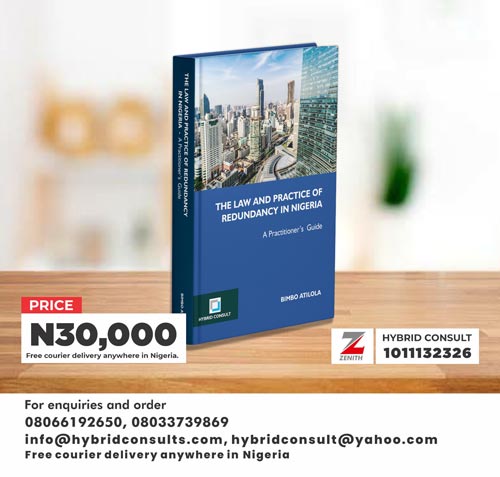 _______________________________________________________________________
"You Don't Need To Be Rich, You Just Need To Start" — Victoria Ezeigwe, Esq Launches Investment Handbook For Nigerians Starting With ₦5,000
_______________________________________________________________________
"You Don't Need To Be Rich, You Just Need To Start" — Victoria Ezeigwe, Esq Launches Investment Handbook For Nigerians Starting With ₦5,000

Get your copy today and take the first step toward financial growth:👉 https://selar.co/4f16676016
_______________________________________________________________________