By Romeo Ese Michael, Esq. (Insolvency Practitioner/Notary Public)

Introduction
As a Legal Practitioner who has witnessed firsthand the frustrations judgment creditors face when attempting to enforce judgments against government agencies, I received the Supreme Court’s decision in Central Bank of Nigeria v. Lidan Engineering Limited & 6 Ors. (SC/CV/82/2021) with considerable relief and satisfaction. This judgment, delivered on 16th of January 2026, represents more than just another appellate decision; it is a watershed moment in Nigerian commercial litigation and judgment enforcement jurisprudence.
In my practice at D.A. Awosika SAN & Partners LLP, I have encountered numerous instances where judgment debtors, particularly government agencies, employ every conceivable legal maneuver to frustrate the enforcement of legitimate judgments. The tactics displayed in this case spanning nearly fourteen years are unfortunately not isolated incidents but rather symptomatic of a broader challenge facing our justice system.
The Supreme Court’s emphatic pronouncement that the Central Bank of Nigeria does not qualify as a “public officer” when acting as banker to government agencies removes a significant obstacle that has long plagued garnishee proceedings. More importantly, the court’s robust condemnation of obstructionist litigation tactics should serve as a clarion call to the legal profession to re-examine our role in the administration of justice.
The Supreme Court of Nigeria, in its recent landmark judgment delivered on 16th of January 2026 in Central Bank of Nigeria v. Lidan Engineering Limited & 6 Ors. (SC/CV/82/2021), has authoritatively settled a lingering controversy regarding the status of the Central Bank of Nigeria (CBN) in garnishee proceedings. The apex court emphatically affirmed that the CBN, when acting in its capacity as a banker to government agencies, does not stand as a “public officer” within the contemplation of Section 84 of the Sheriffs and Civil Process Act, Cap. S6, Laws of the Federation of Nigeria, 2004 (SCPA). This decision has profound implications for judgment enforcement and the dynamics of garnishee proceedings involving federal government funds.
Factual Background
The genesis of this appeal traces back to 2004 when the first to fourth respondents imported six 40-feet containers into Nigeria from the United States of America. Three of these containers were allegedly wrongly auctioned by officials of the Nigerian Customs Service, prompting the respondents to seek redress in the Federal High Court.
In a judgment delivered on 24th of April 2012, the trial court awarded N320,000,000 as damages against the fifth to seventh respondents (representing the Nigerian Customs Service). Despite this judgment, the judgment debtors made no effort to satisfy the debt, instead engaging in a protracted series of applications aimed at frustrating enforcement.
After six years of unsuccessful attempts at direct enforcement, the judgment creditors commenced garnishee proceedings in June 2018 against the CBN, seeking to attach funds belonging to the Nigerian Customs Service held in the appellant’s custody under the Treasury Single Account (TSA) policy.
The Central Legal Issue
The crux of the appeal centered on whether the CBN, as custodian of federal government funds, qualified as a “public officer” under Section 84(1) and (3) of the SCPA, thereby requiring the prior consent of the Attorney-General of the Federation before garnishee proceedings could be instituted.
Section 84(1) of the SCPA provides:
“Where money liable to be attached by garnishee proceedings is in the custody or under the control of a public officer in his official capacity or in custodia legis, the order nisi shall not be made under the provisions of the last preceding section unless consent to such attachment is first obtained from the appropriate officer…”
The appellant contended that as a public officer, the mandatory consent requirement had not been fulfilled, rendering the garnishee proceedings incompetent.
The Supreme Court’s Definitive Pronouncement
In a unanimous decision delivered by Obande Festus Ogbuinya, JSC (with concurring judgments from Mohammed Lawal Garba, JSC; Tijjani Abubakar, JSC; Haruna Simon Tsammani, JSC; and Habeeb Adewale Olumuyiwa Abiru, JSC), the Supreme Court dismissed the appeal and firmly established the following principles:
- The CBN as Banker, Not Public Officer
The court held that when the CBN acts in its capacity as a banker to federal government agencies, the relationship is one of banker and customer. Relying heavily on its earlier decision in CBN v. Interstella Communications Ltd (2019) 7 NWLR (Pt. 1618) 294, the court emphasized that this banking relationship strips the CBN of the status of “public officer” for purposes of Section 84 SCPA.
Ogbuinya, JSC stated unequivocally:
“The appellant is not a public officer in the circumstances of the instant case as contemplated by the provision of section 84(1) of the SCPA… The settled posture of the law is that once a word or a phrase in an enactment has been judicially or statutorily defined, it bears that meaning assigned to it and sheds/drops its ordinary or technical meaning.”
- The Doctrine of Stare Decisis
The Supreme Court reinforced the binding nature of its previous pronouncements, holding that courts are bound to follow judicial definitions assigned to statutory terms by the apex court in subsequent proceedings. The court cited Dapianlong v. Dariye (2007) 8 NWLR (Pt. 1036) 332 and other authorities to emphasize this principle.
- Consent Not Required in Banker-Customer Relationships
Having established that the CBN was not a public officer in the circumstances, the court held that the requirement for prior consent from the Attorney-General of the Federation did not arise. The court noted that the respondents had, out of abundance of caution, sought the consent of the Attorney-General, which was ignored for an entire year, a fact that further supported their case.
- Enforcement Against Non-Parties to Original Proceedings
In addressing whether the Nigerian Customs Service (NCS) could be treated as the judgment debtor despite not being named as such in the original suit, the court relied on Order II Rule 16 of the Judgment (Enforcement) Rules, which provides:
“Where a person not being a party in a proceeding obtains an order or has an order made in his favour, he shall be entitled to enforce obedience to such order by the same process as if he were a party in the proceeding; and any person not being a party in a proceeding against whom obedience to any judgment may be enforced, shall be liable to the same process for enforcing obedience to such judgment as if he were a party to the proceeding.”
The court held that the NCS, as an agency of the federal government maintaining a TSA with the CBN, could properly be treated as the judgment debtor whose funds were liable to attachment, notwithstanding that it was not expressly named as a party in the original proceedings.
The Sui Generis Nature of Garnishee Proceedings
Throughout the judgment, the Supreme Court emphasized the unique character of garnishee proceedings. Ogbuinya, JSC described garnishee proceedings as sui generis, a procedure of enforcing monetary judgment where ordinary methods of execution are inapplicable.
The court explained:
“By dint of this process, the court has the power to order a third party to pay direct to the judgment creditor the debt due or accruing from him to the judgment debtor, or as much of it as may be sufficient to satisfy the judgment debt and the costs of the garnishee proceeding.”
This special nature explains why enforcement can proceed against parties and funds even where the ordinary rules of privity and party status might otherwise apply.
The Treasury Single Account Policy
A critical factor in the court’s reasoning was the operation of the TSA policy, which mandates that all Ministries, Departments and Agencies (MDAs) of the federal government maintain accounts with the CBN. The court noted that the NCS, as a Federal Government agency, fell squarely within this mandate.
The court held:
“In wearing the toga of that glorious status, it comes squarely within the firmament of Ministries, Departments and Agencies (MDAs) that are mandated to maintain accounts with the appellant under the canopy of Treasury Single Account (TSA) policy of the Federal Government of Nigeria.”
This finding established the necessary nexus between the judgment debtor (NCS) and the garnishee (CBN), satisfying the requirement that the garnishee must hold “debts due and accruing to the judgment debtor.”
A Judicial Rebuke of Obstructionist Tactics
Perhaps the most striking feature of this decision is the strong rebuke delivered by Habeeb Adewale Olumuyiwa Abiru, JSC in his concurring judgment. His Lordship condemned the tactics employed by the judgment debtors and their counsel to frustrate judgment enforcement for nearly fourteen years.
Abiru, JSC observed:
“This case is a perfect example of what happens when Counsel approach the resolution of a dispute between parties from a very myopic and self-serving perspective, and without regards to the truth and substantial justice of the matter… Unfortunately, they all got compliant lawyers to do their bidding and who used the administration of justice system to prevent the first to the fourth Respondents from getting the fruits of the judgment entered in their favour for about fourteen years. This is not right and it is unexplainable to the common man on the street.”
His Lordship reminded the legal profession of its duty to the justice system, quoting the American jurist J. Wesley McWilliams, who wrote that lawyers owe “a sense of gratitude and of obligation” to ensure “constructive work to increase the effectiveness of our judicial system and the welfare of the profession.”
This judicial admonition serves as a powerful reminder that legal practice must be conducted with integrity and respect for the administration of justice, not as a tool for frustrating legitimate claims.
Practical Implications of the Decision
This judgment has several significant implications for legal practice in Nigeria:
- Clarity in Garnishee Proceedings Against CBN
The decision provides definitive clarity that judgment creditors seeking to attach Federal Government funds held by the CBN need not obtain the prior consent of the Attorney-General of the Federation. This removes a potential obstacle to judgment enforcement and prevents the CBN from hiding behind Section 84 SCPA to frustrate legitimate garnishee proceedings.
- Enforcement of Judgments Against Government Agencies
The decision confirms that funds belonging to Federal Government agencies maintained under the TSA can be attached through garnishee proceedings, regardless of technical changes in nomenclature or agency designation. This is particularly important given the frequent restructuring of government agencies.
- The Binding Nature of Stare Decisis
The judgment reinforces that once the Supreme Court has judicially defined a term in a statute, lower courts and parties must accord that term its judicially assigned meaning in subsequent proceedings. This promotes certainty and predictability in the law.
- Professional Responsibility of Lawyers
The strong rebuke from Abiru, JSC should serve as a wake-up call to the legal profession. Lawyers must balance zealous advocacy for their clients with their duties as officers of the court and servants of justice. Using procedural technicalities to frustrate judgment enforcement for over a decade, as occurred in this case, brings the administration of justice into disrepute.
Protection of Judgment Creditors’ Rights
The decision affirms that the law will not permit the pathway to judgment enforcement to be littered with “insurmountable thorns and twists.” As Ogbuinya, JSC observed, such obstacles would “equip a successful party with a barren victory” and “demystify the majesty and sanctity of the temple of justice.”
Having handled several garnishee proceedings in Federal and State High Courts, I can attest that the issues raised in this appeal are far from academic. The question of whether the CBN qualifies as a “public officer” requiring the Attorney-General’s consent has been a recurring obstacle in judgment enforcement.
I recall a particular case where our firm successfully obtained judgment against a federal government agency, only to spend an additional two years navigating garnishee proceedings. The CBN raised the same preliminary objection regarding Section 84 of the SCPA, despite the fact that the Attorney-General was listed as a party to the original suit. The frustration experienced by our client—a small business owner who had been deprived of his legitimate dues—was palpable.
This experience, multiplied across countless similar cases nationwide, underscores why this Supreme Court decision is so critical. It is not merely about legal technicalities; it is about whether our justice system can deliver meaningful remedies to those who seek its intervention.
Conclusion: A Call for Professional Introspection
The Supreme Court’s decision in CBN v. Lidan Engineering Limited represents a significant milestone in Nigerian jurisprudence on garnishee proceedings and judgment enforcement. By definitively holding that the CBN does not qualify as a “public officer” when acting as banker to government agencies, the court has removed a major impediment to the enforcement of judgments against federal government entities.
This decision is more than a legal precedent, it is a mirror held up to the Nigerian legal profession. When I read Justice Abiru’s scathing rebuke of the obstructionist tactics employed in this case, I could not help but reflect on my own practice and the practices I observe daily in our courts.
How often have we, as lawyers, prioritized technical victories over substantive justice? How often have we used our knowledge of procedure to delay the inevitable rather than to expedite resolution? How often have we allowed our duty to our clients to overshadow our duty to the court and to the administration of justice?
This case should prompt each of us to examine these questions honestly. The first to fourth respondents waited fourteen years to enforce a judgment they obtained in 2012. Fourteen years! During this period, they likely incurred substantial legal costs, experienced financial hardship, and questioned whether approaching the courts had been the right decision. This is not the kind of experience that builds public confidence in our justice system.
As I conclude this article, I am reminded of why many of us chose to study law in the first place, not merely to win cases, but to serve justice. The Supreme Court has done its part by delivering this clear and principled judgment. Now it is our turn, as members of the legal profession, to ensure that we do not become obstacles to the very justice we are sworn to uphold.
To my colleagues who represent government agencies, zealous advocacy does not require frustrating legitimate claims indefinitely. Sometimes, the best service we can provide our clients is honest advice that they should satisfy valid judgments rather than engage in futile appeals and objections.
To my colleagues who represent judgment creditors, this decision is a powerful tool, but let us use it wisely and ethically. Let us not adopt the same obstructionist tactics we rightly condemn when employed by others.
To all of us, let us remember that behind every case citation, every legal principle, and every procedural rule, there are real people seeking real justice. The measure of our success as lawyers should not be how many cases we can delay, but how much justice we can facilitate.
This judgment offers hope that our courts are willing to confront the challenges plaguing judgment enforcement in Nigeria. Let us, as Legal Practitioners, rise to meet this moment and ensure that this hope is not misplaced.
Romeo Ese Michael, Esq. (Insolvency Practitioner/Notary Public) is a Partner/Head of Chambers at D.A. Awosika SAN & Partners LLP, Lagos, where he handles complex commercial litigation, banking disputes, environmental cases, and Copyrights.

Get your copy today and take the first step toward financial growth:👉 https://selar.co/4f16676016
_______________________________________________________________________ The Law And Practice Of Redundancy In Nigeria: A Practitioner’s Guide, Authored By A Labour & Employment Law Expert Bimbo Atilola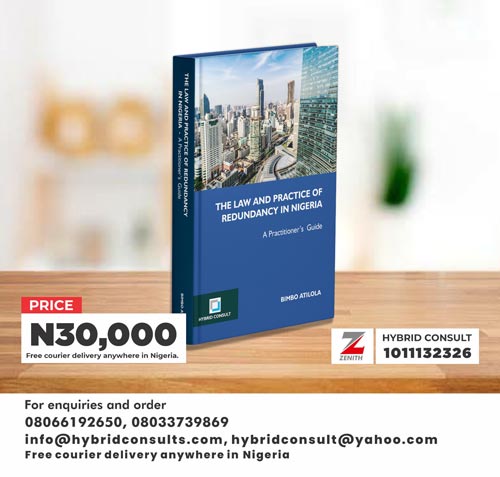 _______________________________________________________________________
[A MUST HAVE] Evidence Act Demystified With Recent And Contemporary Cases And Materials

Available now for NGN 40,000 at ASC Publications, 10, Boyle Street, Onikan, Lagos. Beside High Court, TBS. Email publications@ayindesanni.com or WhatsApp +2347056667384. Purchase Link: https://paystack.com/buy/evidence-act-complete-annotation
______________________________________________________________________ ARTIFICIAL INTELLIGENCE FOR LAWYERS: A COMPREHENSIVE GUIDE
Reimagine your practice with the power of AI “...this is the only Nigerian book I know of on the topic.” — Ohio Books Ltd
Authored by Ben Ijeoma Adigwe, Esq., ACIArb (UK), LL.M, Dip. in Artificial Intelligence, Director, Delta State Ministry of Justice, Asaba, Nigeria.
Bonus:
Get a FREE eBook titled “How to Use the AI in Legalpedia and Law Pavilion” with every purchase.
ARTIFICIAL INTELLIGENCE FOR LAWYERS: A COMPREHENSIVE GUIDE
Reimagine your practice with the power of AI “...this is the only Nigerian book I know of on the topic.” — Ohio Books Ltd
Authored by Ben Ijeoma Adigwe, Esq., ACIArb (UK), LL.M, Dip. in Artificial Intelligence, Director, Delta State Ministry of Justice, Asaba, Nigeria.
Bonus:
Get a FREE eBook titled “How to Use the AI in Legalpedia and Law Pavilion” with every purchase.
How to Order: 📞 Call, Text, or WhatsApp: 08034917063 | 07055285878 📧 Email: benadigwe1@gmail.com 🌐 Website: www.benadigwe.com
Ebook Version: Access directly online at: https://selar.com/prv626