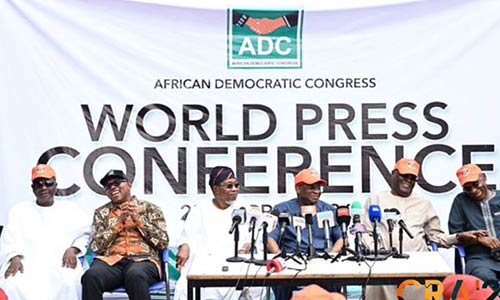
In a revealing interview, INEC Chairman Professor Joash Amupitan admitted he first heard about the Court of Appeal judgment on social media, after which mysterious “people” began calling him demanding that David Mark’s group be removed. But who were these callers? Meanwhile, former Senator Ishaku Abbo has named a serving governor and a former minister as the sponsors of the legal actions tearing the ADC apart. And as the party heads back to court on April 7 armed with the Electoral Act’s “jurisdiction killer,” top opposition leaders including Atiku Abubakar, Peter Obi, and Rabiu Kwankwaso are already considering abandoning the ADC for alternative platforms.

In an interview that has raised more questions than it answered, INEC Chairman Professor Joash Amupitan made a startling admission about how he first learned of the Court of Appeal judgment that triggered the ADC crisis — and what happened immediately after.
“Now when I first heard of it, because it was delivered or deferred, I heard of it on the news, social media, and before I knew it people were calling me that INEC has — David Mark’s group has been ordered to be removed.”
Who were these “people” calling the INEC Chairman? Who had access to his phone number and the audacity to call the chairman of Nigeria’s electoral commission immediately after a court ruling, demanding the removal of a faction’s leadership? And why were they framing the Court of Appeal’s order — which was to “maintain status quo ante bellum” — as a directive to remove David Mark?
Amupitan said he refused to act on social media information and insisted on reviewing the actual judgment before making any decisions.
“I said I cannot act on social media news information. I read it on the social media, then I look at it. It was an interlocutory appeal that has been dismissed. Ordinarily, we should be talking of going for the substantive trial.”
But despite this stated position of caution, INEC did eventually act — issuing a press statement on April 1 that withdrew recognition from both factions, effectively paralysing the ADC. The question that remains unanswered is: what happened between the INEC Chairman’s stated refusal to act on social media and the commission’s eventual action? Who applied the pressure? And who were the callers?
Amupitan disclosed that after the social media reports and phone calls, on March 16, 2026, he received two conflicting letters from solicitors representing both the David Mark faction and the Nafiu Bala Gombe faction. Each letter made opposing demands.
The Mark faction’s lawyers demanded that INEC continue to recognise the leadership inaugurated on July 29, 2025, arguing that this was the status quo ante bellum. The Bala faction’s lawyers demanded that INEC de-recognise Mark and Aregbesola and recognise Bala as the legitimate chairman.
Faced with conflicting demands, INEC chose neither — and instead withdrew recognition from both, a decision that Senator David Mark has described as “inventing a status quo that never existed” and acting in contempt of the Court of Appeal.
INEC received conflicting letters. But before the letters arrived, “people” were already calling the Chairman. Were the callers connected to the letter-writers? Were they connected to the ruling party? Were they the same “unnamed political actors” that former Senator Abbo would later identify?
Former Senator Ishaku Abbo, who represented Adamawa North, provided the most explosive insight into who is behind the ADC crisis. Speaking via his verified Facebook page, Abbo linked the crisis to betrayal, internal disagreements, and crucially, external interference.
Abbo alleged that unnamed political actors, including a serving governor and a former minister, sponsored the legal actions against the party. While he did not name them directly, his allegation is the clearest indication yet that the ADC’s legal troubles are not purely internal but are being externally fuelled by political figures with an interest in destroying the opposition.
Abbo gave a detailed account of how the crisis unfolded. He said Nafiu Bala was present at the Yar’Adua Centre, clapping and cheering as David Mark and Rauf Aregbesola took over as national chairman and secretary respectively. An agreement had been reached to cede certain positions to members of the legacy structure from each geopolitical zone.
“If you check the picture, the man sitting before me is Nafiu Bala. He was at the Yar’Adua Centre clapping and cheering as David Mark and Rauf Aregbesola took over as national chairman and secretary respectively.”
According to Abbo, Bala was supposed to be appointed national vice-chairman for the north-east under the agreement. But the Mark-led leadership reneged on this agreement and instead installed Babachir David Lawal in the position. Bala rejected an alternative offer of zonal financial secretary.
“During the formation of the David Mark-led NWC, the new leadership reneged on the earlier agreement to make Bala national vice-chairman northeast and instead installed Babachir David Lawal in the position. At this point, he started plotting how to bring the whole roof down.”
Abbo urged Bala to withdraw the court case and work towards unity, and called on INEC to reverse its decision, warning of consequences if the situation persists.
Adding another explosive layer to the crisis is the emergence of a certified resignation document that confirms Nafiu Bala resigned from the ADC leadership on May 17, 2025 — two full months before the July 29 NEC meeting that installed David Mark, and four months before he approached the courts on September 2, 2025 seeking to be recognised as chairman.
The letter, signed by then-ADC National Chairman Ralph Okey Nwosu and National Secretary Alhaji Said Baba Abdullahi, formally notified INEC of Bala’s resignation. It bears the official stamp of INEC headquarters in Abuja, marked “Certified True Copy” and signed by an Assistant Chief Legal Officer. Handwritten notes indicate receipt of the document on August 13, 2025.
The document is explosive because it means INEC knew Bala had resigned before the July 29 meeting, before the September 9 upload of the new NWC names, and before Bala went to court. Yet INEC’s April 1 statement treated Bala’s claim as though it had equal standing with Mark’s leadership — creating what David Mark called “a false equivalence.”
If INEC had Bala’s resignation letter in its possession — certified and stamped — why did it treat him as a legitimate factional leader? Why did it create a “false equivalence” between a man who had resigned and a leadership that was inaugurated in an INEC-monitored meeting? And does this not confirm that INEC was acting under external pressure rather than on the basis of its own records?
The crisis took yet another dramatic turn when reports emerged, published by 247ureports, alleging that Nafiu Bala Gombe received ₦2 billion from senior officials within the Tinubu administration to destabilise the ADC ahead of the 2027 elections. Following these reports, Bala has allegedly gone into hiding.
While these bribery claims remain unverified by independent forensic agencies, they have intensified what observers are calling a “credibility crisis” surrounding Bala, especially after his claims regarding his own resignation letter were met with widespread scepticism.
If Bala truly received ₦2 billion to destabilise the ADC, who authorised the payment? From which account did it come? And if the allegation is false, why has Bala allegedly gone into hiding instead of publicly denying it and producing evidence to the contrary?
The ADC will officially return to the Federal High Court, Abuja, before Justice Emeka Nwite on Tuesday, April 7, 2026, immediately following the Easter holidays. The party’s legal team, reportedly supported by prominent legal minds including Inibehe Effiong and Abdul Mahmud, is expected to file a motion for the summary dismissal of the suit brought by Nafiu Bala (Suit No. FHC/ABJ/CS/1819/2025).
The ADC’s core argument centres on what lawyers are calling the “jurisdiction killer” — Section 83(5) of the newly promulgated Electoral Act 2026, which explicitly states:
“No Court in Nigeria shall entertain jurisdiction over any suit or matter pertaining to the internal affairs of a political party.”
— Section 83(5), Electoral Act 2026
By citing this provision, the ADC aims to render Bala’s challenge legally void. Legal experts argue that this section was specifically designed to prevent frivolous litigation from being weaponised by external interests to disrupt opposition platforms. The Act also introduces severe consequences: mandatory costs of at least ₦10 million against both the plaintiff and their legal counsel if the matter is deemed an unauthorised intrusion into party affairs.
The spotlight will be on Justice Nwite to determine whether he upholds the jurisdictional shield of the Electoral Act 2026 or allows the substantive suit to proceed — a decision that could decide the ADC’s survival as a viable opposition force for 2027.
As the legal battles rage, the ADC’s most high-profile members are not waiting to see how the crisis resolves. According to political insiders, top opposition figures including former Vice President Atiku Abubakar, former Labour Party presidential candidate Peter Obi, and former Kano Governor and NNPP leader Rabiu Kwankwaso are already involved in high-level consultations about abandoning the ADC for alternative platforms.
Sources close to the developments warned that the legal battles surrounding the ADC may extend beyond the party’s primaries and the submission deadline for party registers, effectively placing any ADC candidate at a significant disadvantage.
“If this crisis continues and members contest under the ADC, and the party eventually loses recognition, they cannot simply defect to another party afterward.”
Emergency consultations among opposition leaders are expected to take place in Abuja shortly after the Easter period, where stakeholders will deliberate on a viable political strategy for 2027.
As a fallback, opposition leaders are reportedly evaluating two relatively stable political platforms:
The APP is considered structurally stable since its formation. The party currently holds limited representation in the National Assembly, including seats occupied by Hon. Ikenga Ugochinyere and Hon. Matthew Nwaogu. Its relative stability and existing parliamentary presence make it an attractive option for opposition leaders seeking a platform free of the factional chaos that has plagued other parties.
The NDC is a relatively new party promoted by former Bayelsa State Governor Seriake Dickson. Though it has minimal parliamentary presence, it is free of internal leadership disputes — a critical advantage given the experience of LP, PDP, NNPP, and ADC, all of which have been consumed by factional warfare.
Sources indicate that opposition leaders are approaching the situation with extreme caution. Any decision on adopting a new party platform is expected to be kept confidential until the most strategic moment, to avoid alerting the ruling APC and giving it time to deploy the same destabilisation tactics that have been used against other opposition parties.
Constitutional lawyer Ekemini Udim has suggested an internal solution that, if adopted, could resolve the crisis without the need for opposition leaders to abandon the ADC entirely.
“If they still had time before the congress, my suggestion would have been for David Mark to step aside and allow Ralph Nwosu to return to his position as National Chairman, conduct the Congress, and at the Congress, the exco will be dissolved thus paving way for David Mark and co to emerge afresh.”
The suggestion has merit in legal terms: it would effectively reset the party’s leadership to the pre-dispute status, conduct a fresh congress under the legacy leadership, and then allow the Mark-led team to emerge through a clean, uncontested process. However, whether the current political dynamics — including the ego, distrust, and external interference that have fuelled the crisis — would allow such a pragmatic solution remains highly doubtful.
The ADC crisis does not exist in isolation. It is the latest in a pattern that has systematically destroyed every major opposition party in Nigeria:
- Labour Party (LP): Consumed by the Lamidi Apapa vs. Julius Abure factional war, rendered non-functional through competing court orders.
- PDP: Weakened from within by Nyesom Wike’s cross-party alliance with the ruling APC, with key members defecting and the party’s cohesion shattered.
- NNPP: Paralysed by internal litigation and factional disputes, eventually losing its biggest asset — Kwankwaso — to the ADC.
- ADC: Now being torn apart by the Nafiu Bala court case, INEC’s withdrawal of recognition, and allegations of external sponsorship from the ruling party.
In every case, the pattern is the same: internal dispute, court orders, INEC confusion, party paralysis, and the ruling APC as the sole beneficiary. The destruction of the ADC would complete the cycle, leaving Nigeria with no viable opposition platform ahead of 2027.
With LP destroyed, PDP weakened, NNPP emptied, and ADC under siege — and with a serving governor and a former minister allegedly sponsoring the legal actions, mysterious callers pressuring the INEC Chairman, and ₦2 billion allegedly paid to destabilise the party — is anyone still in doubt that this is a coordinated campaign to impose a one-party state on Nigeria?
- April 7, 2026: ADC returns to Federal High Court before Justice Emeka Nwite. Motion for summary dismissal of Bala’s suit based on Section 83(5) of the Electoral Act 2026.
- Post-Easter Consultations: Atiku, Obi, and Kwankwaso expected to meet in Abuja to decide whether to stay in ADC or move to APP or NDC.
- Party Register Deadline: The submission deadline for party registers is approaching and may be used as a tactical pressure point.
- INEC’s Next Move: Will the commission reverse its April 1 decision, or continue to refuse recognition of any ADC faction?
- Nafiu Bala: Will he emerge from alleged hiding? Will the ₦2 billion bribery allegation be investigated? Will he withdraw the court case as Abbo has urged?
- The Unnamed Governor and Minister: Will their identities be revealed? And are they the same “people” who were calling the INEC Chairman?
 Interested buyers are encouraged to place their orders and enquiries via:
0704 444 4777, 0704 444 4999, 0818 199 9888
Website: www.alexandernigeria.com
Interested buyers are encouraged to place their orders and enquiries via:
0704 444 4777, 0704 444 4999, 0818 199 9888
Website: www.alexandernigeria.com
 Reimagine your practice with the power of AI “...this is the only Nigerian book I know of on the topic.” — Ohio Books Ltd
Authored by Ben Ijeoma Adigwe, Esq., ACIArb (UK), LL.M, Dip. in Artificial Intelligence, Director, Delta State Ministry of Justice, Asaba, Nigeria.
Bonus:
Get a FREE eBook titled “How to Use the AI in Legalpedia and Law Pavilion” with every purchase.
Reimagine your practice with the power of AI “...this is the only Nigerian book I know of on the topic.” — Ohio Books Ltd
Authored by Ben Ijeoma Adigwe, Esq., ACIArb (UK), LL.M, Dip. in Artificial Intelligence, Director, Delta State Ministry of Justice, Asaba, Nigeria.
Bonus:
Get a FREE eBook titled “How to Use the AI in Legalpedia and Law Pavilion” with every purchase.
How to Order: 📞 Call, Text, or WhatsApp: 08034917063 | 07055285878 📧 Email: benadigwe1@gmail.com 🌐 Website: www.benadigwe.com
Ebook Version: Access directly online at: https://selar.com/prv626
_______________________________________________________________________ [A MUST HAVE] Evidence Act Demystified With Recent And Contemporary Cases And Materials
 ______________________________________________________________________
“Bridging Theory And Courtroom Practice” — Hagler Sunny Okorie, Nathaniel Ngozi Ikeocha Unveil ‘Functional’ Tort Law Book For Nigerian Legal System
______________________________________________________________________
“Bridging Theory And Courtroom Practice” — Hagler Sunny Okorie, Nathaniel Ngozi Ikeocha Unveil ‘Functional’ Tort Law Book For Nigerian Legal System
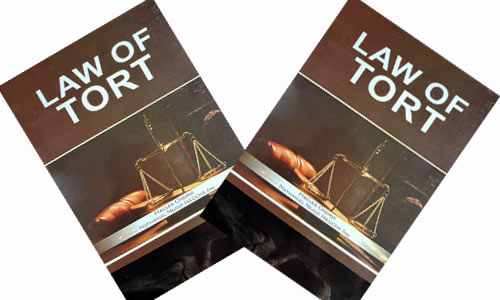 The book, titled The Law of Torts in Nigeria: A Functional Approach, authored by Professor Hagler Sunny Okorie Ph.D and Ikeocha, Nathaniel Ngozi Esq, offers law students, practitioners, and academics a comprehensive guide to understanding and applying tort law in Nigerian courts. Interested buyers can place orders via the following contact numbers: 08028636615, 08037667945, 08032253813, or +234 902 196 2209.