By Samuel A. Oguntuyi, Esq.

At 4:30am, the alarm disrupted the quietness of a cramped Kubwa apartment. A young advocate freshly robed in a starched shirt, with his wig and gown encased in a worn leather box, braved hours of slow, agonizing crawl through the Kubwa Expressway’s congested lanes to reach the High Court Complex in Maitama. Maintaining a discreet presence in the courtroom was an elderly client of his who had travelled overnight from Rivers State, seeking to enforce a land judgment first litigated when his now-grown children were still in primary school. Decked in the typical South-South attire and armed with the optimism of a man who had waited long enough, the elderly client seemed to have arrived the courtroom at no less an hour than 8:00a.m., his heart buoyed by eager anticipation and the enduring hope that, at long last, his matter would inch a little closer to the justice he had long awaited.
By 9:00a.m., his Counsel had joined him to sit in a sweltering, off-grid courtroom, alongside legions of counsel, sweating through their wool gowns in a very warm and humid atmosphere; with the air in the room thick with anxiety and stale heat. Finally, at about 11:15a.m., the Court’s registrar emerged from behind the heavy wooden door of the judge’s chambers. With a practiced, emotionless cadence that shattered months of preparation, she delivered the words that freeze the blood of every litigator in Nigeria:
“I am sorry to announce that the court will not sit today.”
No prior notification. No explanation, and no apology. Only a casual wave of the hand to dismiss months of strategy, thousands of Naira in transit costs, and the desperate hopes of litigants seeking justice. The phrase “The Court will not sit” is deceptively simple. In Nigerian legal practice, it can conceal an extraordinary variety of institutional failures expressed in the following ways: the court did not sit; the court did not take the matter; the court’s ruling is not ready; the court’s judgment is not ready; my Lord is still proof-reading the records; the court did not have the file; the court did not see the process, or sometimes, the court has not communicated the adjourned date. And when the Court does not, somebody pays. Usually, it is the litigant who bears the painful repercussion of this administrative lapse. In the same vein, his solicitor also bears the brunt of professional setback.
An empirical look at judicial delay, case disposition and the credibility of the justice system.
As the familiar saying goes: Justice delayed is justice denied. The expression has become so familiar in legal discourse that its real significance is sometimes lost. Yet, behind every adjournment, every unresolved motion and every case that remains on the cause list for years is a litigant waiting for justice; a business suffering uncertainty; a victim seeking redress or an accused person whose liberty is at stake. A judicial system that is persistently bogged down by delay and inefficiency risks losing public confidence, and as confidence declines, litigants may become reluctant to seek judicial intervention, disputes may be resolved through self-help, and the legal profession itself may suffer reputational damage. The question, therefore, is not merely whether cases are eventually decided, but how long litigants must wait for that decision.
Notwithstanding its socio-economic and legal and political challenges, it bears asking how Nigeria compare with other jurisdictions. What does the available statistics tell us about the duration of civil and criminal proceedings in Nigeria, the United States of America, the United Kingdom and South Africa?
Measuring the pace of justice
For a meaningful comparison, the duration of a case should ordinarily be measured from its commencement to its final disposition at first instance. Such disposition may occur through a default judgment, dismissal, settlement, guilty plea, conviction, acquittal or a contested judicial decision, as applicable. Three distinct measures must, however, be kept apart. The first is the time from filing to disposition. The second is the time from filing to trial. The third is the actual time spent conducting the trial. A case may require relatively few hours of courtroom proceedings but remain pending for years because of adjournments, congested dockets, delayed service, unavailable witnesses or the postponement of judgment.
Whilst there appears to be no sufficient and publicly available national data that establishes a current, directly comparable average duration for all civil and criminal proceedings from commencement to final disposition in Nigeria, available empirical research, using the Federal High Court of Nigeria and the High Court of the FCT, Abuja as a case study, provide a useful starting point.
Starting with the Federal High Court, the Chief Judge of the Federal High Court of Nigeria, Justice John Terhemba Tsoho, at the opening of the 2025/2026 Special Legal Year court session of the Federal High Court announced that judges of the Court disposed of 16,019 cases out of 181,924 pending matters during the 2024/2025 legal year. The disposed matters comprised 3,113 civil cases, 5,818 criminal cases, 3,724 motions, and 3,364 fundamental human rights cases The Chief Judge further disclosed that 165,905 cases (comprising of 44,650 civil cases, 44,078 criminal cases, 46,228 motions, and 30,949 fundamental rights enforcement applications) were pending across the court’s divisions nationwide. The development represents an update on the 161,999 cases that were carried over into the 2024/2025 legal year of the court.[1] See https://nairametrics.com/2025/12/15/federal-high-court-disposes-of-16019-cases-in-one-year-cj/?utm_ accessed on 29th October, 2026.
In the same vein, the Annual Report on the Return of Cases & Archive Department of the High Court of the FCT, Abuja, for the second quarter of 2026 (April-June, 2026) obtained on 4th November, 2026 during the celebration of the 2026/2027 Legal Year Ceremony, raises some important questions about the performance of the Court, particularly concerning case disposal, backlog management and the efficiency of the administration of justice. Indeed, the figures reveal a significant backlog problem and growing caseload. For instance, the report indicator shows that out of the 16,849 cases (consisting of 14,588 civil cases; 2,261 criminal cases) brought forward from the preceding 1st quarter (January-March), only a total of 1,716 were disposed of. This occurred despite the Court receiving 1,998 new filings, resulting in a total of 17,101 pending cases carried over into the next quarter.[2]
These figures are significant. They suggest that, in the cases examined, litigants could wait several years for a first-instance decision. For a claimant seeking recovery of money, enforcement of contractual rights or protection of a proprietary interest, four years is not a trivial inconvenience; it may mean prolonged financial uncertainty, mounting legal expenses and the erosion of the practical value of the remedy eventually obtained. Similarly, a criminal case that remains unresolved for more than three years can impose considerable hardship on victims, witnesses, defendants and the wider community. The figures must nevertheless be interpreted carefully. They are historical findings from a sampled study, not verified national averages for 2026. Nor should they automatically be taken to represent every case disposed of through default judgment, settlement, withdrawal or other non-trial procedures.
A 2026 Nigerian litigation practice guide also describes civil proceedings as typically lasting approximately two to three years, with commercial non-commercial suits sometimes taking up to five years from filing to judgment.[3]
Furthermore, a publication titled, “The report Measuring the Pace of Justice Through Data: A Ranking of State High Courts of Nigeria” by the civil rights organization- Citizens’ Gavel, (supported by the Open Society Initiative for West Africa (OSIWA)), examined 1,388 cases across 33 states. It assessed case timelines, including the period between commencement and judgment. The findings for the High Court of the Federal Capital Territory are particularly instructive. The study reported an average duration of 1,477 days for civil cases, equivalent to approximately four years and one month. For criminal cases, it reported 1,188 days, or approximately three (3) years and three (3) months.[4]
More recent criminal justice assessments also demonstrate substantial variation among states and court levels. The Centre for Socio-Legal Studies’ 2025 assessment of implementation of the Administration of Criminal Justice Laws reported state-level estimates ranging from a few months to several years, depending on the jurisdiction and court. For example, reported estimates for criminal proceedings in the High Courts ranged from six to twelve (12) months in Plateau State to approximately four years in Ebonyi State.[5]
These estimates should not be mistaken for a statistically calculated national average. Their real significance lies in the variation they reveal and the need for more consistent judicial data. Nigeria’s problem, therefore, is not simply that some cases take too long. It is also that the absence of comprehensive, standardised public data that makes it difficult to measure the problem precisely, identify its principal causes and evaluate whether reforms are producing measurable improvements. For example, a comprehensive judicial performance report should include: the case clearance rate, the average case disposition time, statistics on adjournments, age of pending cases (e.g. 1-2 years; 3-5 years, 5-10 years, 10 years and above, et al), etc.
It is also important to distinguish the overall caseload from cases that proceed to trial. From an international perspective, the United States, for instance, offers a useful example of the importance of making this distinction. Statistics published by the United States federal judiciary for fiscal year 2024 recorded a median of approximately 13.7 months from filing to disposition for civil cases in the federal district courts.[6] However, cases that proceeded through trial took considerably longer. The average filing-to-disposition period for civil cases that went through trial was approximately 31.6 months, or two years and eight (8) months. Statistics for criminal cases shows a similar pattern. In fiscal year 2024, the average time to disposition for federal criminal defendants whose cases were resolved by guilty plea was approximately nine (9) months. For defendants whose cases proceeded to jury trial, the average time was approximately 24.4 months.[7]
These figures demonstrate that the overall duration of a court’s caseload can be substantially shorter than the duration of its fully contested cases. It is important to note that the foregoing statistics concern the federal district courts; not every state and federal court in the United States. State courts handle a substantial proportion of the country’s ordinary civil disputes and criminal prosecutions.
England and Wales provide another useful comparison. Official Ministry of Justice statistics distinguish civil claims by procedural track and criminal proceedings by court level. For civil claims, the figures for the fourth quarter of 2025 reported median times from claim issue to trial of approximately 36.1 weeks for small claims and 57.4 weeks for fast, intermediate and multi-track claims. These figures translate to approximately eight and thirteen(13) months respectively. Criminal cases that proceeded to a Crown Court jury trial following a not-guilty plea took considerably longer. The median charge-to-completion period for that category was approximately 445 days, or fourteen to fifteen (15) months. It is instructive to state that these figures illustrate the value of differentiating between cases resolved without a contested trial and those requiring the full machinery of criminal adjudication.[8]
Back here in motherland Africa, South Africa presents a different evidential challenge. The South African Judiciary’s 2024/2025 annual reporting, for example, recorded finalisation rates of approximately 56 per cent for civil applications and 60 per cent for civil trials in the Regional Courts. It also reported that no reserved judgments in those courts exceeded three (3) months from the date of the last hearing during the review period.[9] For criminal matters, paragraph 5 of the South African Department of Justice Customer Service Charter for Court Users states that a criminal matter brought before a court should ordinarily be finalized within six (6) months, with twelve (12) months allowed for murder and other serious or complex offences.[10]
These are useful indicators of court performance, but they are by no means measures of average case duration. However, the proper lesson from these comparative statistics, is not that one country has solved judicial delay while another has failed; it is that effective judicial administration requires clear targets, reliable data, transparent reporting and a sustained commitment by the court to reducing unnecessary delay. The age of cases at disposition and the number of old cases remaining unresolved are equally important. Nigerian judiciary needs a more comprehensive and transparent system of judicial performance measurement. Without consistent data on filing dates, disposition dates, adjournments, case types and methods of resolution, it is difficult to establish a reliable national baseline or determine whether interventions are reducing delay.
Conclusion and Way Forward
The legitimacy of a judicial system depends not only on the correctness of its decisions but also on its ability to deliver those decisions within a reasonable time. Where the resolution of a dispute becomes a protracted contest of endurance, the cost of litigation rises, the value of remedies diminishes, and public confidence is placed at risk. Justice must not only be done; it must be done within a reasonable time. A system that cannot measure its delays accurately will struggle to eliminate them. Nigeria must therefore move beyond general complaints about congestion and make timely disposition a measurable, transparent and enforceable objective of judicial administration.
Nigeria’s response should begin with a national judicial performance database capable of measuring the full life cycle of a case. Every case should have a recorded commencement date and a final disposition date. Likewise, the database should distinguish civil from criminal proceedings, trial from non-trial dispositions, and first-instance decisions from the conclusion of appellate proceedings.
The judiciary should publish annual statistics showing the median and mean duration of cases, the proportion disposed of within six (6), twelve (12), twenty-four (24) and thirty-six (36) months, the number of cases pending beyond prescribed thresholds, and the average number of adjournments attributable to each relevant cause. With respect to clearing swelling backlogs of cases, the model operated by the Lagos State Judiciary called the “Backlog Elimination Programme (BEP)”[11] which was designed to decongest the courts by re-evaluating old cases and finding ways of resolving them through Alternative Dispute Resolution (ADR) or accelerated hearing, is most humbly recommended.
Additionally, court-specific reporting would also make it possible to distinguish systemic problems from the performance of individual courts. Where delays arise from inadequate judicial staffing, poor court infrastructure, insufficient courtroom space or defective case-listing systems, the appropriate response may require institutional investment. Where they arise from repeated adjournments, failure to comply with procedural directions or dilatory litigation tactics, firmer case management and the consistent application of procedural rules may be required.
The infrastructural deficit and delays in the dispensation of justice in our courts are complex, systemic, and deeply ingrained in administrative culture: for instance, most Courts operate without centralized electronic registries or real-time digital cause lists. Similarly, power grid collapse or generator failure routinely stalls proceedings. Judges, stripped of basic air conditioning and lighting in windowless chambers, are forced to choose between heatwaves and abandoning their dockets. In the same vein, abrupt administrative decisions warranting Judges to be frequently summoned on short notice to emergency workshops, ceremonial functions, or election petition tribunals, and most times without public notification, occasion these delays.
It is however significant to point out that Judicial delay is not always the product of an inadequate number of judges, delay tactics by disreputable lawyers, insufficient funding or an overwhelming caseload; oftentimes, it is a consequence of how individual judges manage (or fail to manage) their courtrooms. Some of these inadequacies include repeated adjournments; late commencement of court sittings; failure to sit on scheduled dates; excessive time in delivering rulings; delayed delivery of judgments; poor control of proceedings; allowing counsel to dictate the pace of proceedings through repeated applications for adjournments and unnecessary procedural objections. The inadequacies also include prolonged adjournments; allowing unnecessary interlocutory applications; failure to control the length of proceedings; failure to deliver timely rulings on applications; unnecessary insistence on physical attendance and refusing to utilise available virtual hearing facilities where appropriate; failure to impose sanctions for deliberate delay, amongst other shortcomings.
Accordingly, Judges should devise effective ways of managing proceedings firmly and efficiently without compromising the right to a fair hearing. Judges must also ensure stricter case management and effective control of unnecessary adjournments. In this regard, the Judge could impose substantial punitive cost against any party whose conduct or lack of diligence results in stalled proceedings. There should also be a deliberate effort to improve communication between the Bench and the Bar through the creation of dedicated whatsApp groups for prompt communication of unforeseen court closures or inactivity. Lawyers, too, have a professional responsibility to avoid unnecessary adjournments and procedural manoeuvres designed merely to postpone the inevitable determination of a dispute. The objective however must not be speed at the expense of justice, because an unjust decision delivered quickly is not an achievement. The objective is to eliminate avoidable delay while preserving due process, impartial adjudication and the opportunity for every party to present its case.
The author, Samuel A. Oguntuyi, Esq. is an Abuja-based Legal Practitioner, and can be reached on 08132386317 and solegal954@gmail.com
References:
[1] See https://nairametrics.com/2025/12/15/federal-high-court-disposes-of-16019-cases-in-one-year-cj/?utm accessed on 29th October, 2026.
[2] 2026-2027 Legal Year Ceremony of the FCT Judiciary Annual Report.
[4]https://files.gavel.ng/Uploads/Publications/MEASURING-THE-PACE-OF-JUSTICE-THROUGH-DATA.pdf. accessed on 29th October, 2026.
[5]https://www.nms.ng/uploads/NATIONAL%20ASSESSMENT%20REPORT%2C%202025.pdf. accessed on 29th October, 2026.
[6]https://www.uscourts.gov/sites/default/files/2025-01/jb_na_distciv_0930.2024.pdf; 29th October, 2026
[7]https://www.uscourts.gov/sites/default/files/document/jff_6.3_0930.2024.pdf?utm_; https://enforcementoutcomes.com/timeline-benchmarks/?utm_ 29th October, 2026
[8] https://enforcementoutcomes.com/timeline-benchmarks/?utm_
[9]https://www.judgesmatter.co.za/wp-content/uploads/2025/12/Annual-Judiciary-Report-2024_2025.pdf. Accessed on 09 November, 2026
[10] https://www.justice.gov.za/policy/misc/courtusers.htm?utm_ Accessed on 09 November, 2026
[11] https://lagosstate.gov.ng/blog/2018/05/17/lagos-cj-decries-backlog-of-court-cases/ 29th October, 2026
[A MUST HAVE] Evidence Act Demystified With Recent And Contemporary Cases And Materials

Available now for NGN 40,000 at ASC Publications, 10, Boyle Street, Onikan, Lagos. Beside High Court, TBS. Email publications@ayindesanni.com or WhatsApp +2347056667384. Purchase Link: https://paystack.com/buy/evidence-act-complete-annotation
______________________________________________________________________ “Enhance Legal Practice With Authoritative Reports” — Alexander Payne Offers Comprehensive Law Reports, Spanning Over A Century Of Nigerian Jurisprudence Interested buyers are encouraged to place their orders and enquiries via:
0704 444 4777, 0704 444 4999, 0818 199 9888
Website: www.alexandernigeria.com
“A Comprehensive Guide To Evidence Law” — Releases Second Edition In Three Volumes, Covering 4,051 Cases
For enquiries and orders, contact: 08035526491 Email: jerryamadisilk@gmail.com
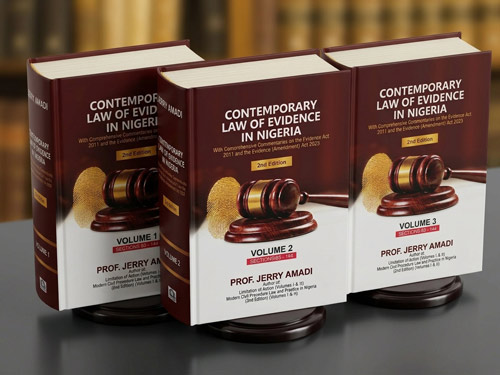 Prof. Jerry Amadi’s Evidence Law, Second Edition (2026), contains 3,314 pages in three volumes, covering the Evidence Act 2011, its 2023 amendment, and 4,051 Nigerian and English cases.