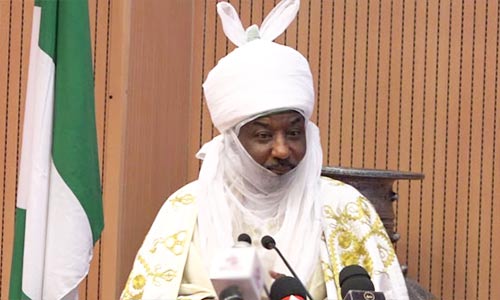
The Emir of Kano, Muhammadu Sanusi II, has warned the Federal Government against treating Nigerians who criticise its economic policies or raise concerns about poverty and hardship as enemies of President Bola Tinubu’s administration.

Sanusi, a former Governor of the Central Bank of Nigeria (CBN), urged the government to embrace constructive criticism, reduce excessive expenditure and introduce stronger social protection measures to address the difficulties confronting Nigerians.
The monarch spoke virtually on Tuesday, November 3, 2026, at the Oxford Global Think Tank Leadership Conference, organised by the Oxford Global Think Tank.
He maintained that although the economic reforms introduced by the Tinubu administration had produced measurable improvements in some economic indicators, the government must recognise that millions of Nigerians continued to struggle with poverty, hunger and inadequate access to essential services.
According to him, raising concerns about the economic conditions of citizens should not automatically be interpreted as political opposition or an attack on the President.
“It’s not every time people talk about poverty or talk about difficulty that they’re just enemies of the government or making an attack on the president. That is not how to respond to economic distress,” Sanusi said.
The former CBN Governor stressed that government officials must distinguish genuine public concerns from political attacks, particularly when citizens draw attention to the consequences of economic policies.
He argued that constructive engagement with critics would help policymakers identify shortcomings in existing programmes and make necessary adjustments to improve economic outcomes.
Sanusi also expressed concern about the size of government expenditure, warning that Nigeria could not successfully pursue fiscal consolidation while maintaining unsustainable spending commitments.
He said the Federal Government must demonstrate greater discipline in managing public resources and make deliberate choices about where available funds should be invested.
The monarch referred to figures from the World Bank’s October 2026 Nigeria Development Update, which showed that Federal Government interest payments amounted to approximately 124 per cent of reported federal revenue in the first half of 2026.
He maintained that the figures highlighted the need for urgent attention to debt sustainability and the country’s fiscal position.
The World Bank’s report showed that interest payments reached approximately N7.7 trillion between January and June 2026, compared with reported federal revenue of N6.2 trillion during the same period.
However, the Federal Ministry of Finance had earlier disputed the interpretation of the 124 per cent ratio, arguing that it compared debt obligations covering different tiers of government with an incomplete federal revenue figure.
The Ministry maintained that the calculation did not provide an accurate assessment of the country’s overall debt sustainability, noting that the World Bank projected full-year debt service at 46 per cent of revenue in 2026.
Sanusi nevertheless emphasised the need for the government to address debt sustainability and introduce wider structural reforms that would strengthen economic performance over the long term.
He argued that meaningful economic reform must extend beyond the removal of petrol subsidy and the liberalisation of the foreign exchange market.
According to him, while those measures formed part of the reform process, they could not independently address the structural challenges affecting Nigeria’s economy.
The monarch called for comprehensive policies covering electricity supply, agricultural productivity, technological development, public expenditure and social welfare.
He particularly emphasised the need for government to establish clear spending priorities, noting that limited financial resources required difficult choices between competing development projects.
Sanusi explained that expenditure on roads, electricity, agriculture and technology should be determined by their expected contributions to economic growth and citizens’ welfare.
He illustrated the challenge by noting that every $10 billion committed to road construction represented resources that could no longer be deployed to electricity or agriculture.
The former CBN Governor maintained that such decisions required careful consideration because government expenditure in one sector necessarily reduced the resources available for other priorities.
He consequently urged policymakers to prioritise investments capable of improving productivity, creating employment opportunities and strengthening the foundations of sustainable economic growth.
Despite his concerns about government spending and the effects of economic hardship, Sanusi acknowledged that the Tinubu administration had recorded progress in key economic indicators.
He cited improvements in gross domestic product growth, inflation and foreign reserves as developments that deserved recognition.
According to him, Nigeria’s economic growth had increased from an average of 0.9 per cent during the previous administration to approximately 4.5 per cent.
“I think moving from an average growth rate of 0.9 per cent to 4.5 per cent is progress. Moving from inflation of over 30 per cent to 14.5 per cent is progress,” he said.
Sanusi also pointed to the improvement in Nigeria’s foreign reserves, which he put at approximately $55 billion.
“Moving from the point where in 2023 the central bank’s reserves were maybe negative to where we are now having reserves of $55 billion is progress,” he stated.
The monarch maintained that these developments represented positive changes in the country’s macroeconomic position and should be acknowledged regardless of political differences.
He explained that recognising the achievements of an administration did not mean overlooking the difficulties confronting the population.
According to him, improved economic indicators would have greater meaning when they translated into better living conditions, increased employment opportunities and improved access to essential services.
Sanusi identified poverty, hunger, maternal mortality, malnutrition, education and healthcare as areas requiring urgent government attention.
He maintained that the progress recorded in economic growth, inflation and external reserves had not yet adequately addressed those challenges.
The former CBN Governor also questioned the timing of social protection interventions introduced to cushion the effects of economic reforms.
He argued that the government should have designed and implemented comprehensive social safety net programmes from the beginning of the reform process, rather than allowing vulnerable Nigerians to bear the immediate consequences without sufficient support.
According to him, policies involving the removal of subsidies and changes to the foreign exchange system should be accompanied by measures that protect low-income households and other vulnerable groups.
He stressed that economic reforms would be more sustainable when citizens could see practical improvements in their living standards.
Beyond the immediate economic challenges, Sanusi called for greater inclusion of women in governance and decision-making.
He expressed concern that women remained inadequately represented in government institutions despite their important roles in households, communities and national development.
The monarch identified maternal health, childhood malnutrition and early childhood development as policy areas where women’s experiences and contributions were particularly important.
He maintained that involving more women in decision-making would help ensure that public policies adequately addressed the needs of families and vulnerable populations.
Sanusi also urged the Federal Government and citizens to abandon an adversarial approach to national discussions.
He said the government should not regard every disagreement as hostility, just as citizens should recognise improvements where government policies produced positive results.
According to him, Nigeria required cooperation between policymakers and the population to address its economic difficulties and strengthen public confidence.
The former CBN Governor further maintained that improvements in electricity supply, agricultural productivity and technological investment could support higher economic growth and create additional opportunities for Nigerians.
He urged the government to pursue these priorities alongside measures to reduce excessive expenditure and strengthen debt sustainability.
Sanusi’s remarks reflected his position that Nigeria’s economic recovery should be assessed not only through macroeconomic indicators but also through the extent to which government policies improve the welfare of ordinary citizens.
While acknowledging the progress recorded under the Tinubu administration, the Emir insisted that poverty, hunger and other social challenges remained matters requiring urgent attention.
He maintained that constructive criticism should be welcomed as part of efforts to improve governance, rather than dismissed as opposition to the President or his administration.
[A MUST HAVE] Evidence Act Demystified With Recent And Contemporary Cases And Materials

Available now for NGN 40,000 at ASC Publications, 10, Boyle Street, Onikan, Lagos. Beside High Court, TBS. Email publications@ayindesanni.com or WhatsApp +2347056667384. Purchase Link: https://paystack.com/buy/evidence-act-complete-annotation
______________________________________________________________________ “Enhance Legal Practice With Authoritative Reports” — Alexander Payne Offers Comprehensive Law Reports, Spanning Over A Century Of Nigerian Jurisprudence Interested buyers are encouraged to place their orders and enquiries via:
0704 444 4777, 0704 444 4999, 0818 199 9888
Website: www.alexandernigeria.com