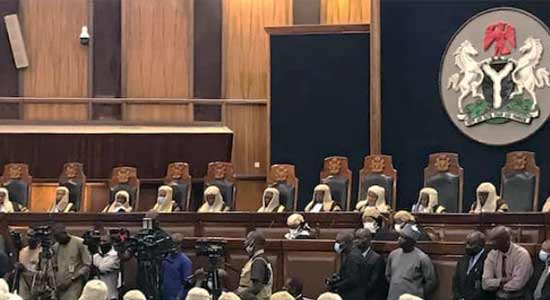
The Supreme Court, on Friday, dismissed the suit filed by the Kogi State Government and 18 other state governments challenging the constitutionality of the laws establishing the Economic and Financial Crimes Commission (EFCC), the Independent Corrupt Practices and Other Related Offences Commission (ICPC), and two other institutions.


The other two institutions whose constitutionality was contested are the Nigerian Financial Intelligence Unit (NFIU) and the Proceeds of Crime Recovery and Management Act.
In a unanimous judgment delivered by Justice Uwani Abba-Aji, the seven-member panel of Justices of the apex court dismissed the suit for lacking merit and substance.
Justice Abba-Aji ruled that the states were entirely wrong in asserting that the EFCC, established by an Act of the National Assembly, is an illegal and unlawful body. She emphasized that the law empowers the EFCC, ICPC, and NFIU to investigate and prosecute individuals accused of abuse of office, economic crimes, and financial misconduct.
The plaintiffs, in the suit marked SC/CV/178/2023, argued that the Supreme Court, in Dr. Joseph Nwobike vs Federal Republic of Nigeria, had previously held that the EFCC Establishment Act was based on a United Nations Convention against Corruption. They claimed that in enacting the law in 2004, the provisions of Section 12 of the 1999 Constitution, as amended, were not adhered to.
The plaintiffs contended that Section 12 of the Constitution requires the majority of the state Houses of Assembly to approve any convention before it is domesticated into Nigerian law. They argued that since this procedure was allegedly not followed, the EFCC Act and other related laws could not be applied to states that did not approve them.
The plaintiffs further argued that any institution formed by domesticating a UN Convention without following constitutional requirements should be deemed illegal.
However, the Supreme Court resolved all the issues raised in the suit against the plaintiffs. The court held that the EFCC Act, being a law of the National Assembly and not a treaty, does not require ratification by state Houses of Assembly.
The court ruled that the National Assembly has the constitutional authority to enact laws addressing financial crimes, abuse of power, and corruption.
“The EFCC Act is a competent law and does not require the ratification of the Kogi State House of Assembly,” Justice Abba-Aji declared. She added, “In all, the plaintiffs’ suit has failed and is accordingly dismissed in its entirety.”
The suit, which was initially instituted by attorneys general of 16 states, sought the scrapping of the anti-graft agency. While some states withdrew from the suit, some others asked to be joined as co-plaintiffs.
The states that initiated the suit include Ondo, Edo, Oyo, Ogun, Nassarawa, Kebbi, Katsina, Sokoto, Jigawa, Enugu, Benue, Anambra, Plateau, Cross-River and Niger.
However, at the resumed hearing on October 22, Imo, Bauchi, and Osun states joined the suit as co-plaintiffs while Anambra, Ebonyi, and Adamawa states announced their decisions to withdraw their suits.
The trio’s suits were struck out, accordingly, by the court.
It will be recalled that the EFCC was established by an Act of the National Assembly on December 12, 2002, by the then administration of former President Olusegun Obasanjo.
Following the appointment and confirmation of its pioneer Executive Chairman, Mallam Nuhu Ribadu, and other administrative officers by the Senate, the Commission commenced its operational activities on April 13, 2003, though its Establishment Act was later amended in 2004.
However, in the suit before the apex court, the states, through their respective Attorneys General, argued that Section 12 of the 1999 Constitution, as amended, was not complied with before the EFCC began its operations.
According to the plaintiffs, it was a mandatory provision of the Constitution that the majority of the Houses of Assembly of States must vote and agree to the passage of the EFCC Act, insisting that it was not something that only the National Assembly was legally allowed to do.
They told the Supreme Court that none of the states was carried along before the EFCC was established by the then President Obasanjo’s administration.
They argued that the Supreme Court had, in a decided case-law in Dr. Joseph Nwobike vs. Federal Republic of Nigeria, held that it was a United Nations Convention against corruption that was reduced into the EFCC Establishment Act and that in enacting this law in 2004, the provision of Section 12 of the 1999 Constitution, as amended, was not followed.
The plaintiffs maintained that since due process was not followed before the EFCC Establishment Act was enacted, it cannot be applicable in states that never approved of it, in accordance with provisions of the 1999 Constitution, as amended.
They argued that any agency that was formed as a result of the Act ought to be regarded as an illegal institution.
The states relied on the fact that since the 1999 Constitution, as amended, is the supreme law of the land, any Act of the National Assembly that is inconsistent with the constitution ought to be declared a nullity.
The two other agencies the states also challenged their legitimacy, were the Independent Corrupt Practices and other Related Offences Commission, ICPC, and the Nigerian Financial Intelligence Unit, NFIU.
Even though the suit, marked: SC/CV/178/2023, was originally brought before the court by Kogi State, however, some states applied and were joined as co-plaintiffs while others filed applications for their own suit to be consolidated with the matter.
The Federal Government had on October 22, when the parties adopted their briefs of argument, urged the apex court to dismiss the suit for want of merit.
FG, which was represented by the Attorney-General of the Federation and Minister of Justice, Prince Lateef Fagbemi, SAN, challenged the competence of the legal action, which it described as a threat to the ongoing fight against corruption and financial crimes in the country.
The AGF maintained that contrary to the contention of the states, the EFCC was validly established in line with the provision of Section 15(5) of the 1999 Constitution, as amended.
Fagbemi, SAN, equally refuted the claim of the plaintiffs that the Act that established the EFCC was an offshoot of an international convention that was not properly domesticated in Nigeria.
 Interested buyers are encouraged to place their orders and enquiries via:
0704 444 4777, 0704 444 4999, 0818 199 9888
Website: www.alexandernigeria.com
Interested buyers are encouraged to place their orders and enquiries via:
0704 444 4777, 0704 444 4999, 0818 199 9888
Website: www.alexandernigeria.com