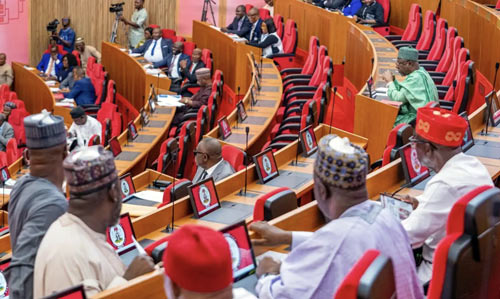
The Senate has directed the Nigerian Communications Commission to investigate the billing practices of mobile network operators following complaints of airtime deductions arising from failed, interrupted and dropped calls.

The upper chamber also urged the regulator to introduce measures requiring operators to automatically reverse or refund airtime deducted from verifiably failed calls and qualifying network-related service interruptions.
The resolution followed the adoption of a motion moved by Senator Tahir Mungonu during plenary.
The Senate expressed concern over persistent complaints from telecommunications subscribers who allegedly lose airtime on unsuccessful or interrupted calls despite not receiving the services for which they were charged.
Lawmakers observed that poor network quality often forces subscribers to make repeated calls before establishing successful connections, resulting in additional costs.
They also cited abrupt disconnections, inaudible conversations and other network interruptions as factors that further increase the financial burden on consumers.
The Senate maintained that Nigerians should not be made to pay for telecommunications services that were not effectively delivered, noting that seemingly small deductions could amount to substantial financial losses when aggregated across millions of subscribers.
It expressed particular concern about the impact on low-income earners, traders, students and small business operators who spend portions of their income on airtime.
The lawmakers consequently urged the NCC to establish an accessible and time-bound complaints and redress mechanism for subscribers seeking refunds or compensation over unjustified deductions and persistent service failures.
The Commission was also asked to conduct independent technical audits of operators’ billing systems to ensure that subscribers are charged only for actual and properly delivered call durations.
The Senate further urged the NCC to strengthen enforcement of Quality-of-Service standards and impose appropriate sanctions on operators whose persistent network deficiencies violate regulatory requirements.
It mandated its Committee on Communications to invite the NCC and relevant telecommunications operators, including MTN Nigeria, Globacom, Airtel Nigeria and 9mobile, to investigate the complaints, assess the financial losses suffered by subscribers and report back within four weeks with recommendations for further legislative and regulatory action.
The NCC was equally directed to report to the Senate within four weeks on the outcome of its investigation and the measures proposed to address the complaints.
The Senate recalled that the Nigerian Communications Act, 2003, empowers the NCC to regulate the telecommunications industry, protect consumers and enforce acceptable standards of service delivery.
Meanwhile, the Senate also passed the National Senior Secondary Education Act (Amendment) Bill, 2026, for third reading.
The Executive Bill seeks to address gaps identified in the implementation of the existing law and strengthen the regulation and coordination of public senior secondary education across the country.
Presenting the report of the Senate Committee on Education (Basic and Secondary), Senator Orji Kalu said the proposed amendments were designed to strengthen the governance of the National Senior Secondary Education Commission, improve coordination between the federal and state governments, promote accountability and ensure effective implementation of national education policies.
Kalu, who presented the report on behalf of the committee chairman, Senator Usman Adamu, said the bill was referred to the committee after its consideration by the Senate on October 28.
He explained that although the Commission was established under the National Senior Secondary Education Commission Act No. 45, 2023, experience in implementing the legislation had revealed areas requiring legislative intervention.
“The proposed amendments are therefore intended to address these challenges and make the Act more effective in achieving its objective,” he said.
Kalu disclosed that the House of Representatives had also considered the bill and referred it to its Committee on Basic Education and Services, necessitating joint stakeholders’ engagement and clause-by-clause consultation to ensure uniformity in the legislative process.
Following the presentation, the Senate dissolved into the Committee of the Whole, considered the report clause by clause and adopted the committee’s recommendations before passing the bill for a third reading.
[A MUST HAVE] Evidence Act Demystified With Recent And Contemporary Cases And Materials

Available now for NGN 40,000 at ASC Publications, 10, Boyle Street, Onikan, Lagos. Beside High Court, TBS. Email publications@ayindesanni.com or WhatsApp +2347056667384. Purchase Link: https://paystack.com/buy/evidence-act-complete-annotation
______________________________________________________________________ “Enhance Legal Practice With Authoritative Reports” — Alexander Payne Offers Comprehensive Law Reports, Spanning Over A Century Of Nigerian Jurisprudence Interested buyers are encouraged to place their orders and enquiries via:
0704 444 4777, 0704 444 4999, 0818 199 9888
Website: www.alexandernigeria.com
“A Comprehensive Guide To Evidence Law” — Releases Second Edition In Three Volumes, Covering 4,051 Cases
For enquiries and orders, contact: 08035526491 Email: jerryamadisilk@gmail.com
 Prof. Jerry Amadi’s Evidence Law, Second Edition (2026), contains 3,314 pages in three volumes, covering the Evidence Act 2011, its 2023 amendment, and 4,051 Nigerian and English cases.