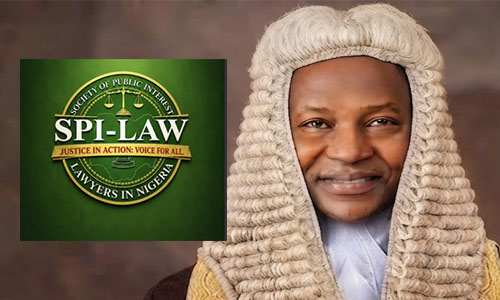
The Society of Public Interest Lawyers in Nigeria has filed a petition for professional misconduct and infamous conduct in a professional respect against a former Attorney-General of the Federation and Minister of Justice, Mr. Abubakar Malami, SAN, before the Legal Practitioners Disciplinary Committee at the Body of Benchers in Abuja.

The petition was filed on 28 September 2026 and is registered as Case No. BBLPDC/2196/2026, Incorporated Trustees of the Society of Public Interest Lawyers in Nigeria v Abubakar Malami, SAN.
It is founded on the findings made against him by an arbitral tribunal of the International Chamber of Commerce in its Final Award dated 16 September 2026 in ICC Case No. 26260/SPN/AB/CPB, Sunrise Power and Transmission Company Limited & Anor v Federal Government of Nigeria.
By the Originating Application, the applicant, described as being of No. 104, Airport Road, Warri, Delta State, applies that the respondent “be required to answer to the allegations contained in the Statement/Affidavit which accompanies this Application and that such Order be made as the Honourable Committee shall think right.”
The application is signed by Mr. Olukunle O. Edun, SAN, Mr. J. O. Aikpokpo-Martins and Mr. Olajide A. Abiodun as applicant’s counsel, and bears the received stamp of the Legal Practitioners Disciplinary Committee dated 28 September 2026.
For service on the respondent, the document gives the address of A. A. Malami, SAN & Co., 3rd Floor, Elizade Nigeria Ltd, Plot 596, Independence Avenue, Cadastral Zone, opposite Bolingo Hotel, Central Business District, Abuja, or, in the alternative, the Kuje Correctional Centre, Abuja.
The accompanying notice states that the applicant proposes to rely on the statements and affidavit of facts and accompanying documents on oath listed in it.
Those documents are the affidavits of facts setting out the allegations and the matters relied upon; a flash drive containing a copy of the Final Award; an extract of the relevant and material parts of the Final Award; and such further documents as may be necessary or as the Committee may require.
The persons who made statements in support are listed as Mr. John Aikpokpo-Martins, Mr. Kunle Edun, SAN, and the Attorney-General of the Federation, who is to be subpoenaed.
The notice informs the respondent that if he wishes any person who has made one of the statements to attend the hearing as a witness, he must notify the applicant and the Secretary to the Committee not less than nine days before the date set down for the hearing, and that in the event of his failure to do so the Committee may accept the statement or affidavit in evidence without more.
The petition is expressed to be brought in the public interest pursuant to the Legal Practitioners Disciplinary Committee Rules 2020 and the Legal Practitioners Act.
It describes the applicant as an incorporated body registered under Nigerian law and committed to the advancement of the rule of law, the protection of the public interest, the integrity of the legal profession, and the accountability of public officers and legal practitioners who hold or have held high public office.
It states that the application is brought pursuant to Rule 4 of the Committee’s Rules and to the provision of the Legal Practitioners Act which empowers any person to bring allegations of professional misconduct against a legal practitioner whose name is on the Roll.
Of the respondent, it states that he is a legal practitioner enrolled to practise in Nigeria, a Senior Advocate of Nigeria, and the former Attorney-General of the Federation and Minister of Justice from November 2015 to May 2023, appointed to that office by virtue of being a legal practitioner called to the Nigerian Bar, and that at all material times he remained bound by the Rules of Professional Conduct and owed “the highest duties of honesty, integrity, loyalty to the Federation, and fidelity to the rule of law.”
According to the petition, the Final Award “contains detailed, reasoned, and damning findings that the Respondent, while serving as Attorney-General of the Federation, engaged in conduct amounting to corruption, acted deliberately against the best interests of Nigeria, maintained an inappropriate and corrupt relationship with a party adverse to Nigeria, and displayed a shocking disregard for the administration of justice.”
The tribunal was composed of Ms. Melanie van Leeuwen as President, Mr. Simon Nesbitt, KC, and Professor Stavros Brekoulakis, with its seat in Paris, France, and the award followed a full evidentiary hearing at which high-ranking Nigerian officials, including former President Muhammadu Buhari, gave evidence.
The dispute concerned, among other things, the validity and enforceability of a Settlement Agreement dated 21 January 2020 and an Addendum dated 25 March 2020, which the respondent signed on behalf of the Federal Government of Nigeria while serving as Attorney-General.
The petition sets out the tribunal’s findings by category.
On authority, it states that the tribunal found that the respondent, together with the then Minister of Power, “lacked authority to execute the Settlement Agreement and the Addendum on behalf of Nigeria” and “did not possess apparent or ostensible authority to bind Nigeria,” with the consequence that the instruments were held not binding, at paragraphs 785 and 786 of the award.
On corruption, the petition states that the tribunal found that the Settlement Agreement and Addendum “are a product of corruption,” at paragraph 1405.
It states that the tribunal accepted the testimony that the respondent “directly solicited a bribe” and claimed a portion of the settlement sum that would be paid to Sunrise, at paragraphs 1352 and 1354, the tribunal having recorded that “the Tribunal has no reason to doubt the veracity of Mr. Adesanya’s testimony to the effect that Attorney-General Malami solicited a bribe from Mr. Adesanya during the conversation he recorded.”
It further states that the tribunal drew an adverse inference that “a corrupt deal was in fact reached between Mr. Adesanya, on the one hand, and Attorney-General Malami on the other,” consisting of a promise to pay him a share of the settlement sum in exchange for his cooperation in committing Nigeria to the instruments, at paragraphs 1403, 1404 and 1407.
The extract exhibited with the petition sets out the tribunal’s description of that deal in three parts: the quid, being the promise to pay the Attorney-General a share of the settlement sum payable to Sunrise under the Addendum; the pro, being the causal link between that promise and his cooperation in committing Nigeria to the settlement obligations and the coordination of procedural steps in the arbitrations; and the desired quo, being his signing of the Addendum of 25 March 2020, which would entitle Sunrise to a settlement payment of at least 200 million dollars, or, in the event of a financial default, 400 million dollars.
The tribunal held that the instruments are unenforceable because they are “a product of corruption and violate Nigerian public policy,” at paragraph 1408.
On the respondent’s conduct of the negotiation, the petition cites the finding that he “has not been negotiating on behalf of Nigeria when he insisted on a change of the terms and conditions of the settlement but for Sunrise,” and that “it was his responsibility to act in the best interest of Nigeria alone,” so that his having deliberately acted against those interests led the tribunal to conclude “that he was motivated by other incentive(s),” at paragraph 1374.
On the relationship between the two men, the petition cites the finding that “there was an inappropriate relation between Mr. Adesanya and Attorney-General Malami,” in the context of which “the gentlemen shared a high degree of trust and, it would appear, a lack of moral compass,” and that he “was actively applying his efforts to the benefit of Sunrise so ‘that we get paid’,” at paragraph 1394.
The extract records the tribunal’s further observation that it had no difficulty finding that the word “we” employed in the WhatsApp exchanges between the two men referred to Mr. Adesanya and the Attorney-General, and that had he appeared at the hearing to give evidence, the tribunal would have confirmed that point with him.
It also cites the finding that the red flags in the evidence were “indicative of a corrupt relation between Mr. Adesanya and Attorney-General Malami,” at paragraph 1402.
On the conduct of the arbitration itself, the petition states that despite being called as a witness by Nigeria and being present in Paris during the hearing, where he met with his father-in-law, former President Buhari, the respondent refused to appear for cross-examination.
It cites the tribunal’s record of its “disappointment” and its “serious dissatisfaction with the disregard that both Mr. Malami and Mr. Aondoakaa have displayed for the administration of justice in this arbitration and for the Tribunal,” and its attribution of “limited weight, if any,” to his witness statement, at paragraphs 1000 and 1001.
The petition argues that given the office he had held as the highest-ranking legal officer of the country, he was fully aware of the importance of witness examination for due process purposes, and that his refusal to submit to cross-examination while in the same city as the hearing “constitutes a profound contempt for the administration of justice.”
The exhibited extract records that Nigeria informed the tribunal that the former Attorney-General was unwilling to testify and was under investigation by the Economic and Financial Crimes Commission, that the tribunal rejected a late request to exclude his witness statement, and that it noted it would take his non-appearance into account in determining what weight, if any, to give that statement.
By reason of those facts and findings, the applicant alleges that the respondent is guilty of professional misconduct and infamous conduct in a professional respect, contrary to Rule 1 of the Rules of Professional Conduct for Legal Practitioners 2023, which requires every lawyer to uphold and observe the rule of law, promote and foster the course of justice, maintain a high standard of professional conduct, and not engage in any conduct which is unbecoming of a legal practitioner.
One of the supporting affidavits notes that the 2023 Rules were “incidentally signed into operation by the Respondent.”
The petition further alleges breaches of the fundamental duties of honesty, integrity and fidelity to the client, in this case the Federal Republic of Nigeria; the prohibition against engaging in corrupt practices or conduct that brings the legal profession into disrepute; and section 11 of the Legal Practitioners Act, which empowers the Committee to deal with infamous conduct in any professional respect and conduct incompatible with the status of a legal practitioner.
The particulars of misconduct pleaded are five.
The first is that, while serving as Attorney-General of the Federation and Chief Law Officer of Nigeria, he engaged in or facilitated a corrupt deal in connection with the negotiation and execution of the Settlement Agreement and Addendum, including the solicitation of a bribe or undue advantage.
The second is that he deliberately acted against the best interests of the Federal Republic of Nigeria, his client, by prioritising the interests of a private party over those of the Federation.
The third is that he maintained an inappropriate and corrupt relationship with a party adverse to Nigeria while holding the office of Attorney-General.
The fourth is that he signed instruments which purported to bind Nigeria without the requisite presidential or executive authority.
The fifth is that he displayed a serious disregard for the administration of justice by refusing to submit to cross-examination in an international arbitration in which he was a key witness, despite being present in the city of the hearing.
The petition states that the respondent “was not an ordinary practitioner,” having been “the Chief Law Officer charged with protecting the legal interests of the Nigerian State and upholding the Constitution and the rule of law.”
“When the highest legal officer of the land is found by an independent international tribunal to have engaged in corruption, to have acted against the nation’s interests, and to have treated the administration of justice with contempt, the integrity of the entire legal profession in Nigeria in the estimation of other countries is placed in jeopardy,” it states.
“The Applicant respectfully submits that if the Committee fails to act decisively on findings of this gravity, the message to the public and to the profession will be that high office confers immunity from professional accountability. That message would be catastrophic.”
It adds that the findings are “detailed, reasoned, and based on a full evidentiary record,” and “provide a more than sufficient foundation for this Committee to call upon the Respondent to answer.”
The applicant prays the Committee for a finding that the respondent is guilty of professional misconduct or infamous conduct in a professional respect; for such direction as the Committee may deem fit under section 11 of the Legal Practitioners Act, including, without limitation, an order that his name be struck off the Roll of Legal Practitioners, or such lesser sanction as the Committee considers appropriate; and for such further or other orders as the Committee may deem fit.
The application is supported by two affidavits, both sworn at the Registry of the Legal Practitioners Disciplinary Committee in Abuja on 28 September 2026.
The first is deposed to by Mr. John Aikpokpo-Martins, President of the applicant, who states that he has carefully read and studied the Final Award and that the findings concerning the respondent “are grave, detailed, and damning,” and exhibits the award on a flash drive as Exhibit SPI-LAW 1 on account of its voluminous nature.
He deposes that he makes the affidavit in the public interest, and that the Committee, “as the statutory guardian of the honour and integrity of the legal profession in Nigeria, must call the Respondent to answer these grave allegations,” failing which “a dangerous message” would be sent “to the International community and the Nigerian general public that high public office in Nigeria confers immunity from professional accountability.”
“The findings of the ICC Tribunal are not mere allegations,” he states. “They are reasoned conclusions reached after a full adversarial process, the examination of witnesses (including the former President of Nigeria), and a careful evaluation of contemporaneous documents and oral evidence. They provide a solid and compelling foundation for disciplinary proceedings.”
He urges the Committee to certify that there is a case to answer, to direct the respondent to answer the allegations, and upon due hearing to make such directions under section 11 of the Act as the justice of the case demands.
The second affidavit is deposed to by Mr. Olukunle Kunle Edun, SAN, Vice President of the applicant, who exhibits as Exhibit SPI-LAW 2 the extract of the relevant and material parts of the award, and deposes in substantially the same terms.
The exhibited extract, signed by Mr. Olukunle O. Edun, SAN, organises the principal references to the respondent in the award thematically, with paragraph numbers and page references to the two parts of the award.
It reproduces the award’s entry for him in its list of key dramatis personae, describing him as Attorney-General and Minister of Justice of Nigeria from 11 November 2015 to May 2023, in private practice at A. A. Malami, SAN & Co from May 2023 to the present, signatory of the Settlement Agreement and the Addendum, and a witness for Nigeria in the arbitration who submitted one witness statement and did not appear to give oral evidence.
The extract notes that the page numbers refer to the pagination of the two parts of the award as provided, that the paragraph numbers are those of the award itself, and that users should cross-check against the original award text for complete context, footnotes and surrounding analysis when preparing any formal petition or submission.
In a statement issued on 29 September 2026 and signed by its Director of Media and Publicity, Ms. Sadiya Saleh, the society said the office of Attorney-General of the Federation is the highest legal office in the land and that its occupant “must embody absolute integrity, loyalty to the Federation, and fidelity to the rule of law.”
“We believe that no one, no matter how highly placed, is above professional accountability. Failure to call the Respondent to answer would send a catastrophic message that high office confers immunity from the ethics of the Bar,” the statement said.
It urged the Committee, “as the statutory guardian of the honour and integrity of the profession, to certify that there is a case to answer and to invite Mr. Malami, SAN, to defend the allegations.”
The society added: “We emphasize that these are allegations for disciplinary inquiry based on the Tribunal’s findings; the LPDC will afford the Respondent full fair hearing as required by law.”
“The law must be no respecter of persons,” the statement concluded.
[A MUST HAVE] Evidence Act Demystified With Recent And Contemporary Cases And Materials

Available now for NGN 40,000 at ASC Publications, 10, Boyle Street, Onikan, Lagos. Beside High Court, TBS. Email publications@ayindesanni.com or WhatsApp +2347056667384. Purchase Link: https://paystack.com/buy/evidence-act-complete-annotation
______________________________________________________________________ “Enhance Legal Practice With Authoritative Reports” — Alexander Payne Offers Comprehensive Law Reports, Spanning Over A Century Of Nigerian Jurisprudence Interested buyers are encouraged to place their orders and enquiries via:
0704 444 4777, 0704 444 4999, 0818 199 9888
Website: www.alexandernigeria.com
Interested buyers are encouraged to place their orders and enquiries via:
0704 444 4777, 0704 444 4999, 0818 199 9888
Website: www.alexandernigeria.com