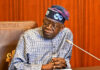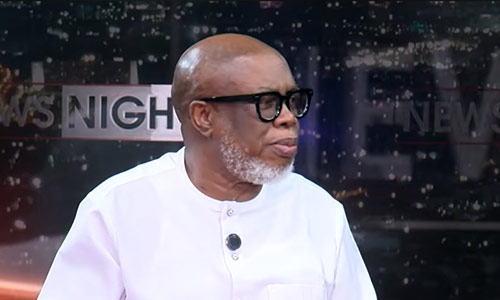
A constitutional lawyer, Dr. Yemi West-Idahosa, has said that he cannot identify any constitutional violation in the prolonged absence of President Bola Ahmed Tinubu from the country, arguing that the Constitution nowhere prohibits a working vacation and that responsibility for any failure lies with a National Assembly which has declined to exercise the power given to it.

He spoke on the programme Newsnight, as the President’s absence approached a month and both the African Democratic Congress and the Nigeria Democratic Congress pressed the question of who is exercising presidential authority.
The presidential campaign council of the African Democratic Congress has demanded full disclosure from the presidency over the absence, saying the administration owes Nigerians a clear and transparent explanation together with details of who is exercising presidential authority while the President remains abroad. The party has said that administrative explanations do not answer the essential question of who is constitutionally and effectively responsible for the country’s affairs in his absence, a view shared by the Nigeria Democratic Congress, which insists that Nigeria cannot be run on delegated authority.
The Vice President, Senator Kashim Shettima, has since returned to the country after representing the President at the 81st session of the United Nations General Assembly in New York, where Nigeria pressed for permanent African representation on the Security Council, fairer access to global financing and stronger support for developing countries on climate change, and urged African states to stop relying on raw mineral exports and to develop processing and manufacturing capacity on the continent. While in New York he held talks with leaders of the Economic Community of West African States and with the Deputy Secretary-General of the United Nations, Ms. Amina Mohammed, and engaged Nigerians in the diaspora on investment, expertise and national development.
Asked what the Constitution says about an absence of 21 days and who is in charge when the President is on vacation, the lawyer answered the second question first.
“Let me first say clearly that there is someone in charge. The President is in charge. He is completely in charge,” he said.
He then set out the provision. “Section 145 is clear. It says that when the President wishes to go on vacation, or when he is unable to perform his functions, he must send a letter, what we may call a declaration, to the National Assembly to inform them of that development. On this occasion, that did not happen.”
“Then the second point is where he does not do so within 21 days. And by the way, one of those two occasions has occurred. Then the duty moves to the National Assembly to use a simple resolution and ensure that the Vice President takes over. So the driving force is the National Assembly.”
Turning to whether a President may be on vacation and working at the same time, he said the text must be read against the realities of office.
“I think you cannot deal with the Nigerian Constitution in isolation from reality. Current global practice is that presidents cannot actually take a vacation, because the command structure always remains with the President. The decision on what happens and what does not rests with the President.”
“So when most presidents around the world travel for any reason, they remain in working contact, which is what is now called a working vacation.”
“A working vacation simply means that the President, while on vacation, remains responsible for the activities of government. And the question you must ask is, does the Constitution prohibit that? There is no mention in the Constitution prohibiting this. It is one of the silences of the Constitution.”
He located the authority in the general grant of executive power. “Under section 5, the President may exercise what we call implied executive powers. So long as the matter is in the public interest, what he does is not a breach of the authority of the National Assembly. Nor is it a breach of the declared judicial powers.”
“I am not aware of a Supreme Court decision prohibiting him from having a working vacation. And I am not aware of any resolution of the National Assembly on the matter,” he said.
He then turned the question on the legislature.
“The question you must also ask, assuming without conceding that he was indeed doing something flagrantly contrary to the Constitution, is what prevents the National Assembly, which has been given the powers to activate that through a resolution? Why do they stand by with folded arms watching?”
“So why is that National Assembly incapacitated, voluntarily incapacitated? Who can prevent the National Assembly from doing its work? So it is a circle of assumptions and questions. But on the whole, I cannot identify a constitutional violation or breach.”
Put to him that the country had been through this before, under the late President Umaru Musa Yar’Adua and the late President Muhammadu Buhari, that the law exists and the problem therefore lies not in the Constitution but in its implementation by the National Assembly, he agreed.
Asked who compels the National Assembly to act where it has failed to do so, and what should follow, he pointed to the courts.
“Citizen advocacy. Ideally, it falls to us as citizens to test this scenario before the court and say, listen, the President comes to say he is on a working vacation. The President did not transmit. He did not make that decisive transmission. The National Assembly, after 21 days, did not exercise its resolution. What should the outcome be? And that is why the judiciary exists, to make that declaration.”
He entered a caution immediately. “But understand one thing clearly. Not all the President’s actions can be subjected to scrutiny, so long as they do not breach the express powers allocated to the other branches of government. We are in a constitutional democracy. Do not forget also that there are clear separations of powers.”
“Under section 5 of the Constitution, executive powers are vested in the President, including the maintenance of law and order and a range of other matters. Do not forget also that he is the country’s chief promoter. And he is the country’s chief thinker. So if you go to Chapter Two, which contains the directive principles and state policies he is supposed to pursue.”
He gave an illustration. “He can, for example, say, oh, I am going on vacation to France, but I will work there because I have some political matters to address with that country. And at the same time, he receives security briefings from the security agencies. He also takes decisions on critical funding matters.”
“So it is not really possible in modern governance for a President to have an exclusive vacation as is expected. So traditionally, heads of state in Europe, in the United Kingdom and in the United States move to this vacation methodology.”
Put to him that the appearances told a different story, with the President abroad and the Vice President simultaneously out of the country, with Nigerians not seeing the President at the General Assembly, and with 37 persons alleged to be illegal miners dying in the custody of the Nigeria Security and Civil Defence Corps, he declined the role he was being offered.
“Well, I am not here to defend the President. That is not my brief,” he said. “But let us clarify the question of who addresses the United Nations General Assembly and who does not. There are a number of countries that permanently send their foreign ministers to do so. Even at the last session of the General Assembly, a few foreign ministers did so.”
Pressed on who authorised the Vice President to address the Assembly, on the footing that a Vice President ordinarily has no such power and that a formal delegation within the President’s gift is required, he made the point his own.
“No one can but the President. So if that happened, it is evidence of effective and continuing direction,” he said.
He applied the same reasoning to the deaths in Niger State. “You also spoke about the Niger scenario where there were casualties. I understand that an order was issued for an investigation. And those orders came from the highest authority.”
“So he may not need to be here physically to take those decisions, so long as he is not incapacitated. So long as he is not incapacitated, and whether he is working or on vacation, the important thing is this: can he still activate the structures of government? Can he issue orders to them? Can he make them work effectively? Can he coordinate their work? If he is doing that, I am not sure there is any breach of law that can be regarded as gross misconduct.”
The presenter noted in closing that the Constitution does not provide that the President must be physically present to perform his functions, but that the position is contested, and that a political party, the African Action Congress, is now suing the President and the National Assembly over the failure to transmit powers to the Vice President.
[A MUST HAVE] Evidence Act Demystified With Recent And Contemporary Cases And Materials

Available now for NGN 40,000 at ASC Publications, 10, Boyle Street, Onikan, Lagos. Beside High Court, TBS. Email publications@ayindesanni.com or WhatsApp +2347056667384. Purchase Link: https://paystack.com/buy/evidence-act-complete-annotation
______________________________________________________________________ “Enhance Legal Practice With Authoritative Reports” — Alexander Payne Offers Comprehensive Law Reports, Spanning Over A Century Of Nigerian Jurisprudence Interested buyers are encouraged to place their orders and enquiries via:
0704 444 4777, 0704 444 4999, 0818 199 9888
Website: www.alexandernigeria.com
Interested buyers are encouraged to place their orders and enquiries via:
0704 444 4777, 0704 444 4999, 0818 199 9888
Website: www.alexandernigeria.com