Only last week, I was reading the African power supply survey report that put Mauritius in a very enviable position on the electricity access and supply map. For a developing, small island State, Mauritius has achieved 100 percent electricity access and has a blooming power sector, while Nigeria has an access rate tethering somewhere between a measly 40 and 50 percent (who barely even get the supply) and an energy supply of between 2,500 and 4, 00 megawatts, (the higher number being a rarity) to a 180 million population.

The recently concluded NBA Conference curated a discussion on the ailing power sector in Nigeria and power investments, where renowned players in the industry like Mr Babatunde Raji Fashola, Dr Emmanule Ibe Kachikwu, Dr Sam Amadi, Mr Azu Obiaya and Alhaji Hamisu Abubakar. Essentially, in simple terms, they were discussing why we cannot get light. I would briefly attempt a pragmatic analysis of the main issues that were the focus of the descant and proffer what I think can be veritable solutions to the power industry challenges in this Sub-Saharan State.
Three issues of major concern were raised in the course of the discussion, which I will address anon. First the issue of tariffs, then the concern of electricity theft which was discussed by Alhaji Abubakar, and availability of funding for GEnCos’ and Discos that was discussed by Mr Obiaya
The Minister of Power, Works and Housing confabulated on ‘An Overview Of The Power Sector, With A Special Focus On The Power Sector Recovery Programme’ and touched on the challenges. The challenges to the sector have remained fairly the same since 1929, although with the unbundling, into Generation Companies (GenCos), Distribution Companies (DisCos), and the Transmission Company of Nigeria (TCN) there have been even more peculiar challenges. Some of these challenges include lack of funding, high debt index as a result of low tariffs, electricity theft, non-payment of bills, inability of the Nigerian Bulk Electricity Trading Company (NBET) to pay for its supplies, inadequacy of supply, low gas to power output, lack of technological capacity for power generated, low pricing of gas, insufficient capacity, lack of data, poor maintenance culture, inefficiencies and over-manning, inadequate training, among others. These issues were discussed at the conference.
The current Power Sector Recovery Programme (PSRP) which is a high point of reform in the sector, brought to bear the N701 billion injection by CBN to NBET for offsetting debts of GenCOs, as a major stride by the recovery programme to scale up the industry. The PSRP work-plan is a very ambitious document, one which, if followed, presents the country with a highly probable energy success story. It involves among others, a financial plan which will review and analyse the accumulated deficit across the value chain and according to different factors and a financial simulation model and financial analysis of the GenCos and DisCos.
The electricity industry, like any bloc of the energy industry has a colossal fiscal appetite and insufficient funding to address these funding needs. Some of the challenges for DisCo’s include:
- Non-cost reflective tariffs: The concern prevalent in the industry among the 11 DisCos is how the Multi Year Tariff Order (MYTO 2.1) is non-reflective of their needs, especially in covering their running costs. NERC adopted sculpting of the tariff such that DisCos are required to under-recover now (by charging less than the cost reflective tariff) and are allowed to recover in the future. This model, while bringing temporary ease on the retail tariff, comes with attendant challenge of how to manage the huge shortfall resulting from the sculpted tariff contributing to the funding problems of the DisCo’s
- Huge metering and billing gap: Another major challenge facing the DisCos is the inability to provide meters for consumers. In fact, there are more consumers without meters than those with them. The latest data provided by NERC revealed that only 3.39 million customers nationwide, representing 45 percent of total electricity customers, have electricity meters. This has contributed in no mean manner to the shortfall in revenue due to the fixed or estimated billing methods, which contrary to the belief of consumers, results in a loss rather than profit to the DisCos.
- Electricity theft and unpaid electricity bills: As at May 2016, the amount DisCo’s were being owed by the MDA’s, Federal and State governments alone totalled N78.7 billion with the Nigerian Army being the single largest debtor. PHED, the DisCo that serves the FCT, as at last count was N70 billion in debt. According to the CEO of PHED, Mr Jay McCoskey, ‘There’s no distribution company in Nigeria that is bankable right now.’
There are also the problems of shortage of power supply, poorly managed network infrastructure, policy somersaults, delays in getting regulatory approvals and the lingering political risks that have made it difficult to raise capital to fund critical projects
In overcoming these challenges, first there is a dire need for up to date statistics on the power sector to ensure them that the energy resource project is bankable and build investor confidence. Unless that happens, the required investment in the distribution sector may not materialise. The government should also consider outsourcing the metering project to other companies in order to ensure the metering is done while relieving the DisCos of the financial capital required to do that.
Furthermore, the Bureau of Public Enterprises (BPE) as a 40 percent shareholder (and effectively the largest investor in DisCos) also has a role to play in enabling the provision of long-term capital to them. The BPE is in a position to leverage its shareholding in all eleven DisCos under a structured financing, to raise long-term debt capital on behalf of them. In addition, the BPE must be ready to also dilute its shareholdings in DisCos as well, should the need arise. This may not be the BPE’s core role but it needs to look at taking on this mandate for the privatisation process to be successful in the long run. The BPE needs to immediately relax the onerous anti-dilution restriction placed by the BPE on Core Investors, which effectively constraints them from diluting their shares at Disco level to enable Core Investors raise the much needed equity financing.
On non-remitting of tariffs, we should start asking the question ‘Why are consumers not paying their bills?’ Poor electricity supply, even for those who have access, definitely serves as one, and the lack of a proper tariff structure and strengthened institutions to shore up the deficit from individuals and government agencies especially, which owe the bulk of the sum.
A core regulatory task of NERC in relation to tariffs is to design fair and equitable electricity tariffs for numerous customer classes and periodically review and redesign those tariffs considering a variety of objectives. Part of this process is the balancing of costs, benefits, and risk among ratepayers, utilities, and private investors, as well as aligning tariffs with public policy objectives. Tariffs must be designed at rates high enough to maintain the financial and operational health of the utility, attract private investment, meet growing demand, minimize outages, and address a variety of other capital-intensive objectives. Yet, consumer costs must be low enough to promote economic growth and productivity, protect the interests of low-income populations, and prevent ratepayers from providing windfall profits to utilities and private investors.
Addressing the issue of metering and electricity theft, financing and installing a meter is one half of the puzzle, the other, and perhaps more daunting half, is meter management. Management of electricity meters involves the reading, inspection, routine parts replacement, testing, emergency repair of meters and generally all such actions required to ensure the meter is functional at all times. This comes with its attendant costs. In other jurisdictions where there is a competitive metering industry, electricity customers usually bear this cost. A proposition should perhaps be made for NERC should consider re-introducing a meter management fee component of electricity. Electricity theft can also be attributed to absence of accountability, inadequate and ineffective enforcement of law, political protection of employees and influential customers and a warped customer attitude that it is okay to steal from the state.
In summary, electricity theft, tariffs and funding are inter-connected problems, a deck of cards that lean on each other to stay upright, thus if strong institutions for recovering tariffs are put in place, a tariff holiday similar to tax holidays are introduced, halving the excessive amounts owed by consumers, if investment is encouraged by policy and available data, and if a decent amount of electricity supply is made available incentivising consumers to pay up, then funding for the industry might not be so much of a challenge. The need for strong institutions though, is desiderata, because without them, reforms will be like towering skyscrapers built on quicksand.
Caleb Adebayo is a Trainee Associate at Wole Olanipekun and Co., with devout interest in the dynamics of Power, Energy and Infrastructure. He can be reached at calebadebayoc@gmail.com

 ARTIFICIAL INTELLIGENCE FOR LAWYERS: A COMPREHENSIVE GUIDE
Reimagine your practice with the power of AI “...this is the only Nigerian book I know of on the topic.” — Ohio Books Ltd
Authored by Ben Ijeoma Adigwe, Esq., ACIArb (UK), LL.M, Dip. in Artificial Intelligence, Director, Delta State Ministry of Justice, Asaba, Nigeria.
Bonus:
Get a FREE eBook titled “How to Use the AI in Legalpedia and Law Pavilion” with every purchase.
ARTIFICIAL INTELLIGENCE FOR LAWYERS: A COMPREHENSIVE GUIDE
Reimagine your practice with the power of AI “...this is the only Nigerian book I know of on the topic.” — Ohio Books Ltd
Authored by Ben Ijeoma Adigwe, Esq., ACIArb (UK), LL.M, Dip. in Artificial Intelligence, Director, Delta State Ministry of Justice, Asaba, Nigeria.
Bonus:
Get a FREE eBook titled “How to Use the AI in Legalpedia and Law Pavilion” with every purchase.
How to Order: 📞 Call, Text, or WhatsApp: 08034917063 | 07055285878 📧 Email: benadigwe1@gmail.com 🌐 Website: www.benadigwe.com
Ebook Version: Access directly online at: https://selar.com/prv626
________________________________________________________________________ The Law And Practice Of Redundancy In Nigeria: A Practitioner’s Guide, Authored By A Labour & Employment Law Expert Bimbo Atilola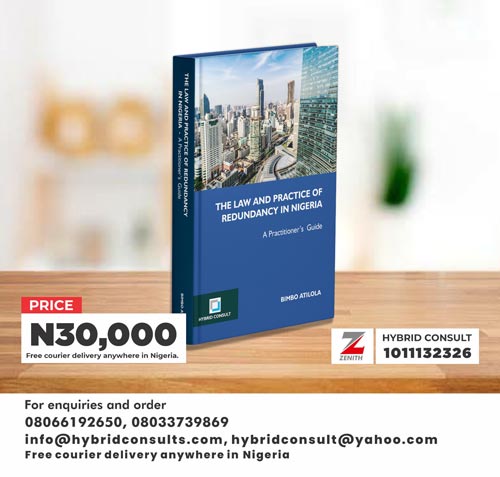 _______________________________________________________________________
"You Don't Need To Be Rich, You Just Need To Start" — Victoria Ezeigwe, Esq Launches Investment Handbook For Nigerians Starting With ₦5,000
_______________________________________________________________________
"You Don't Need To Be Rich, You Just Need To Start" — Victoria Ezeigwe, Esq Launches Investment Handbook For Nigerians Starting With ₦5,000

Get your copy today and take the first step toward financial growth:👉 https://selar.co/4f16676016
_______________________________________________________________________