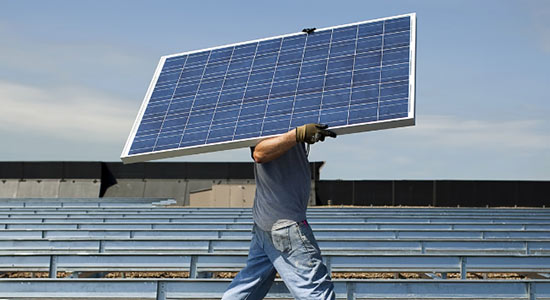
The Federal Government, through the Nigerian Electricity Management Services Agency, has raised the alarm over the increasing number of fire incidents linked to improperly installed rooftop solar photovoltaic systems across the country.

As Nigeria’s power sector continues to operate below expectations, many Nigerians are turning to solar to escape blackouts. However, cases of fire outbreaks from rooftop solar panels are becoming a source of concern to both the government and citizens.
In a strongly worded public notice, NEMSA expressed serious safety concerns, noting that many of the reported incidents were associated with poor workmanship, the use of substandard materials, the absence of protective devices, and non-compliance with technical standards and regulations.
The public notice, signed by the Chief Electrical Inspector of the Federation, stated, “The Nigerian Electricity Management Services Agency has observed with serious safety concern the increasing number of fire incidents allegedly linked to improperly installed rooftop solar photovoltaic systems across the country.”
“It is important to note that while the adoption of renewable energy is strongly encouraged in line with Nigeria’s energy transition objectives, safety must remain paramount.”
Pursuant to Section 176 (m) and Section 184 (8) of the Electricity Act 2023, NEMSA has now issued comprehensive safety guidelines for the installation of rooftop solar PV systems in Nigeria.
The agency directed members of the public to engage the services of qualified and NEMSA-certified solar PV system installers only. It stressed that these certified professionals possess the necessary skills, experience, and knowledge of technical standards and regulations.
In the new guidelines released, NEMSA said, “The installation of the rooftop solar PV system must be carried out only by NEMSA-certified electrical contractors.
“The NEMSA-certified contractor must be in possession of his/her valid NEMSA competency certificate during the installation works.
“A load assessment of the facility or premises must be conducted prior to installation to ensure the system is appropriately sized and can operate safely.
“The roof must be structurally sound and capable of supporting the PV solar system.”
NEMSA warned that “panels should be installed using appropriate mounting structures, as weak roof construction or improper installation can result in roof damage, fire hazards, and significant safety risks.”
The agency further stated that PV modules with cracks, bent frames, air bubbles, hot spots, or loose junction boxes should not be used, as damaged modules can cause electrical faults, reduce system performance, and increase the risk of fire or equipment failure.
On electrical safety, the notice declared, “Maintain a minimum clearance of 0.13m between the roofing material and the PV modules to ensure adequate ventilation and cooling during high temperatures. Insufficient clearance may lead to overheating, reduced system performance, and potential damage to the modules.”
It also mandated installers to install DC and AC isolators to enable emergency shutdown. “Provide appropriately rated circuit breakers and fuses to prevent overloading and install surge protection devices to protect the system against lightning surges. Ensure proper earthing (grounding) of the entire system, with an earth resistance value of 2 ohms or below,” it stated.
NEMSA emphasised the need for proper battery installation, warning that “batteries should be installed in a well-ventilated, secure location away from living areas and heat sources.”
For lithium batteries, the agency directed that a battery management system must be provided, and the installation site should be equipped with an appropriate cooling or air-conditioning system to maintain safe operating temperatures.
When installing a solar system on the rooftop of an existing house, it was directed that if the system capacity cannot support the entire household load, the installer must ensure proper load separation at the distribution board, stressing that all solar cables should be neatly routed through conduits or trunking to maintain safety and organisation.
Operators were told to ensure that communication cables and power cables are routed separately and never run together in the same conduit, as combining them can lead to signal interference, degraded system performance, and a higher risk of electrical faults or fire.
NEMSA also advised installers and owners to perform regular checks and maintenance of the rooftop PV system by cleaning the solar panels to prevent dust accumulation and overheating, periodically inspecting cables, connectors, and the inverter, and promptly replacing any damaged components.
The agency warned installers and the public, saying, “Solar PV system installers and members of the public must take note of the guidelines outlined above and ensure strict compliance. Adhering to these standards is essential for safety, system performance, and regulatory compliance.”
[A MUST HAVE] Evidence Act Demystified With Recent And Contemporary Cases And Materials

Available now for NGN 40,000 at ASC Publications, 10, Boyle Street, Onikan, Lagos. Beside High Court, TBS. Email publications@ayindesanni.com or WhatsApp +2347056667384. Purchase Link: https://paystack.com/buy/evidence-act-complete-annotation
______________________________________________________________________ “Enhance Legal Practice With Authoritative Reports” — Alexander Payne Offers Comprehensive Law Reports, Spanning Over A Century Of Nigerian Jurisprudence Interested buyers are encouraged to place their orders and enquiries via:
0704 444 4777, 0704 444 4999, 0818 199 9888
Website: www.alexandernigeria.com
Interested buyers are encouraged to place their orders and enquiries via:
0704 444 4777, 0704 444 4999, 0818 199 9888
Website: www.alexandernigeria.com