By Stanley Maduabuchi Ofoegbu Esq


Life is all about business transactions. Directly or indirectly, every living soul is transacting one business or another with another person. While some are into legitimate business, some are into illegal business while some are into other forms of activities though illegal, but to them they are part of business life and hence, “man must wack and man must survive”.
whether legal or illegal, some consideration in form of money are mostly given out or dispensed during business negotiation and or transactions usually with the aim that a reasonable profit either in monetary terms or other forms of valuables will be achieved in other words, it is usually built on the basis of a quid quo pro status possibly in support of the Biblical saying that he who will not work, let him not eat.
While the above assertion has received many pronouncements including judicial pronouncement, not all persons who invest into a business benefit from it. A lot of persons invest a huge amount of money into a certain business idea suggested by others only to be told painful stories at the end. Some, negotiate business with others who are made to part with huge amount of money for the performance of the contract only to be told painful stories. Some also, are made to pay in money to another upon a false and fraudulent representation of facts that never exist as though they do exist. Some, though are neither made to pay any money upon a false representation but through performance of their own obligation in a contract, mistakenly pay in money to another only to realize after they have been debited. In some cases, some pay in money over a subject matter only for the subject matter to give way after money has already been spent owing to no fault of either parties. Some on their own, are made to pay in money under duress by way of imposition using coercive means. Some too, are made to part with their money through extortion from the other party who either uses violent means or a cunning and indirect means to achieve same. Some, are forced to part with their money under oppression beyond their capacity. Some also, are made to part with their money as a result of their present situation or challenge and so on. All the identified circumstances above, all have bearings in contract, quasi contract and illegal transactions including criminal activities for which a criminal charge may be filed.
What then is the way out? Are there remedies for victims or persons who lost their money under the identified circumstances especially where and when the consideration in the said contract fails? What about persons who didn’t enter into a full contract but were made to part with their money only to be told how Eve deceived Adam by the Devil? What about people who got robbed or mistakenly transferred money to another among others? What about Banks and some financial institution and loan companies who secretly take and use money belonging to their customers? Will the affected go empty handed?
Before the advent of Equity, the common Law was highly rigid and not providing adequate remedies to its observers. Most claims under the doctrine of common law were lost to strict adherence of the law and hence, many wounds were left untreated. However, with the advent t of Equity, hope and joy was restored to the legal system as most claims that would have been defeated under the doctrine of common law were allowed to succeed for instance, the decision of a court of equity that says “a man who build a house, should be allowed to live inside”.
It is now a settled law and principle that the law will not suffer a wrong without a remedy see EWHRUDGE V WARRI LOCAL GOVERNMENT COUNCIL AND ANOR {2005}7 NWLR (PT924) 334 AT P.359. Also, the law is now settled that where a party has a right, he has a corresponding remedy which is usually expressed in the maxim: “Ubi jus ibi remedium” See ALIU BELLO AND ORS V ATTORNEY GENERAL OF OYO STATE (1986) 5NWLR AND BRIGADIER GENERAL JAMES OMEBIJE ABDULLAHI V NIGERIAN ARMY AND ORS (2018)14 NWLR (PT1639) 272 AT 295.Accordingly, there is a legal remedy for most if not all the circumstances described above provided the proper channel is followed.
Where a man pays money into another man’s account and such money was paid in error, the man who made the payment or transfers will still be able to recover the money paid in error. The law does not support a man to reap where he did not sow see C.N EKWUOGOR INVESTMENT NIG LTD V ZENITH BANK AND ORS (2018) LPELR-46602 (CA), ODUWOBI V BARCLAYS BANK DCO (1962) 1 SCNL 226. This is also in line with Biblical injunction and admonition that he who didn’t work, should not reap in 2 Thessalonians 3:10. Accordingly, where money was wrongly transferred to another man’s account, it is not time for the receiver to give testimony for prayers being answered for such money are never his and are recoverable by the real transferor who can show proof that he actually did transfer some money to the receivers account and that it was done in error. Whichever way, the court does not waste time in ordering the receiver or the receivers bank to return the said money as there is no justification for the money in the first instance and thus, there is hope for the hopeless through the machinery of law.
Where a man, dispenses with a certain amount of money for a job to be performed and for one reason or the other which can either be that the receiver who was actually supposed to carry out the execution of the work failed or for other reasons the job being the subject matter was not done especially, where the subject matter is no longer in existence owing to no fault of the parties, the man who had already dispensed with some amount of money will never assumed the position of the Biblical man called Aaron the son of Amram. He will still be able to recover his money following the failed consideration especially, where based on the circumstances of the case, the money ought to still be intact. The mere fact that the subject matter fails, is no reason why the transferor being the man who made the payment will go empty handed. The law definitely, will not allow it unless he fails to use the instrumentalities of the law in his favour see BURAIMOH V BAMGBOSE (1983) 3 NWLR (PT.109) 352 AT 364, ODIBA V AZEGE (1991)7 NWLR (PT.206) 724 and host of others. Hence, a man who part with his money for the performance of a subject matter that fails will not be allowed to go home empty handed. Besides being able to sue for breach of contract where the fault is attributable to the other party who received the money, other legal remedies still accrues to him where the fault cannot be attributed to the other party who received the money. The remedy in law is known as action for money had and received. The above cited cases are relevant to this cause. See AJIBADE V MAYOWA AND ANOR (1978) VOL11. N.S.C.C 458.
Sometimes, people are made to part with their money unnecessarily. Not because they actually want to enter into a contractual relation or willing to let the money out as charity rather, they are forced to give out their money by others who may claim that the money is to be used for a particular purpose and thereby impose the collection of the said money by way of taxation for which a large number of persons are made to contribute. Money expended in this circumstance is recoverable by an action at law where it was discovered that the money was illegally imposed and collected by whoever did. Individuals who contributed their own quota can recover their money. This is because the law frowns at unjust enrichment. People who contributed will not be allowed to go empty handed. They are allowed by the doctrines of equity to commence an action personally or in a representative capacity to collect what rightly belongs to them. This is tied to the law of natural justice and equity, See CHARTERED BANK LTD V RIRST AFRICAN TRUST BANK LTD AND ANOR (2005) LPELR 11350 (CA) where the court held inter alia that it is clear that any civilized system of law is bound to provide remedies for cases of what has been called unjust enrichment or benefits that is to prevent a man from retaining the money of or some benefit derived from another which is against conscience that he should keep. See also, FIBROSA SPOLKA AKCJNA V FAIRBRAIRN LAWSON COMBE BARBOUR LIMITED (1943) A.C 32.
While the above is the case of some persons, others part with their hard-earned money through extortion by public officers who are performing one duty or the other in the name of laid down rules and procedures. It is not a new thing that corruption has eaten deep into the fabrics of our system of government here in Nigeria. In fact, every Nigerian in international scene is regarded as a corrupt man at first sight. Most often than not, public officers in different ministry and department saddled with different statutory duties end up collecting money from the innocent citizens just to perform their duties as it relates to the innocent citizens. Some go as far as charging high and exorbitant amount before performing the work they are employed and paid for. Worst is that, where money are not released to them by the person who wants his job done, the persons file goes missing or is left unattended to for months and even years unless he has Father Abraham in such department or other similar department. While this anomaly continues, there is a legal remedy for anyone who is forced directly or indirectly to part with his money. Money given in circumstance when it is not supposed or when the amount charged is higher than the recommended and prescribed amount, amount to extortion which the law frowns at. Under the law, such money is recoverable by an action for money hard and received. The duty is now on the person who is crying over the money collected from him to approach the court for a refund. See OBMIAMI BRICK AND STONE LIMITED V ACB LTD (1992) 3 NWLR (PT229) 260, IRIRI V ERHURHOBARA (1991)2 NWLR (PT173)252. Thus, a man who suffered extortion either by a government agent or any other person is entitled to bring an action in court to recover the money unjustly collected from him. In this circumstance, the fact that the person knew that money ought not to be given will not vitiate his legal remedy because the defense of duress will come into play for his salvation especially, as duress is another ground for commencing an action for money had and received.
Question
What about people who lost their money through fraudulent tricks and scams from fraudulent persons? Can they also recover so as not to go empty handed?
Things are getting tougher each day and so everyone is trying to survive. Criminally minded individuals now devise fresh and new tactics for obtaining from their unsuspecting victims. Some sell goods that are bad, some come with a promise that looks real only to collect money from their victims. Some go as far as making promise and counter offers just to create some hope in the minds of their victims. In fact, some go to the extent of incorporating NGOs and companies just to ensure that money is collected using those means. Some time ago, a landlord in Lagos state collected a whopping sum of about N450,000 (four hundred and fifty thousand naira) from a now client of mine with the aim of letting him have an apartment of which he is the landlord in Lagos state. My client visited the said apartment and found it worthy to live in before parting with his money. Upon receipt of the money and preparation to pack in, the landlord informed my client to give him some time so that the former occupant will remove his minor belongings in the said apartment. My client obliges and agreed with the supposed landlord who said the house will be vacant in less than seven days. One month gone, the landlord was yet to deliver vacant possession of the house rather, he was brandishing different excuses. Angrily, my client demanded for a refund of his money since the consideration has failed and the landlord has been promising to refund same with different versions of excuses running into a year now. Now, the bottom line is, money spent in circumstances of this nature is recoverable by an action in court for money had and obtain including damages. In most cases as this, punitive damages are usually awarded as deterrent to other fraudulent persons out there. Hence, persons who lost their money through this medium should not for any reason, think that all hope is lost especially, when such money were paid through bank transfers. They are not to leave the battle for God to fight alone but rather, they should approach a legal practitioner to help them recover their sweat for equity does not suffer a wrong without a remedy and equity aids the vigilant and not the indolent for even the Holy Book in 2nd Timothy 1:7 provides that God has not given his people the spirit of fear but of power and of a sound mind. Thus, it takes only a fearless and a sound mind to approach the temple of justice being the court of law for a redress. Accordingly, they shall not empty-handed go.
Furthermore, it is very possible to see a man who will say that though I have parted with my money, none of the above situation applies to me rather, I was attacked by armed robbers or thieves. Is there any remedy for me?
The doctrine of equity also provides a remedy for these class of persons under the law of money had and received. It does appear that the law of money had and received is indeed, encompassing to a reasonable extent to providing equitable remedies. When people are attacked, they are forced to part with their belongings either at gun point or other deadly instruments. To some, they are forced to part with their phones, ATM cards and other valuables which may be used to withdraw their money without their notice. These class of persons; undue advantage is being taken of their position by criminal elements who accost them with deadly weapon. They are oppressed, forced, manhandled and beaten in most cases and hence, they cannot help it but to part with their money and other valuables to save their lives. In such circumstances, though criminal prosecutions can lie or in most cases, lies against the suspected criminals, a civil action for money had and received can still be commenced to recover the money that was fraudulently obtained under duress. While upon conviction the defendant or defendants are sentenced to terms of imprisonment, upon prove of evidence in civil trial, the defendant or defendants are ordered to return the money to the victim. This is the law as established by the doctrine of equity. See C.N. EKWUOGOR INVESTMENT NIG LTD V ZENITH BANK AND ORS supra.
Also, there appears circumstances when money is given to Mr A for onward transfer to Mr B or C and due to one reason or the other, Mr A made use of the money for his personal needs. The law does not leave the real owner who is supposed to benefit from that money without remedy. Under the principle of money had and received, the receiver is bound by law to return the money to the true owner as the law will not allow him to keep same not being his money. Accordingly, persons who have suffered from this act of unjust enrichment, can bring an action in court for money had and received. See FBN PLC V OZOKWERE (2013) LPELR 21897 (SC), CHARTERED BANK LTD V FIRST AFRICAN TRUST BANK LTD AND ANOR (2005) LPELR 11350 (CA), METROPOLITAN ESTATES V UNION BANK (2018) LPELR -43989 (CA), AEROFLOT SOVIET AIRLINES V UBA LTD (1986) 1 NSCC 698. This action also lies against individuals who borrowed money with a promise to pay back but failed to keep to the promise, Banks and other financial institution who for one reason or the other, surreptitiously make use of their customers money without their consent, the court upon an action for money had and received for which they are custodian orders them to return the money and, in most cases, award damages against them. Hence, persons who suffer under these class should not be allowed to go empty handed.
In summary, the law does not allow a man to keep a money that by conscience he is not allowed to keep. Where he does, the law treats him as a debtor who is required to pay back the money collected. He is by law expected to search for the creditor and pay the creditor wherever the creditor is provided the creditor is in Nigeria. Hence, the proper court to initiate an action for money had and received is the court situated where the creditor resides.
The law upholds dignity in labour and frowns at a man trying to feed fat upon the innocent sweat of another for no justifiable reason. People should be allowed to own and enjoy their money and no one should be denied his share. Though certain, the law does not command the doing of the impossibility. A man who knowingly enters an illegal contract or business plan and part with his money cannot approach the temple of justice for a remedy for the law does not command the doing of illegality. Accordingly, a man who willfully offers bribe to a public officer for the performance of an act which later failed, cannot approach the law for a redress for he who seeks equity must do equity and approach equity with clean hands and equity follows the law. See BROWN V ADEBANJO (1986) 1 NWLR 383.P.394-395, CRAIG V CRAIG (I942) 16 NLR 103.
Stanley Maduabuchi Ofoegbu is a private legal practitioner based in Abuja with the following contacts 08068515340, 08181689769, ofoegbustanley72@gmail.com
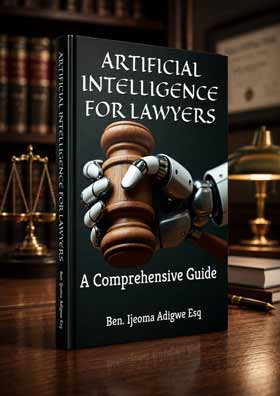 The book also examines Nigeria's legal ecosystem, focusing on the LPELR and NBA AI Guidelines. As a bonus, every purchase comes with a FREE eBook titled: How to Use the AI Features in LegalPedia and LawPavilion.
Ohio Books Ltd praises the publication, stating:
"....this is the only Nigerian book I know of on the topic."
How to Order:
📞 Call, Text, or WhatsApp: 08034917063 | 07055285878
📧 Email: benadigwe1@gmail.com
🌎 Website: www.benadigwe.com
Ebook Version: Access it directly online at https://selar.com/prv626
Authored by Ben Ijeoma Adigwe Esq., ACIarb (UK), LL.M, Dip. in Artificial Intelligence, Director at the Delta State Ministry of Justice, Asaba, Nigeria.
______________________________________________________________________
[A MUST HAVE] Evidence Act Demystified With Recent And Contemporary Cases And Materials
The book also examines Nigeria's legal ecosystem, focusing on the LPELR and NBA AI Guidelines. As a bonus, every purchase comes with a FREE eBook titled: How to Use the AI Features in LegalPedia and LawPavilion.
Ohio Books Ltd praises the publication, stating:
"....this is the only Nigerian book I know of on the topic."
How to Order:
📞 Call, Text, or WhatsApp: 08034917063 | 07055285878
📧 Email: benadigwe1@gmail.com
🌎 Website: www.benadigwe.com
Ebook Version: Access it directly online at https://selar.com/prv626
Authored by Ben Ijeoma Adigwe Esq., ACIarb (UK), LL.M, Dip. in Artificial Intelligence, Director at the Delta State Ministry of Justice, Asaba, Nigeria.
______________________________________________________________________
[A MUST HAVE] Evidence Act Demystified With Recent And Contemporary Cases And Materials

 Interested buyers are encouraged to place their orders and enquiries via:
0704 444 4777, 0704 444 4999, 0818 199 9888
Website: www.alexandernigeria.com
Interested buyers are encouraged to place their orders and enquiries via:
0704 444 4777, 0704 444 4999, 0818 199 9888
Website: www.alexandernigeria.com