

The Rivers State High Court sitting in Port Harcourt has delivered a judgment clarifying the procedure for appointing replacement members of the Board of Trustees of Host Communities Development Trusts under the Petroleum Industry Act (PIA), 2021, holding that consultation with the Trust’s Advisory Committee is required in such appointments.

Justice S. H. Aprioku delivered the judgment on September 29, 2026, in Suit No. PHC/2237/CS/2025, filed by Dr. Sunny Ogide, for himself and as representative of the Advisory Committee of the Obagi Host Communities Development Trust, against the Registered Trustees of Obagi Oilfields Host Communities Development Trust and Total Energies EP Nigeria Limited.
The court upheld the legal arguments advanced by the claimant’s counsel, Precious U. Dike, Esq., concerning the interpretation of Regulation 12(1)(b) of the Nigerian Upstream Petroleum Host Communities Development Regulations, 2022, made pursuant to the Petroleum Industry Act, 2021.
The dispute centred on whether a settlor, when appointing replacement members of a Host Communities Development Trust’s Board of Trustees, must consult the host communities directly or the Advisory Committee established under the applicable regulatory framework.
In the originating summons filed on behalf of the claimant, Dike argued that although Sections 235(4) and 251(3) of the Petroleum Industry Act, 2021, provide for consultation with host communities in relation to the appointment of trustees, the procedure governing the appointment of replacement trustees is different.
He contended that Regulation 12(1)(b) of the Nigerian Upstream Petroleum Host Communities Development Regulations, 2022, specifically addresses the replacement of trustees and requires the settlor to consult the Advisory Committee of the Host Communities Development Trust.
According to the claimant’s position, the settlor is not required to undertake a fresh consultation with the host communities when appointing replacement members of the Board of Trustees, as the applicable regulation provides a distinct procedure for such appointments.
Dike further argued that the relevant regulations, made pursuant to provisions of the Petroleum Industry Act, including Sections 10(f), 234(2) and 235(6)(a), must guide the appointment and replacement of trustees.
The defendants opposed the claimant’s position, but the court resolved the issue in favour of the claimant.
In its judgment, Justice Aprioku granted declaratory relief concerning the interpretation of Regulation 12(1)(b), holding that the second defendant, as settlor, was empowered to consult solely the Advisory Committee of the Obagi Oilfields Host Communities Development Trust in the replacement and reappointment of members of the first defendant’s Board of Trustees.
The court consequently granted an order of perpetual injunction restraining the second defendant, its agents, privies, representatives and other persons acting on its behalf from consulting any other group or institution apart from the Advisory Committee of the Obagi Oilfields Host Communities Development Trust when constituting replacement trustees for the first defendant.
The court also awarded costs of ₦500,000 against the second defendant in favour of the claimant.
The decision establishes the applicable consultation procedure for replacing members of the Board of Trustees of the Obagi Oilfields Host Communities Development Trust and distinguishes that process from the consultation requirements applicable to the initial appointment of trustees.
The judgment is significant to the interpretation of the Petroleum Industry Act and the regulations governing Host Communities Development Trusts, particularly concerning the respective roles of settlers, host communities and advisory committees in the constitution and administration of their boards.
The ruling also underscores the legal importance of compliance with the specific regulatory provisions governing the replacement and reappointment of trustees, rather than treating the initial appointment procedure and subsequent replacement process as identical.
The claimant’s counsel, Precious U. Dike, a Port Harcourt-based legal practitioner, successfully advanced the interpretation adopted by the court.
The matter was determined through an originating summons procedure, which placed the interpretation of the relevant statutory and regulatory provisions before the court.
According to the judgment order, Dike appeared for the claimant, while Dr. L. H. Ogbonna represented the first defendant. The second defendant was recorded as absent at the delivery of the judgment.
The judgment adds to the judicial interpretation of provisions of the Petroleum Industry Act, 2021, and the Nigerian Upstream Petroleum Host Communities Development Regulations, 2022, concerning the administration of Host Communities Development Trusts.
By granting both declaratory and injunctive reliefs, the court affirmed the role of the Advisory Committee in the replacement process and restrained consultation outside the procedure established by the applicable regulations.
[A MUST HAVE] Evidence Act Demystified With Recent And Contemporary Cases And Materials
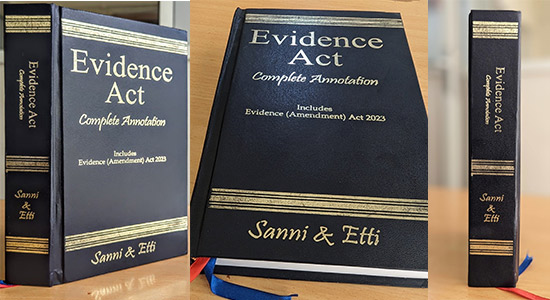
Available now for NGN 40,000 at ASC Publications, 10, Boyle Street, Onikan, Lagos. Beside High Court, TBS. Email publications@ayindesanni.com or WhatsApp +2347056667384. Purchase Link: https://paystack.com/buy/evidence-act-complete-annotation
______________________________________________________________________ “Enhance Legal Practice With Authoritative Reports” — Alexander Payne Offers Comprehensive Law Reports, Spanning Over A Century Of Nigerian Jurisprudence Interested buyers are encouraged to place their orders and enquiries via:
0704 444 4777, 0704 444 4999, 0818 199 9888
Website: www.alexandernigeria.com
“A Comprehensive Guide To Evidence Law” — Releases Second Edition In Three Volumes, Covering 4,051 Cases
For enquiries and orders, contact: 08035526491 Email: jerryamadisilk@gmail.com
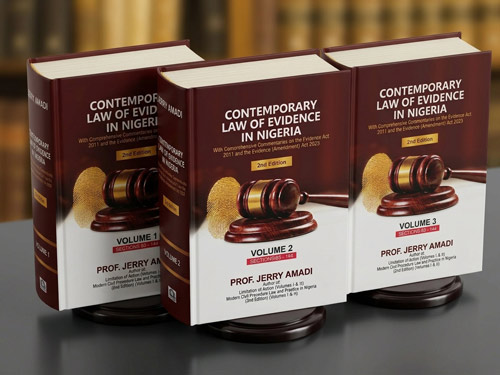 Prof. Jerry Amadi’s Evidence Law, Second Edition (2026), contains 3,314 pages in three volumes, covering the Evidence Act 2011, its 2023 amendment, and 4,051 Nigerian and English cases.