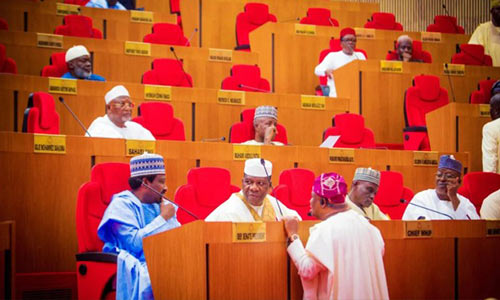
The Senate has announced that it will hold an emergency plenary sitting on Tuesday, February 10, 2026, amid growing public controversy over its recent amendments to the Electoral Act, particularly the rejection of mandatory real-time electronic transmission of election results.


The announcement was made on Sunday in a statement signed by the Clerk of the Senate, Emmanuel Odo.
“The President of the Senate, Godswill Akpabio, has directed the reconvening of plenary for an emergency sitting on Tuesday, February 10th, 2026,” the statement said, adding that the session would commence at 12 noon and that all senators had been requested to attend.
Contrary to its earlier adjournment to February 26, 2026, the Nigerian Senate will now reconvene for the emergency session.
The upper chamber had last Thursday adjourned plenary after passing the Electoral Act (Amendment) Bill, 2026, to allow lawmakers to participate in the ongoing budget defence sessions by Ministries, Departments, and Agencies (MDAs) ahead of the final consideration and passage of the ₦58.47 trillion 2026 Appropriation Bill, scheduled for March 17.
A competent source, who disclosed the development, confirmed that the specific reason for the sitting was not disclosed. However, the development may not be unconnected to the mounting public backlash trailing the Senate’s decision to reject key proposals in the Electoral Act (Amendment) Bill.
The emergency sitting comes barely days after the Senate passed the Electoral Act Amendment Bill on February 4 but voted down Clause 60(3), which sought to make the real-time electronic transmission of election results mandatory.
During clause-by-clause consideration of the amendment bill, the Senate, presided over by Senate President Godswill Akpabio, adopted a motion moved by Senate Chief Whip Tahir Monguno and seconded by Deputy Senate President Barau Jibrin to reject the proposed Section 60(3).
The rejected amendment had proposed that: “The presiding officer shall electronically transmit the results from each polling unit to the IReV portal in real time, and such transmission shall be done after the prescribed Form EC8A has been signed and stamped by the presiding officer and/or countersigned by candidates or polling unit agents, where available.”
Form EC8A is the official document used to record votes at polling units.
The proposal was widely interpreted as an attempt to transform electronic transmission of results from a discretionary action into a mandatory legal obligation.
Instead, the Senate retained Section 60(5) of the existing Electoral Act, 2022, which states: “The presiding officer shall transfer the results, including the total number of accredited voters and the results of the ballot, in a manner as prescribed by the Commission.”
Other rejected provisions reportedly included proposals that would have allowed voters to download or reprint missing or unissued Permanent Voter Cards (PVCs).
At the conclusion of deliberations, Senate President Akpabio announced the constitution of a conference committee to harmonise differences between the Senate and House of Representatives versions of the amendment bill.
The Senate’s conference committee comprises Senators Simon Lalong (Plateau, APC), Adeniyi Adegbonmire (Ondo, APC), Tahir Monguno (Borno, APC), Adamu Aliero (Kebbi, APC), Orji Uzor Kalu (Abia, APC), Abba Moro (Benue, PDP), Asuquo Ekpeyong (Cross River, APC), Aminu Abbas (Adamawa, PDP), and Tokunbo Abiru (Lagos, APC).
The House panel is chaired by Hon. Bayo Balogun (Lagos, APC) and includes Hon. Fred Agbedi (Bayelsa, PDP), Hon. Sada Soli (Katsina, APC), Hon. Ahmadu Jaha (Borno, APC), Hon. Igariwey Iduma Enwo (Ebonyi, APC), Hon. Saidu Musa Abdullahi (Niger, APC), and Hon. Zainab Gimba (Borno, APC).
The joint committee is expected to determine whether the Senate’s position or the House version will prevail in the final harmonised bill.
The Senate’s decision has triggered intense public criticism. Civil society organisations, opposition figures, election observers, and even some lawmakers accused the Senate of weakening electoral transparency ahead of the 2027 general elections.
Among the prominent voices that criticised the Senate’s position are former Minister of Education, Dr. Oby Ezekwesili; the Nigerian Society of Engineers (NSE); PDP chieftain Chief Bode George; the Obidient Movement; the Rule of Law and Accountability Advocacy Centre (RULAAC); Yiaga Africa; and the Human Rights Writers Association of Nigeria (HURIWA).
The groups described the Senate’s action as retaining loopholes capable of undermining public confidence in the electoral process.
In response to the growing backlash, 13 senators across party lines, led by Senator Enyinnaya Abaribe (PDP, Abia South), convened an emergency press briefing at the National Assembly, insisting that the Senate did not reject electronic transmission of results.
Abaribe stated: “We came out to correct the wrong impression. The Senate did not, I repeat, did not reject electronic transmission of results.”
Senate President Godswill Akpabio has defended the chamber’s position, insisting during a public engagement that the Senate did not reject electronic transmission of results and declaring that the legislature would not be intimidated.
Meanwhile, findings indicate that several civil society groups are mobilising for a protest at the National Assembly to demand the restoration of Section 60(3) to mandate real-time electronic transmission of results.
Tuesday’s emergency plenary is expected to revisit the controversial amendment amid sustained public outcry and the prospect of legal challenges by some stakeholders, including human rights lawyer, Femi Falana, SAN.
All eyes are now on Tuesday’s emergency sitting, as observers speculate that the Senate may move to address the controversy surrounding the Electoral Act amendment.
[A MUST HAVE] Evidence Act Demystified With Recent And Contemporary Cases And Materials

Available now for NGN 40,000 at ASC Publications, 10, Boyle Street, Onikan, Lagos. Beside High Court, TBS. Email publications@ayindesanni.com or WhatsApp +2347056667384. Purchase Link: https://paystack.com/buy/evidence-act-complete-annotation
______________________________________________________________________ “Enhance Legal Practice With Authoritative Reports” — Alexander Payne Offers Comprehensive Law Reports, Spanning Over A Century Of Nigerian Jurisprudence Interested buyers are encouraged to place their orders and enquiries via:
0704 444 4777, 0704 444 4999, 0818 199 9888
Website: www.alexandernigeria.com
Interested buyers are encouraged to place their orders and enquiries via:
0704 444 4777, 0704 444 4999, 0818 199 9888
Website: www.alexandernigeria.com