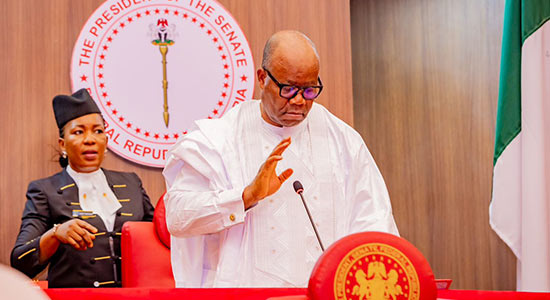
WITH just weeks to the expected Independent National Electoral Commission proclamation of the Notice on 2027 general election in February, the National Assembly may have come under intense pressure over delay in passing the Electoral Act (2022) amendments pending in the Parliament.

The pressure became more pronounced at the weekend as some major stakeholders expressed serious concern over the delay, giving knocks to the National Assembly for not prioritising the electoral act over partisan political interests.
The House of Representatives concluded its own side of the legislative process as it passed the Bill last December before it proceeded on recess.
Aside the joint public hearing held last October by the joint Committee of the National Assembly on Electoral Matters, the Senate is yet to pass the Bill.
One of the highlights of the Electoral Act Amendment Bill 2025 is an amendment which seeks to make the electronic transmission of results mandatory, with penalties for non-compliance.
The proposed Section 60(5) reads, “The Presiding Officer shall transmit the results, including the total number of accredited voters, to the next level of collation both electronically and manually.”
According to the proposed bill, officers who issue unstamped ballot papers or result sheets could face a one-year jail term or a N1 million fine.
The bill also expands the criminalisation of buying and selling of votes; punishable by a fine of N5million and imprisonment term of 2 years, and a 10-year ban on contesting election.
The draft amendment before the National Assembly proposed that the next presidential and governorship elections be held in November 2026, thereby moving the polls six months earlier than the existing practice.
The proposed amendment read: “Elections into the office of the President and Governor of a State shall be held not later than 185 days before the expiration of the term of office of the last holder of the office.”
Stakeholders, who spoke with Nigerian Tribune, maintained that it would be difficult for the National Assembly to conclude the process, a situation that would compel the Independent National Electoral Commission to stick to the existing Electoral Act 2022, in order to meet up with the deadline for the release of notice of election.
By the provisions of Section 28(1) of the Electoral Act 2022, INEC is required to publish a notice of election stating the date of the election, not later than 360 days before the date of the election and for a by-election, not later than 14 days before the day of the election.
Former Vice President Atiku Abubakar and Civil Society Organisations (CSOS) had lamented the delay by the National Assembly in the rapping up of the electoral amendment meant to improve the nation’s future elections.
Atiku had, in a statement particularly that the Senate may be preparing ground for delay of the Electoral law due to some fundamental and critical amendments in the proposed Electoral Act.
He opined that a major setback to the 2023 “elections is the loopholes in the Electoral Act 2022 that paved the way for the brazen rigging of that election, and the near-impossibility of petitioners to advance their cases in the courts.
“It is imperative that if the mistakes of the 2023 election are to be corrected, the legal instrument for the conduct of the 2027 and subsequent future elections needs to be reviewed.
“But as things stand, it has become obvious that the Senate is determined to frustrate the passage of amendments to the 2022 Electoral Act,” he said.
Pioneer chairman of the All Progressives Grand Alliance, Chief Chekwas Okorie, accused the Senate of deliberately frustrating the process of the passage of the Electoral Act Amendment Bill 2025. He argued that the time is short for the lawmakers to tidy the legislative process ahead of the mandatory presidential assent.
He said: “It is unfortunate that Senate is delaying it. The President of the Senate, Godswill Akpabio assured us that before they go on recess, they would have passed it and Nigerians were hopeful that they will enter a new year with a new Electoral Act.
“I think they know the reason why they are delaying it but they must consider the stability of the country.
“The existing Act of 2022 has loopholes for manipulations. That’s why they will talk about glitches, declare results in the middle of the night and tell opposition parties to go to court.
“Nigerians should hold National Assembly responsible if the 2027 Election is rigged. On the part of INEC, it submitted a very elaborate proposals and the amendment has even passed public hearing. The House of Representatives has done a good job by passing the Bill. I don’t see any difficulty with the Senate adopting the position of the House of Representatives through concurrence. INEC will have no option but to adopt it once the President assents. But the Senate knows why it is stalling it.”
A former National Commissioner of INEC, Barrister Festus Okoye, told Nigerian Tribune that both chambers of the National Assembly have genuinely expended time and resources to push through the amendment and faulted insinuation of a deliberate ploy by either of the chambers to stall the process.
He said:” The early and prompt enactment of the Electoral Act, 2022 (as amended), or the Electoral Act, 2026 (as repealed and re-enacted), will align with best practices, regional, and international standards. The National Assembly should therefore ensure that the Electoral Act is passed swiftly to positively influence the electoral process and the 2027 general election.
“It is commendable that the leadership of the National Assembly established a Joint Technical Committee comprising the Senate and the House of Representatives to suggest amendments to the Electoral Act and prepare a Bill for that purpose.
“The Joint Technical Committee of the National Assembly dedicated significant effort to amending the Act. The Committee held technical sessions, retreats, and public consultations on issues essential to ensuring fair and credible elections, and proposed substantial amendments to reinforce the foundations of the electoral process and enhance public confidence in our democracy. Passing the Act would be a fitting culmination of the dedication and sleepless nights invested in the process. “
The former INEC national commissioner and chairman, information and voter education committee, noted that “the early and timely passage of the new Electoral Act will allow the Independent National Electoral Commission to publish the timetable and schedule of activities for the 2027 General Election. Conversely, a delayed passage will disrupt timelines, cause uncertainty, and heighten anxiety within the electoral process.
“Some of the timelines in the Act are mandatory, and compliance is non-negotiable. For instance, section 28(1) of the current Electoral Act, 2022 states that the Commission shall, no later than 360 days before the day appointed for holding an election under the Act, publish a notice in each state of the Federation and the Federal Capital Territory indicating the date of the election and specifying the location where nomination papers are to be delivered.
Barrister Okoye raised alarm of a looming constitutional crisis in the event that timelines for the 2027 general elections are disrupted, owing to tardiness in the passage of the Electoral Act. He also declared that it would create unnecessary anxiety in the political parties and instigate tension in the political space.
“The risk of the late passage and signing of the Electoral Act is that it fundamentally affects the mandatory timelines in section 28(1) of the Electoral Act 2022 and sections 132, 133, 134, and 135 of the Constitution of the Federal Republic of Nigeria, 1999 (as amended).
“An early and timely passage of the Act will also enable the electoral management body to prepare for party primaries, register new political parties, and deregister non-performing parties. Under section 29 of the current Electoral Act, every political party must, no later than 180 days before the date set for a general election under the Act, submit to the Commission the list of candidates it proposes to sponsor at the election, who must have emerged from valid primaries. The Commission must prepare for this task. Political parties must also prepare and conduct their primaries and resolve their internal disputes at least a month before the period for submitting the list of validly nominated candidates expires. The late passage of the Act will create an atmosphere of uncertainty, anxiety, and fear in the political space.”
Speaking on the same issue, the Movement for Credible Elections (MCE) believes the current situation surrounding the Electoral Act amendment is a deliberate attempt to frustrate the urge by Nigerians for a credible election in 2027.
Head of the secretariat of MCE, Comrade Olawale Okunniyi, said the delay is designed to return the status quo that denies Nigerians credible framework for elections and by extension, genuine democracy.
He said: “The problem is that Nigerian politicians are not interested in having credible frameworks for our elections and by extension genuine democracy, but to sustain the present cash and carry, and highest bidder politics. They bother less about electoral reforms. For them, electoral reform is like committing political suicide. Therefore what they plan to do is to retain the existing corrupt electoral framework which allowed them to rig previous elections, but we of the new Movement for Credible Elections (MCE), having recently put a strong petition for electoral reforms before the National Assembly, are now vigilantly watching, while getting set to commence massive mobilization of Nigerians against any form of negligence or laxity that may compromise the integrity of the 2027 elections.”
The Labour Party, through its national publicity secretary, Obiora Iloh, has also spoken vehemently on the issue, stressing that the matter ought to have been meticulously discussed and resolved before now, given its centrality in the electoral process.
“The review ought to have commenced long before now because it needs meticulous discussion to avoid a hasty passage. The last Electoral Act was just in 2022 and we do not have to be constantly amending the law.
“From past experience, no government will want a hasty amendment particularly when a law as it is presently written will favour the incumbent. INEC has also said the 2022 version has very minimal default and that they can rely on it to conduct the next election.
“For us, Nigerians would not be bothered about the composition of the electoral law if not the ugly incidence of deliberate manipulation by the officers of the umpire. No law can be perfect not even the expected one. Rather, Nigerians should be much bothered about the punishment system,” the party stated.
Similarly, leader of the Arewa Youth Coalition, Comrade Yerima Shettima noted that prevarication of the national Assembly on the Electoral Act raises “significant concerns,” and that the implications are capable of reenacting an ugly past on the same matter.
“As we approach the February deadline for INEC’s announcement, the absence of a revised Electoral Act raises critical questions about the readiness of the electoral framework to handle the complexities of the upcoming elections.
“The political atmosphere is already charged, and the implications of a stagnant legislative process could reverberate throughout the nation.
“Firstly, the lack of timely legislative action could lead to a continuation of outdated electoral practices that have been criticised for their inefficiency and susceptibility to manipulation. Without necessary reforms, the electoral process may remain vulnerable to the same pitfalls that marred previous elections, including allegations of rigging and disenfranchisement.
“Citizens, already skeptical of the integrity of their electoral system, may perceive the inaction as a lack of commitment to genuine reform. This sentiment can foster apathy among voters, leading to lower turnout rates and diminished civic engagement. A disengaged electorate is detrimental to democracy, as it undermines the principle of representation and accountability.
“Additionally, the impending elections may witness heightened tensions among political actors, particularly if there is a perception that the electoral framework is skewed in favor of certain parties or candidates. This scenario could lead to increased political violence, as factions vie for control in an environment perceived as unjust.
On his part, the Director of the Commonwealth Institute of Advanced and Professionals, Professor Anthony Kila lamented the tendency by the authorities to resort to the last-minute to tackling issue that ought to be handled with utmost priority and in earnest.
“It is unfortunate that we have to wait for the last minute to do things. It seems to me that our politicians are more interested in partisan affairs than in institution-building. Given the importance of election in the whole democratic process, one would think they would take it seriously and act promptly.
“But they seem more interested in their own internal partisan politics than in focusing on the electoral process. And indeed, we must be realistic about the electoral process, they are less interested in fairness and freedom of the process and how they can win. So, this idea that interested players would be the ones to set the rules, unfortunately, I think it is going to fail us because the way they are going to be looking at it is how they can win, not how to ensure a fair play,” he stated.
In a similar vein, a legal practitioner and Afenifere chieftain, Chief Supo Shonibare, accused the legislative arm of always laying ambush for the citizens on electoral matters, stressing that the current delay on the electoral act passage did not come to him as a surprise.
According to Shonibare, “As we witness the shenanigans of those operating our system of rulership, we see actions and inactions clearly intended to fashion all functions of governance- executive, legislative, and judicial functions to satisfy those in the presidency, without any apologies to anyone.
“It is therefore not surprising to find that the National Assembly will not be in any hurry to take the lead in exercising legislative functions by meddling with the Electoral Act in any manner that may displease the presidency. The gloves are off towards any semblance of our operating a democratic system.”
 ARTIFICIAL INTELLIGENCE FOR LAWYERS: A COMPREHENSIVE GUIDE
Reimagine your practice with the power of AI “...this is the only Nigerian book I know of on the topic.” — Ohio Books Ltd
Authored by Ben Ijeoma Adigwe, Esq., ACIArb (UK), LL.M, Dip. in Artificial Intelligence, Director, Delta State Ministry of Justice, Asaba, Nigeria.
Bonus:
Get a FREE eBook titled “How to Use the AI in Legalpedia and Law Pavilion” with every purchase.
ARTIFICIAL INTELLIGENCE FOR LAWYERS: A COMPREHENSIVE GUIDE
Reimagine your practice with the power of AI “...this is the only Nigerian book I know of on the topic.” — Ohio Books Ltd
Authored by Ben Ijeoma Adigwe, Esq., ACIArb (UK), LL.M, Dip. in Artificial Intelligence, Director, Delta State Ministry of Justice, Asaba, Nigeria.
Bonus:
Get a FREE eBook titled “How to Use the AI in Legalpedia and Law Pavilion” with every purchase.
How to Order: 📞 Call, Text, or WhatsApp: 08034917063 | 07055285878 📧 Email: benadigwe1@gmail.com 🌐 Website: www.benadigwe.com
Ebook Version: Access directly online at: https://selar.com/prv626
______________________________________________________________________ New Year Promo: Get Five Maritime Law Books For N150,000 — 63% Discount The promotion, which commenced on January 8 and runs until February 8, 2026, offers five core maritime law books authored by Dr. Emeka Akabogu, SAN, ordinarily valued at N405,000, for just N150,000 — a 63% discount.
Interested buyers can place their orders through the following channels:
Phone: 0704 329 3271
Online Store: https://paystack.shop/aa-bookstore
Website: www.akabogulaw.com
______________________________________________________________________
[A MUST HAVE] Evidence Act Demystified With Recent And Contemporary Cases And Materials
The promotion, which commenced on January 8 and runs until February 8, 2026, offers five core maritime law books authored by Dr. Emeka Akabogu, SAN, ordinarily valued at N405,000, for just N150,000 — a 63% discount.
Interested buyers can place their orders through the following channels:
Phone: 0704 329 3271
Online Store: https://paystack.shop/aa-bookstore
Website: www.akabogulaw.com
______________________________________________________________________
[A MUST HAVE] Evidence Act Demystified With Recent And Contemporary Cases And Materials

 _______________________________________________________________________