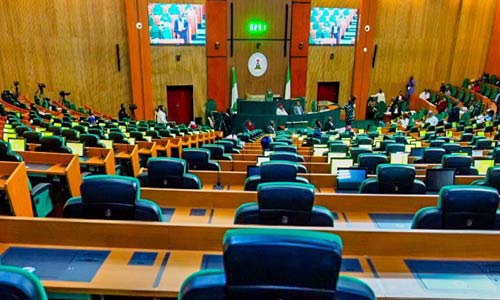
The House of Representatives has passed for third reading a bill seeking to establish a State Security Service Research and Development Bureau to conduct and coordinate research for the State Security Services.

The proposed legislation is designed to strengthen the SSS’s scientific, technological and intelligence capabilities by creating a specialised institution responsible for research, training, innovation and the development of equipment needed to respond to contemporary security threats.
The Chairman of the House Committee on National Security and Intelligence, Ahmed Satome, presented a summary of the committee’s report before lawmakers considered the bill clause by clause during Thursday’s plenary.
Satome said the legislative framework was intended to close existing research and development gaps within Nigeria’s intelligence system in view of changes in global security operations and emerging threats.
He described the SSS as an institution that has played an important role in maintaining national security and said the proposed bureau would expose the service to modern knowledge and practices capable of strengthening its intelligence and operational capabilities.
“The SSS is one agency that has kept this country moving,” Satome said, adding that a dedicated research institution was required to strengthen the service’s operations and align its methods with contemporary global practices.
According to the explanatory memorandum, the bureau will develop and implement a practical intelligence policy for basic and applied research on intelligence-related equipment, materials and operational requirements.
It will also initiate, coordinate and supervise scientific, technological and environmental research activities within the State Security Service.
The bureau is expected to provide strategic direction toward achieving greater self-reliance in meeting Nigeria’s intelligence and security needs rather than depending excessively on foreign equipment, expertise and technology.
It will assess and evaluate the service’s requirements for intelligence-related items and equipment and collaborate with public and private research institutions to develop appropriate solutions.
Clause 2 of the bill empowers the bureau to conduct and coordinate research and development activities across the SSS and harmonise the different research initiatives undertaken by its departments and institutions.
It will translate the results of scientific and technical research into intelligence equipment, operational tools and other products that could be used by public and private institutions where appropriate.
The bureau will also provide scientific and technical information to the SSS and allied institutions, initiate research into new technologies and environmental issues affecting intelligence operations and disseminate findings capable of advancing national security.
Its responsibilities will include organising and coordinating training and research in the natural and technological sciences as they relate to intelligence operations.
The proposed institution will also collaborate with universities on scientific and technological research relevant to intelligence gathering, analysis, surveillance, counterterrorism and other security responsibilities.
Under Clause 3, the bureau may enter into agreements, memoranda of understanding, partnerships and other cooperative arrangements with institutions, agencies and corporations, subject to the approval of its governing council.
It will be permitted to work with national and international institutions to promote and transfer science and technology relating to intelligence operations.
However, foreign institutional cooperation, international liaison, external intelligence engagements and transnational research partnerships undertaken by the bureau must be coordinated in consultation with the National Intelligence Agency.
The requirement is intended to ensure that the SSS’s international research activities remain consistent with Nigeria’s broader foreign-intelligence responsibilities and national security interests.
The bureau will also promote a culture of scientific research within the DSS and undertake activities necessary for advancing research and development in security science and technology.
Its mandate will extend to research in the social sciences and environmental challenges capable of affecting the operations and responsibilities of the service.
Clause 4 proposes the establishment of specialised research centres focusing on cyber intelligence and emerging technology; economic intelligence and critical-infrastructure protection; zonal crime compartmentalisation; geospatial, environmental and human security; and contemporary threats.
The governing council will also be empowered to approve additional research centres where new security risks or technological developments make them necessary.
The training institutions to be placed within the proposed framework include the State Services Academy in Lagos; the Staff Development Centre in Kaduna; the Senior Staff Development Centre in Bauchi; and the Counter Terrorism Centre in Bauchi.
Others are the Research and Development Centre in Bauchi, the Digital and Engineering Academy in Calabar and the State Services Incubation Centre in Enugu.
Through these institutions, the bureau is expected to coordinate intelligence training, research, technological development and the practical application of research findings across the SSS.
The proposed focus on cyber intelligence and emerging technologies reflects the increasing use of digital platforms, sophisticated surveillance systems and technology-driven methods by criminal and terrorist organisations.
Its economic-intelligence and critical-infrastructure unit would concentrate on threats to financial systems, government facilities, energy installations, telecommunications networks and other assets considered essential to national security.
The geospatial, environmental and human-security centre would support research into the relationship between geography, environmental changes, population movements and security threats.
The contemporary-threats centre would examine evolving risks and develop appropriate intelligence strategies, while the zonal crime research component would study security challenges peculiar to different parts of the country.
Although the bill has passed third reading in the House of Representatives, it will not become law solely on the strength of the House’s approval.
It must complete the remaining legislative process, including consideration or concurrence by the Senate, before being transmitted to the President for assent.
[A MUST HAVE] Evidence Act Demystified With Recent And Contemporary Cases And Materials

Available now for NGN 40,000 at ASC Publications, 10, Boyle Street, Onikan, Lagos. Beside High Court, TBS. Email publications@ayindesanni.com or WhatsApp +2347056667384. Purchase Link: https://paystack.com/buy/evidence-act-complete-annotation
______________________________________________________________________ “Enhance Legal Practice With Authoritative Reports” — Alexander Payne Offers Comprehensive Law Reports, Spanning Over A Century Of Nigerian Jurisprudence Interested buyers are encouraged to place their orders and enquiries via:
0704 444 4777, 0704 444 4999, 0818 199 9888
Website: www.alexandernigeria.com
Interested buyers are encouraged to place their orders and enquiries via:
0704 444 4777, 0704 444 4999, 0818 199 9888
Website: www.alexandernigeria.com