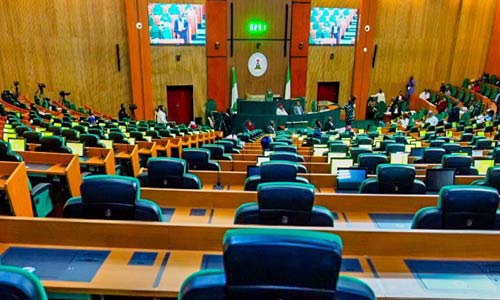
The House of Representatives has passed for third reading a bill seeking to expand the operational powers of the Economic and Financial Crimes Commission to cover emerging financial crimes, including terrorism financing, capital-market fraud and cybercrime.

The proposed legislation seeks to amend the Economic and Financial Crimes Commission (Establishment) Act, 2004, to strengthen the commission’s legal, institutional and enforcement framework in response to changing methods of committing economic and financial crimes.
The bill, sponsored by the member representing Pankshin/Kanke/Kanam Federal Constituency of Plateau State, Yusuf Adamu Gagdi, also proposes tougher penalties for illegal foreign-exchange operators and persons involved in the unauthorised hawking of Nigeria’s legal tender.
Under the proposed amendment, erring Bureau de Change operators and currency hawkers could face penalties including a fine of ₦4 million and imprisonment for two years.
The bill also proposes a five-year jail term for bank officials who disclose confidential information or alert persons being investigated by the EFCC, thereby frustrating investigations or enabling suspects to conceal or transfer suspected proceeds of crime.
The legislation seeks to expressly bring crimes involving digital technologies, cryptocurrencies, illicit financial flows, capital-market manipulation and terrorism financing within the EFCC’s investigative and prosecutorial responsibilities.
It also aims to improve coordination between the commission and other regulatory and law-enforcement agencies responsible for combating money laundering, cybercrime, terrorism financing and financial-market offences.
Gagdi had explained while leading debate on the bill that the existing EFCC Act was enacted more than two decades ago and did not adequately address several forms of financial crime that have emerged with technological and economic developments.
According to him, cybercrime, cryptocurrency manipulation, illicit financial flows, terrorism financing and real estate-based money laundering have become increasingly prevalent, making it necessary to modernise the commission’s enabling law.
The bill also contains provisions intended to strengthen the institutional independence, accountability and operational efficiency of the EFCC.
One of the proposed changes seeks to limit the President’s power to unilaterally remove the EFCC chairman by requiring the approval of a two-thirds majority of both the Senate and the House of Representatives.
The proposed safeguard is intended to protect the leadership of the anti-graft agency from undue political interference and ensure greater stability in the discharge of its responsibilities.
The legislation further seeks to strengthen procedures for the tracing, freezing, seizure, management and final forfeiture of assets believed to be proceeds of economic and financial crimes.
Supporters of the bill argued that updating the EFCC Act would enable the commission to respond more effectively to sophisticated financial offences that were not fully contemplated when the original law was enacted in 2004.
They also maintained that the proposed sanctions against bank officials who compromise investigations would help prevent suspects from moving funds, destroying evidence or escaping after receiving confidential information from financial institutions.
With its passage by the House of Representatives, the bill will require consideration and approval by the Senate before it can be transmitted to the President for assent.
[A MUST HAVE] Evidence Act Demystified With Recent And Contemporary Cases And Materials

Available now for NGN 40,000 at ASC Publications, 10, Boyle Street, Onikan, Lagos. Beside High Court, TBS. Email publications@ayindesanni.com or WhatsApp +2347056667384. Purchase Link: https://paystack.com/buy/evidence-act-complete-annotation
______________________________________________________________________ “Enhance Legal Practice With Authoritative Reports” — Alexander Payne Offers Comprehensive Law Reports, Spanning Over A Century Of Nigerian Jurisprudence Interested buyers are encouraged to place their orders and enquiries via:
0704 444 4777, 0704 444 4999, 0818 199 9888
Website: www.alexandernigeria.com
Interested buyers are encouraged to place their orders and enquiries via:
0704 444 4777, 0704 444 4999, 0818 199 9888
Website: www.alexandernigeria.com