
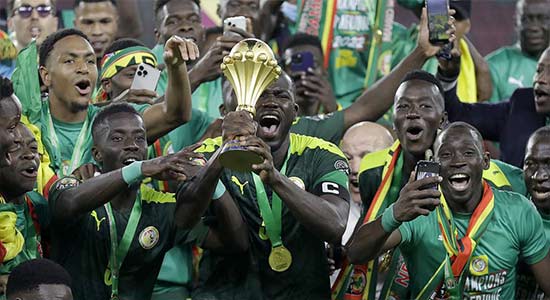
The Court of Arbitration for Sport (CAS) has unanimously upheld an appeal filed by the Senegalese Football Federation (FSF), overturning the Confederation of African Football’s (CAF) decision to strip Senegal of the 2025 Africa Cup of Nations (AFCON) title and award the championship to Morocco.

The three-member arbitral panel held that the referee’s decision to resume the disputed final after Senegalese players temporarily left the pitch was within his exclusive authority and could not be overturned by applying the forfeiture provisions of the AFCON Regulations.
In its decision announced on Tuesday, November 24, 2026, CAS ruled that Articles 82 and 84 of the AFCON Regulations, which CAF relied upon to declare Senegal to have forfeited the match, were inapplicable because the referee did not permanently abandon the game.
The ruling restores Senegal’s 1–0 victory over Morocco in the final played on January 18, 2026, and reverses CAF’s earlier decision awarding Morocco a 3–0 victory.
The dispute arose from the controversial final in Rabat, Morocco, during which Senegalese players temporarily walked off the pitch in protest against a late penalty awarded to the host nation.
Following a review by the video assistant referee (VAR), Congolese referee Jean-Jacques Ndala Ngambo ruled that Senegal’s El Hadji Malick Diouf had fouled Morocco’s Brahim Diaz inside the penalty area in the eighth minute of second-half stoppage time.
The decision sparked confrontations involving players and officials from both teams, prompting Senegal’s then-head coach, Pape Thiaw, to instruct his players to leave the field.
Senegal captain Sadio Mane subsequently urged his teammates to return, and the players eventually resumed the match after an interruption lasting approximately 16 minutes.
The delay was also prolonged by disturbances involving Senegalese supporters, stewards and riot police.
When play resumed, Diaz attempted a Panenka-style penalty, but Senegal goalkeeper Edouard Mendy saved the effort.
The match proceeded into extra time, where Papa Gueye scored the only goal to secure Senegal’s 1–0 victory and the continental championship.
However, the controversy continued after the final when the Royal Moroccan Football Federation (FRMF) challenged the result, arguing that Senegal’s temporary departure from the pitch constituted a breach of the tournament regulations.
CAF initially condemned the conduct of Senegal’s players as “unacceptable” and “inappropriate” and announced that it was examining footage of the incident.
On March 17, 2026, the CAF Appeal Board upheld Morocco’s protest, declaring that Senegal had forfeited the match under Articles 82 and 84 of the AFCON Regulations.
The Appeal Board consequently set aside the result achieved on the pitch and recorded the match as a 3–0 victory in favour of Morocco, effectively stripping Senegal of the title.
The decision was made 57 days after the final and prompted the Senegalese Football Federation to commence arbitration proceedings before CAS.
The FSF challenged CAF’s interpretation of the tournament regulations and maintained that the referee’s decision to restart the match and allow it to proceed to a sporting conclusion could not subsequently be displaced by an administrative declaration of forfeiture.
Senegal argued that the referee had exercised his authority on the field after both teams returned and indicated their willingness to continue playing.
The appeal was heard on October 8, 2026, at the CAS headquarters in Lausanne, Switzerland, during proceedings conducted behind closed doors.
In determining the appeal, the three-member panel unanimously accepted Senegal’s position that the referee possessed the sole authority to determine whether the match should resume or be abandoned.
CAS explained that by blowing his whistle to restart the encounter, the referee had determined that the necessary conditions for continuing the match had been satisfied.
The panel noted that both teams were back on the pitch and had demonstrated their willingness to resume play.
According to CAS, the referee’s decision was therefore a field-of-play decision, protected by the legal principle that generally places sporting decisions made during competition within the authority of match officials.
In its published reasoning, CAS stated that the referee’s authority to resume or terminate the match was exclusive and that his decision to restart play fell within the field-of-play doctrine.
The panel emphasised that the legal consequences of the referee’s decision were confined to the field of play and could not be disregarded merely because a team had temporarily left the pitch during the incident.
The tribunal consequently rejected the application of Articles 82 and 84 to the circumstances of the final.
CAS held that those provisions were intended to determine the result of a match where a team’s conduct caused the referee to abandon the encounter permanently.
Because the Senegal–Morocco final had resumed and been completed, the panel found that the provisions could not lawfully be applied to overturn the 1–0 result.
In its conclusion, CAS declared:
“In conclusion, the panel considers that in resuming the match, the referee did not err in law.”
The tribunal also examined whether the circumstances surrounding the referee’s decision could justify treating his conduct as arbitrary.
It acknowledged that the match official had acted in an atmosphere of considerable tension following the penalty controversy and the temporary departure of the Senegalese players.
However, CAS held that the prevailing circumstances did not establish that the referee had exercised his authority arbitrarily.
The panel found no indication that his decision had been improperly influenced by considerations outside the game.
The tribunal therefore rejected the argument that the tense atmosphere surrounding the incident undermined the validity of the referee’s decision to restart the match.
The effect of the ruling is that CAF’s decision to declare Senegal to have forfeited the final cannot stand, while the result achieved after the match resumed remains valid.
Accordingly, Senegal’s 1–0 victory is restored, and the country regains its status as winner of the 2025 Africa Cup of Nations.
The judgment also resolves the central legal dispute between the football federations over whether a temporary departure from the pitch, followed by a referee-authorised resumption and completion of the match, automatically results in forfeiture under the AFCON Regulations.
CAS distinguished such circumstances from a situation in which a team abandons a match and the referee brings the contest to a permanent end.
The tribunal’s interpretation establishes the basis for its decision that CAF’s forfeiture provisions could not be applied retrospectively to displace the sporting result of a completed match.
Earlier on Tuesday, before the ruling was announced, the Moroccan Football Federation disclosed that it had lodged a complaint with CAS concerning an alleged meeting between FSF President Abdoulaye Fall and a member of the arbitration panel.
Senegalese media subsequently reported that FSF Secretary-General Abdoulaye Sow denied that any such meeting took place.
The allegation and denial were reported separately from the substantive ruling, and no finding establishing that the alleged meeting occurred was disclosed in the account of the decision.
Despite the continuing dispute over the title, Senegal had maintained its claim to the championship following CAF’s March decision.
Ten days after CAF stripped the country of the title, Senegalese players paraded the disputed trophy at the Stade de France in Paris ahead of an international friendly against Peru.
Tuesday’s CAS decision now vindicates Senegal’s challenge to CAF’s forfeiture ruling and confirms the result achieved on the pitch.
The judgment turns on the interpretation of the AFCON Regulations and the legal status of the referee’s decision to resume a match that had been temporarily interrupted.
By upholding Senegal’s appeal unanimously, CAS has restored the country’s Africa Cup of Nations title and overturned CAF’s decision to award the championship to Morocco through a 3–0 forfeiture.
The CAS judges heard evidence at a one-day hearing last month and the court promised a verdict by the end of November with a full written ruling of its judges setting out reasons for their decision.
CAS verdicts can be challenged at Switzerland’s supreme court though only on limited procedural grounds.
The next AFCON tournament starts in June co-hosted by Kenya, Uganda, and Tanzania.
[A MUST HAVE] Evidence Act Demystified With Recent And Contemporary Cases And Materials
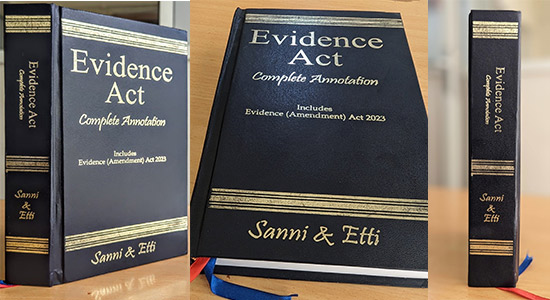
Available now for NGN 40,000 at ASC Publications, 10, Boyle Street, Onikan, Lagos. Beside High Court, TBS. Email publications@ayindesanni.com or WhatsApp +2347056667384. Purchase Link: https://paystack.com/buy/evidence-act-complete-annotation
______________________________________________________________________ “Enhance Legal Practice With Authoritative Reports” — Alexander Payne Offers Comprehensive Law Reports, Spanning Over A Century Of Nigerian Jurisprudence Interested buyers are encouraged to place their orders and enquiries via:
0704 444 4777, 0704 444 4999, 0818 199 9888
Website: www.alexandernigeria.com
“A Comprehensive Guide To Evidence Law” — Releases Second Edition In Three Volumes, Covering 4,051 Cases
For enquiries and orders, contact: 08035526491 Email: jerryamadisilk@gmail.com
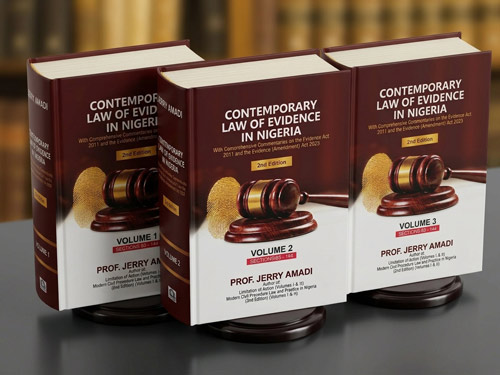 Prof. Jerry Amadi’s Evidence Law, Second Edition (2026), contains 3,314 pages in three volumes, covering the Evidence Act 2011, its 2023 amendment, and 4,051 Nigerian and English cases.