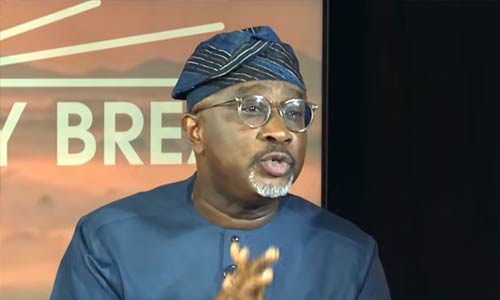
The Chairman of the Senate Ad-hoc Committee on Electoral Amendment and Chairman of the Senate Committee on Judiciary, Human Rights and Legal Matters, Senator Niyi Adegbonmire, SAN, has said that real-time transmission of election results can only happen where there is electronic voting, which Nigeria currently does not have.


Senator Adegbonmire, who represents Ondo Central Senatorial District, made this disclosure on Wednesday during an appearance on Arise Television’s ‘Daybreak’ programme, where he addressed the ongoing controversy surrounding the Electoral Act Amendment Bill.
The senior lawyer explained that there is a total misconception about the INEC Result Viewing (IREV) portal.
“At no time did the Senate say INEC should not use IREV. So what is IREV? IREV was a software developed by INEC to publicize results already declared by INEC at the polling units. It’s not an e-voting platform,” Adegbonmire stated.
“And there’s an error about Nigerians, they keep saying ‘oh, when I vote I want to see my vote.’ It’s not an electronic voting platform. It is a platform done to publicize results already declared by INEC at the polling units.”
Senator Adegbonmire explained why the term “real-time” is problematic in the current Nigerian electoral context.
“Real-time would happen where you do electronic voting. That is the truth. And we are not doing e-voting. INEC does not even have the capability as we speak today. Maybe two, three years. That is all what we desire. And I’m sure INEC will work towards. But today, in 2026, and for the election in 2027, INEC does not have e-voting,” he said.
The senator gave a practical illustration of the challenges with real-time transmission.
“I come from Akure, I vote in Akure. All the electoral materials are brought into Akure two, three days before and kept at the CBN. The night before, they start transporting them to different areas. There are places in Ondo State that you travel eight hours to get to. And after you got in there, then you take a boat to go to some of the riverine areas.
“So you start voting in Akure at 10 a.m. In some other places you start voting at 2 p.m., they probably don’t, some 4 p.m. They probably won’t finish till 10 p.m. So somebody uploads something from my unit at four o’clock because we finish voting and it’s counted. But they are still voting in Ilaje. So whose result is real-time?”
Adegbonmire dismissed claims that the Senate created a dual transmission system.
“There is no dual transmission. And that’s what I’m trying to explain to you. And that’s part of the misconception that the media has brought into play,” he stated.
He explained that the provision requires the presiding officer to first fill results manually into Form EC8A, and it is that form that is then uploaded to IREV.
“Whether we call it upload, transfer, transmission, for as long as we say IREV must be used, IREV will be used in the manner it has been configured. And what is that manner? The manner is simply that you must first manually write out the figures. It is after you have written out the figures and the polling agents have signed that you can upload or transmit or transfer, whatever nomenclature you want to use.”
When asked why the Senate insisted on BVAS as the only mode of authentication but would not make IREV mandatory, Adegbonmire said the comparison was inappropriate.
“Let’s compare apples to apples. How does BVAS work? BVAS is a tablet already configured with every person’s voter’s card. So once you punch it into BVAS, there and then it’s already uploaded on the device. That’s totally different from IREV.
“IREV, there is nothing on IREV from the beginning. It is what you upload on the day of the election. So it’s a totally different thing. Therefore, for you to be able to upload, the device that you are using must have internet access. In BVAS, it’s already configured.”
The senator explained that the amendment was to address concerns raised by the Supreme Court.
“Let me tell you why there is this issue now. It’s because the Supreme Court said you can’t rely only on IREV, particularly when it is not in the Act, but it is in the INEC guideline. That election in 2023, IREV was used. And the National Assembly now said, okay, if that is the issue, let’s put it in the Act to be in line with the Supreme Court judgment.”
Senator Adegbonmire rejected suggestions that legislators were trying to undermine electoral integrity.
“Why would a legislator not want free and fair elections? I, who is here, won an election. I would want my election to be free and fair to enable me coming to the Senate. So why would I want to legislate that we don’t have a fair election? It’s not in my interest. People need to understand that.
“It is in our interest that elections are free and fair. But the opposition can continue to say this or that. Where’s the evidence? Why would I not want a free and fair election? It’s in my interest. It’s the interest of everybody.”
The senator accused the opposition of deliberate misrepresentation.
“That doesn’t mean that you then start to misrepresent facts solely because you have an agenda. And that is the problem with the opposition. The other day somebody said he saw Mr. Peter Obi talking about electronic voting. I said they couldn’t possibly have said that. Both of them want to be president of Nigeria. And they say they don’t know the difference between e-voting and IREV. So these are some of the misconceptions that we need to clear.”
[A MUST HAVE] Evidence Act Demystified With Recent And Contemporary Cases And Materials

Available now for NGN 40,000 at ASC Publications, 10, Boyle Street, Onikan, Lagos. Beside High Court, TBS. Email publications@ayindesanni.com or WhatsApp +2347056667384. Purchase Link: https://paystack.com/buy/evidence-act-complete-annotation
______________________________________________________________________ “Enhance Legal Practice With Authoritative Reports” — Alexander Payne Offers Comprehensive Law Reports, Spanning Over A Century Of Nigerian Jurisprudence Interested buyers are encouraged to place their orders and enquiries via:
0704 444 4777, 0704 444 4999, 0818 199 9888
Website: www.alexandernigeria.com
Interested buyers are encouraged to place their orders and enquiries via:
0704 444 4777, 0704 444 4999, 0818 199 9888
Website: www.alexandernigeria.com