This was the headline in the factually incorrect and legally erroneous reportage by Punch Newspaper in its March 1, 2020 edition over the decision delivered by the National Industrial Court, coram judice B. B. Kanyip, in Suit No: NICN/ABJ/47/2019 instituted by the Incorporated Trustees of Human Development Initiatives (HDI) and 39 Others.

Having perused the said judgment, it is with the greatest respect that I am constrained to submit that, aside from the fact that the headline is overly misleading, the content of the report and the comments contained therein betray a total misapprehension of the judgment and the issues presented before the learned President of the National Industrial Court (NIC).
The crux of the case turned on a narrow compass. The Claimants (HDI and 39 Ors) instituted the action before the National Industrial Court seeking an interpretation that “remuneration” includes “pension” which only the Revenue Mobilisation Allocation and Fiscal Commission (RMAFC) can provide for under Section 124(1) Constitution of the Federal Republic of Nigeria 1999 (as amended). In the Claimants’ estimation, the resultant effect is that the various laws enacted by the States’ Houses of Assembly providing for pensions for ex-Governors and ex-Deputy Governors are unconstitutional, illegal and ought to be nullified.
After a rigorous and painstaking examination of the various constitutional provisions, the learned President of the NIC could not see his way clear that the Claimants got it right. On the question of whether remuneration includes pension, his Lordship pointed out that ‘remuneration’ amounts to payment during pendency of employment, while ‘pension’ is payment during retirement, and adroitly held that ‘renumeration’ under the Constitution is not expansive enough to include pension for ex-Governors and ex-Deputy Governors. With the finery of the tooth-comb, the Court rummaged through the Constitution to hold that what Section 124(1) authorised the RMAFC to determine are salaries and allowances of constitutional office holders, and that ex-Governors and ex-Deputy Governors are not constitutional office holders in respect of whom the RMAFC can stipulate remuneration (which at any rate, does not include pension).
Fundamentally, there is no provision in the Constitution which donates such power to the RMAFC, whereas Section 124(5) of the Constitution expressly provides that States Houses of Assembly may make laws for the grant of pension or gratuity to a person who has held office as Governor or Deputy Governor. Being a power expressly donated by the Constitution, can this be fettered by the Court for extraneous reasons that are extra-constitutional? This, in my view, is the question begging for answers.
While judgments of Court can be critiqued in proper fora (such as law journals and newspaper articles), it would amount to great disservice to pillory a Judge or his judgment on the pages of newspapers, knowing full well that the Judge does not have and would not exercise the “right of reply”. The oath of office the Judge subscribed to was to uphold the Constitution (as it is) and not to embark on a populist crusade to satisfy the yearnings of some members of the public, outside the framework of what is provided for in the Constitution.
Contrary to the headline, it is not the learned President of the National Industrial Court that okayed pensions for ex-Governors. It is Section 124(5) of the Constitution that permitted States’ Houses of Assembly to make such laws. Whilst I personally find such laws and the jumbo pensions accorded ex-Governors and their deputies questionable, if not ‘immoral’, the point that must be vigorously emhasised is that law and morality are not Siamese twins. The Constitution was not made by the Court. The duty the Judge was called upon to discharge, which is the only duty permitted by the Constitution, is to interpret the law as it is [and not what the Claimants perceive it ought to be]. The Learned President of the NIC would have violated his oath of office, if he substituted the duty of interpretation with law-making. His Lordship would have failed if he substituted the ordinary words used in the Constitution for the roars of the public.
The misleading reportage has grave implications for the administration of justice; and I shudder to think that it was deliberate. God forbid that a day would come when Judges, afraid of public reaction, would abandon their duty of interpretation and deploy the swinging moods of the public as thermometer for their decision. The news item and the various persons interviewed therein sought to blame the Judge, who wasn’t shown to have gone outside the Constitution. This is not correct, it is most unfair.
In this regard, it is needful to reiterate the Court’s unsolicited admonition to the Claimants in that case:
“As NGOs, the claimants should have approached the National Assembly to repeal or amend section 124(5) of the Constitution. Or they should have approached the State Houses of Assembly and urge them to repeal the respective laws that grant pensions or gratuities to former Governors and former Deputy Governors. Here, I judicially note the case of Zamfara State which made media rounds. Baffled with their own pension law, they took the best route i.e. by repealing the law that granted their former Governors and former Deputy Governors pension/gratuity”.
It is hoped that the Claimants and other civil society stakeholders will take up the gauntlet as suggested by the Learned President of the NIC rather than chase shadows through specious public interest litigations or misleading newspaper publications as the one under reference.

 ARTIFICIAL INTELLIGENCE FOR LAWYERS: A COMPREHENSIVE GUIDE
Reimagine your practice with the power of AI “...this is the only Nigerian book I know of on the topic.” — Ohio Books Ltd
Authored by Ben Ijeoma Adigwe, Esq., ACIArb (UK), LL.M, Dip. in Artificial Intelligence, Director, Delta State Ministry of Justice, Asaba, Nigeria.
Bonus:
Get a FREE eBook titled “How to Use the AI in Legalpedia and Law Pavilion” with every purchase.
ARTIFICIAL INTELLIGENCE FOR LAWYERS: A COMPREHENSIVE GUIDE
Reimagine your practice with the power of AI “...this is the only Nigerian book I know of on the topic.” — Ohio Books Ltd
Authored by Ben Ijeoma Adigwe, Esq., ACIArb (UK), LL.M, Dip. in Artificial Intelligence, Director, Delta State Ministry of Justice, Asaba, Nigeria.
Bonus:
Get a FREE eBook titled “How to Use the AI in Legalpedia and Law Pavilion” with every purchase.
How to Order: 📞 Call, Text, or WhatsApp: 08034917063 | 07055285878 📧 Email: benadigwe1@gmail.com 🌐 Website: www.benadigwe.com
Ebook Version: Access directly online at: https://selar.com/prv626
________________________________________________________________________ The Law And Practice Of Redundancy In Nigeria: A Practitioner’s Guide, Authored By A Labour & Employment Law Expert Bimbo Atilola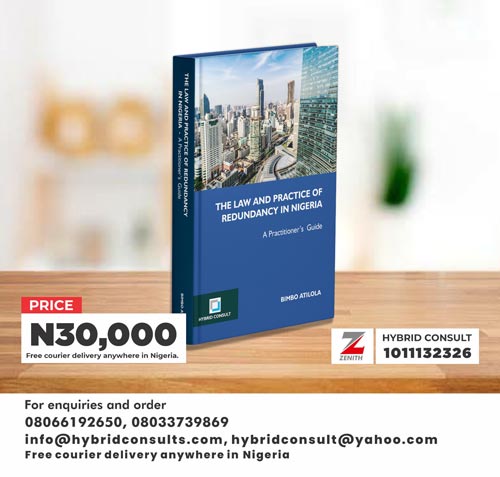 _______________________________________________________________________
"You Don't Need To Be Rich, You Just Need To Start" — Victoria Ezeigwe, Esq Launches Investment Handbook For Nigerians Starting With ₦5,000
_______________________________________________________________________
"You Don't Need To Be Rich, You Just Need To Start" — Victoria Ezeigwe, Esq Launches Investment Handbook For Nigerians Starting With ₦5,000

Get your copy today and take the first step toward financial growth:👉 https://selar.co/4f16676016
_______________________________________________________________________