A retired High Court judge and visiting professor at the National Open University of Nigeria, Hon. Justice (Professor) Alaba Omolaye-Ajileye, PhD, FICMC, has commended His Excellency, Ahmadu Umaru Fintiri, Executive Governor of Adamawa State, for exercising the constitutional power of prerogative of mercy in favour of Mr. Sunday Jackson.

In a public statement, the retired jurist described the Governor’s action as “a luminous example of the true purpose for which the prerogative of mercy is vested in the executive arm of government” and “a singular act of statesmanship, compassion, and constitutional fidelity.”
Governor Fintiri granted the state pardon to Sunday Jackson in commemoration of the Christmas and New Year festivities, as reported by Punch newspaper on December 25, 2025.
Justice Omolaye-Ajileye stated that it has come to his attention “with a sense of professional satisfaction and civic reassurance” that the Governor graciously exercised this constitutional power.
The retired judge recalled that the case, Sunday Jackson v. The State (2025) LPELR-80692, which culminated in this merciful intervention, originated from the Adamawa State High Court, where the appellant (then defendant) was convicted and sentenced to death for culpable homicide.
The judgment was affirmed by the Court of Appeal and upheld by a majority of 4–1 of the Supreme Court bench.
Significantly, Hon. Justice Helen Moronkeji Ogunwumiju, JSC, dissented and accompanied her dissent with an extraordinary and explicit recommendation for clemency for Sunday Jackson.
Justice Omolaye-Ajileye noted: “Surely, such language is neither casual nor customary. Justices of the Supreme Court do not lightly invite executive intervention. When they do so, it is because they apprehend that the rigorous application of legal doctrine has produced an outcome that offends substantive justice.”
He added that Justice Ogunwumiju had stated that the appellant was “a proper candidate for the Governor of Adamawa State to exercise his prerogative of mercy.”
According to the retired judge, Jackson’s case has attracted significant national and international attention since the Supreme Court judgment.
“Human rights organisations, diplomatic actors, and international advocacy groups have expressed concern about the humanitarian dimensions of the case and its potential implications for Nigeria’s human rights profile,” he stated.
Justice Omolaye-Ajileye revealed that Jackson’s case was subjected to extensive scholarly and intellectual scrutiny at a recent session he chaired during the Annual Criminal Law Review organised by the Rule of Law Development Foundation, coordinated by eminent legal practitioner J. B. Daudu, SAN, former President of the Nigerian Bar Association.
At the session, Jackson’s matter emerged as a paradigm case for executive clemency.
“The consensus of participants was clear and unmistakable: the circumstances of the case strongly justified the plea made by Hon. Justice Helen Moronkeji Ogunwumiju, JSC,” he stated.
The retired judge explained that Sunday Jackson’s case did not bear the hallmarks of calculated or cold-blooded murder or criminality.
“Instead, it concerned a poor rural farmer, who lacked legal representation at a critical stage of the proceedings, acted under a sudden and violent confrontation, and found himself enmeshed in circumstances shaped by widespread insecurity and the persistent farmer–herder crisis in his area,” Justice Omolaye-Ajileye stated.
He noted that Jackson’s conviction ultimately turned less on moral blameworthiness than on procedural and evidential contingencies.
The retired judge emphasized that the dissenting judgment of Justice Ogunwumiju demonstrates that the Supreme Court itself was divided on whether Jackson’s actions constituted lawful self-defence.
“And when the highest court of the land is unable to reach unanimity on whether a person’s conduct was criminal or justified, the matter transcends strict legal analysis and properly enters the domain of executive mercy,” he argued.
Justice Omolaye-Ajileye stated that Governor Fintiri’s decision demonstrates “with rare clarity, that the power of mercy is not ornamental, nor merely ceremonial, but a substantive constitutional safeguard designed to temper the rigours of the law with humanity, conscience, and equity.”
He explained that the constitutional prerogative of mercy under Section 212 of the Constitution of the Federal Republic of Nigeria exists for precisely such cases—where the judicial process has reached its conclusion, yet profound questions of justice, humanity, and proportionality remain unresolved.
The retired judge argued that the grant of mercy in this case has not undermined the authority of the Supreme Court.
“On the contrary, it has demonstrated respect for the Court’s processes while acknowledging its internal division and responding to the conscience expressed in a powerful dissent,” he stated.
He added that the judiciary is necessarily constrained by legal rules and procedural frameworks, while the executive arm of government is constitutionally empowered to take a broader view—one that embraces context, public policy, humanitarian considerations, and social justice.
Justice Omolaye-Ajileye dismissed concerns that the pardon might set a dangerous precedent.
“Jackson’s case is not a case that raises concerns about dangerous precedent. It is a singular case, shaped by unique facts, exceptional judicial concern, and compelling humanitarian considerations,” he stated.
The retired judge concluded that the exercise of mercy by Governor Fintiri has not only addressed the immediate injustice perceived in this case but also served the broader national interest.
“Finally, the exercise of mercy by His Excellency has not only addressed the immediate injustice perceived in this case but also served the broader national interest by mitigating international concern, easing social tension, and reaffirming to the whole world, Nigeria’s commitment to balancing justice with compassion,” he stated.
“On behalf of all who remain committed to the ideals of constitutionalism, human rights, and humane governance, I commend His Excellency for this historic decision,” Justice Omolaye-Ajileye concluded.
The retired judge is a former Judge of the High Court of Kogi State and currently serves as a Visiting Professor at the National Open University of Nigeria.
His public commendation highlights the significance of Governor Fintiri’s decision and underscores the important role that executive clemency plays in Nigeria’s justice system, particularly in cases where strict legal application may not fully serve the interests of justice and humanity.
 Interested buyers are encouraged to place their orders and enquiries via:
0704 444 4777, 0704 444 4999, 0818 199 9888
Website: www.alexandernigeria.com
Interested buyers are encouraged to place their orders and enquiries via:
0704 444 4777, 0704 444 4999, 0818 199 9888
Website: www.alexandernigeria.com
 Reimagine your practice with the power of AI “...this is the only Nigerian book I know of on the topic.” — Ohio Books Ltd
Authored by Ben Ijeoma Adigwe, Esq., ACIArb (UK), LL.M, Dip. in Artificial Intelligence, Director, Delta State Ministry of Justice, Asaba, Nigeria.
Bonus:
Get a FREE eBook titled “How to Use the AI in Legalpedia and Law Pavilion” with every purchase.
Reimagine your practice with the power of AI “...this is the only Nigerian book I know of on the topic.” — Ohio Books Ltd
Authored by Ben Ijeoma Adigwe, Esq., ACIArb (UK), LL.M, Dip. in Artificial Intelligence, Director, Delta State Ministry of Justice, Asaba, Nigeria.
Bonus:
Get a FREE eBook titled “How to Use the AI in Legalpedia and Law Pavilion” with every purchase.
How to Order: 📞 Call, Text, or WhatsApp: 08034917063 | 07055285878 📧 Email: benadigwe1@gmail.com 🌐 Website: www.benadigwe.com
Ebook Version: Access directly online at: https://selar.com/prv626
_______________________________________________________________________ [A MUST HAVE] Evidence Act Demystified With Recent And Contemporary Cases And Materials
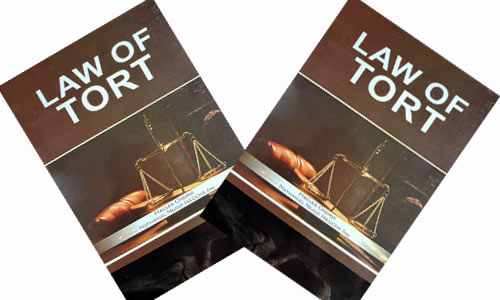 The book, titled The Law of Torts in Nigeria: A Functional Approach, authored by Professor Hagler Sunny Okorie Ph.D and Ikeocha, Nathaniel Ngozi Esq, offers law students, practitioners, and academics a comprehensive guide to understanding and applying tort law in Nigerian courts. Interested buyers can place orders via the following contact numbers: 08028636615, 08037667945, 08032253813, or +234 902 196 2209.