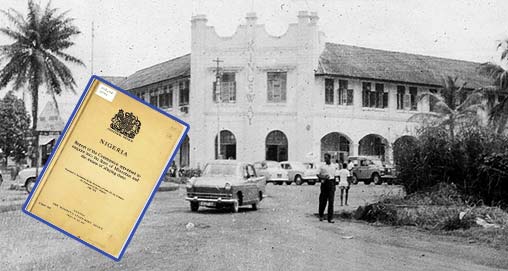
The identity and influence of the Igbo population in Port Harcourt have been a longstanding topic of historical and political discourse. A July 1958 British Colonial Office report shed new light on Port Harcourt’s historical identity, describing it as “an Ibo town” where indigenous Ibos were already outnumbered by Ibos from the hinterland.

Meanwhile, the report, which surfaced amid debates on the identity and integration of Ibos within Rivers State, emphasized the Ibo community’s historical contributions to Port Harcourt’s growth. The document described the Ibo presence as a key factor in the city’s urban and commercial development.
The report, titled “Report of the Commission Appointed to Enquire into the Fears of Minorities and the Means of Allaying Them,” presented to the UK Parliament by the Secretary of State for the Colonies revealed that Port Harcourt consistently voted for the NCNC and showed “continued attachment” to the then Regional Government.
According to the document, Port Harcourt was “built on land that belonged originally to an outlying branch of the Ibo tribe, the Diobus,” but had become “largely inhabited by Ibos from the interior who have come to trade or seek employment.”
According to the 1958 British Commission findings, Igbos in Port Harcourt played a crucial role in trade, education, and the establishment of civic infrastructure in the city. Their entrepreneurial ventures reportedly transformed Port Harcourt into a hub for commerce and industrial activities.
The Commission noted that of the total 747,000 people in the Rivers Province at the time, 305,000 were Ibos, with Port Harcourt forming “the tip of a tongue of Ibo territory which divides Ogoni from Brass and Degema.”
The report opposed the creation of a separate Rivers State, arguing that “the main body of Ibos would be most reluctant to lose” Port Harcourt. The Commission also warned that including Port Harcourt in a Rivers State “would create a problem as acute as that with which we are asked to deal at present and would be sharply resented by the Ibos of the central plateau.”
In its detailed report, the Commission highlighted that creating a Rivers State would have divided the territory into two parts by Port Harcourt and “a broad arm of the sea,” making governance problematic. The proposed state, combining Brass, Degema, and Ogoni Divisions with Western Ijaws, would have had less than half a million people.
The report noted shifting political allegiances, particularly in Ahoada Division, which initially supported the Rivers State idea but later opposed it. According to the document, Ahoada’s change of position was influenced by concerns over potential Ijaw dominance following the inclusion of Western Ijaws in the proposed state.
“To create such a state would cut off the inhabitants from their most probable sources of supply,” the Commission warned, adding that including Ahoada and Port Harcourt would “create a problem as acute as that with which we are asked to deal at present.”
[pdf-embedder url=”https://thenigerialawyer.com/wp-content/uploads/2025/01/Port-Harcourt-Was-Ibo-Town.pdf” title=”Port Harcourt Was Ibo Town”]
- Geographical and Socio-Economic Challenges:
The Commission acknowledged the unique challenges of coastal regions, such as poor infrastructure, limited education, and high costs of development, which were often overlooked by governments based inland. However, it noted that the creation of a separate state for coastal minorities, such as the Ijaws and Ogonis, would introduce significant logistical and economic hurdles. - Rivers State Proposal:
The report highlighted divisions among local communities regarding the proposed Rivers State. While some groups like the Brass and Degema Divisions supported the idea, others, such as Ahoada and Port Harcourt, strongly opposed it. Notably:- Ahoada residents shifted opposition to the Rivers State proposal due to concerns over Ijaw dominance.
- Port Harcourt, predominantly Ibo, demonstrated allegiance to the NCNC government and resisted separation from the Eastern Region.
- Ethnic Tensions:
- Ijaws’ Perspective: They sought recognition for their distinct identity and development needs, desiring a united Ijaw-dominated area.
- Ogoni and Other Groups: Support for regional autonomy was rooted more in dissatisfaction with the status quo than in concrete proposals for governance.
- Challenges of New States:
The report argued against forming new states like the Rivers State due to economic impracticalities and the fragmentation of communities, including divisions created by Port Harcourt’s strategic position.
The report identified widespread fears among non-Ibo communities about political and economic domination by the Ibo-majority NCNC. This fear was fueled by:
- A perception of Ibo political unity and dominance in elections.
- Concerns over autocratic governance and marginalization.
- Suspicion of cultural hegemony, particularly in areas like trade and political appointments.
In Calabar and Ogoja Provinces, the Efiks and Ibibios expressed resentment toward Ibo leadership, rooted in historical tensions. While united in opposition to perceived Ibo domination, tribal divisions and differing priorities hindered cohesive action.
The Eastern Region’s electoral landscape showcased the Ibo-dominated NCNC’s stronghold, particularly in Onitsha and Owerri Provinces. However, minority groups found representation through opposition parties like the Action Group and UNIP, which garnered significant support in the COR (Calabar, Ogoja, and Rivers) area.
While rejecting the creation of a new state in the Eastern Region, the Commission proposed alternative measures to address minorities’ concerns, including improved representation and tailored development initiatives.
[A MUST HAVE] Evidence Act Demystified With Recent And Contemporary Cases And Materials

Available now for NGN 40,000 at ASC Publications, 10, Boyle Street, Onikan, Lagos. Beside High Court, TBS. Email publications@ayindesanni.com or WhatsApp +2347056667384. Purchase Link: https://paystack.com/buy/evidence-act-complete-annotation
______________________________________________________________________ “Enhance Legal Practice With Authoritative Reports” — Alexander Payne Offers Comprehensive Law Reports, Spanning Over A Century Of Nigerian Jurisprudence Interested buyers are encouraged to place their orders and enquiries via:
0704 444 4777, 0704 444 4999, 0818 199 9888
Website: www.alexandernigeria.com
Interested buyers are encouraged to place their orders and enquiries via:
0704 444 4777, 0704 444 4999, 0818 199 9888
Website: www.alexandernigeria.com