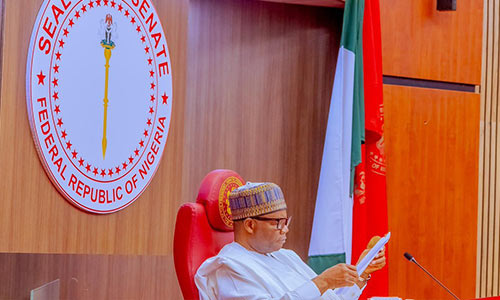
Senate President Godswill Akpabio, on Tuesday, fired back at protesters and critics of the newly passed Electoral Act (Repeal and Re-enactment) Bill, 2026, urging them to obtain and study the legislation before attacking the National Assembly over its decision to discard mandatory real-time transmission of election results.


Speaking shortly after the Senate adopted the votes and proceedings of plenary and passed the contentious bill, Akpabio defended the amendments, insisting they would strengthen Nigeria’s electoral process ahead of the 2027 general elections.
“After today, elections in 2027, if this is assented to and accompanied by the President, will be very smooth, transparent, and will reflect the will of the Nigerian people. I congratulate all of us for the time we have spent on this, including working even on holidays. We have taken our time to do this,” he said.
“Pick up the bill.”
In a pointed message to critics, the Senate President recounted a television interview in which a professor allegedly criticised a separate reform bill without reading it.
“Just to tell a story of what happened on Arise Television morning. There was a professor who was being interviewed on tax reform. And after a lot of bashing on the National Assembly for over 45 minutes, somebody then asked him, ‘Have you read the tax bill?’ He said no, he had not read any portion of the tax bill, but he had come from what he had been told.
“A professor commenting on something he has not read, just because of what he read on social media.”
Akpabio then directly addressed those criticising the Electoral Act amendment.
“So, I hope people will take time, apply to the Senate, apply to the Clerk of the National Assembly, and get a copy of what we have done today. Like what we have done, before they run to social media to criticise and criticise and criticise. And for those of them who are so bold in sitting on television to castigate the National Assembly, please, pick up the bill. Pick up the Act of Parliament and look better at it. Because that is all it is. You don’t need to sit and criticise.”
He further added, “The sessions are open to all. Come and do better. But for us, with the step we have taken today, we have moved elections in Nigeria through a more transparent process more than ever before.”
The major controversy surrounding the bill centred on Clause 60(3), which governs the counting and transmission of results.
The final re-enacted provision reads:
“The Presiding Officer shall electronically transmit the results from each polling unit to the IREV portal, and such transmission shall be done after the prescribed Form EC8A has been signed and stamped by the Presiding Officer and/or countersigned by the candidates or polling agents where available. Provided that if electronic transmission fails due to communication failure, Form EC8A shall remain the primary source of collation and declaration of the result.”
While the Act retains electronic transmission to INEC’s IReV portal, it removes the previously proposed mandatory real-time transmission requirement and explicitly recognises manual collation through Form EC8A as the fallback where network failures occur.
During plenary, Senator Enyinnaya Abaribe called for a division under Order 72 to challenge the proviso. The vote saw 55 senators support the Senate’s position, while 15 voted against reliance on manual procedures.
Chairman of the Senate Committee on Electoral Matters, Simon Lalong, explained that the framework strikes a balance between technology and practicality.
“The goal of this amendment is to strengthen our democratic process, enhance transparency, and restore the confidence of the Nigerian people in our electoral system,” Lalong said.
The bill’s final passage followed a motion for rescission moved by Senate Leader Opeyemi Bamidele, who invoked Orders 1(b) and 53(6) of the Standing Rules to recommit the legislation to the Committee of the Whole.
He argued that the earlier 360-day notice requirement could push the 2027 general elections into the Ramadan fasting period, potentially affecting voter turnout and logistics.
The Senate subsequently corrected discrepancies across more than 20 clauses, including Clauses 1(d), 10, 22, 23, 28, 29, 32, 42, 47, 51, 60, 62, 64, 65, 73, 77, 86, 87, 89, 93 and 143 before repealing and re-enacting the law clause by clause under Order 52(6).
The legislative process was not without drama. The Conference Committee harmonisation meeting reportedly ended in a deadlock, while members of the House of Representatives staged a walkout from a closed-door session, protesting what they described as a retreat from mandatory real-time uploads.
The House had earlier pushed for compulsory real-time transmission to the IReV portal, a position that differed from the Senate’s more flexible framework, accommodating network limitations.
“We have done what ought to be done.”
In his closing remarks, Akpabio called for calm and unity following the heated debates.
“I call on us. I hope that this will bring all the tension down now that we have done what ought to be done. Congratulations to you. I know your constituency will be very proud, and you will be re-elected to come back here and continue your good work.
“Congratulations.”
The Senate thereafter adjourned until February 24.
With the passage of the Electoral Act 2026, Nigeria’s 2027 elections are now set to operate under a framework that permits electronic transmission of results but stops short of mandating real-time uploads, a compromise the Senate insists enhances transparency while safeguarding against infrastructural limitations.

 ARTIFICIAL INTELLIGENCE FOR LAWYERS: A COMPREHENSIVE GUIDE
Reimagine your practice with the power of AI “...this is the only Nigerian book I know of on the topic.” — Ohio Books Ltd
Authored by Ben Ijeoma Adigwe, Esq., ACIArb (UK), LL.M, Dip. in Artificial Intelligence, Director, Delta State Ministry of Justice, Asaba, Nigeria.
Bonus:
Get a FREE eBook titled “How to Use the AI in Legalpedia and Law Pavilion” with every purchase.
ARTIFICIAL INTELLIGENCE FOR LAWYERS: A COMPREHENSIVE GUIDE
Reimagine your practice with the power of AI “...this is the only Nigerian book I know of on the topic.” — Ohio Books Ltd
Authored by Ben Ijeoma Adigwe, Esq., ACIArb (UK), LL.M, Dip. in Artificial Intelligence, Director, Delta State Ministry of Justice, Asaba, Nigeria.
Bonus:
Get a FREE eBook titled “How to Use the AI in Legalpedia and Law Pavilion” with every purchase.
How to Order: 📞 Call, Text, or WhatsApp: 08034917063 | 07055285878 📧 Email: benadigwe1@gmail.com 🌐 Website: www.benadigwe.com
Ebook Version: Access directly online at: https://selar.com/prv626
________________________________________________________________________ The Law And Practice Of Redundancy In Nigeria: A Practitioner’s Guide, Authored By A Labour & Employment Law Expert Bimbo Atilola _______________________________________________________________________
New Year Promo: Get Five Maritime Law Books For N150,000 — 63% Discount
_______________________________________________________________________
New Year Promo: Get Five Maritime Law Books For N150,000 — 63% Discount
 The promotion, which commenced on January 8 and runs until February 8, 2026, offers five core maritime law books authored by Dr. Emeka Akabogu, SAN, ordinarily valued at N405,000, for just N150,000 — a 63% discount.
Interested buyers can place their orders through the following channels:
Phone: 0704 329 3271
Online Store: https://paystack.shop/aa-bookstore
Website: www.akabogulaw.com
______________________________________________________________________
The promotion, which commenced on January 8 and runs until February 8, 2026, offers five core maritime law books authored by Dr. Emeka Akabogu, SAN, ordinarily valued at N405,000, for just N150,000 — a 63% discount.
Interested buyers can place their orders through the following channels:
Phone: 0704 329 3271
Online Store: https://paystack.shop/aa-bookstore
Website: www.akabogulaw.com
______________________________________________________________________