A Senior Advocate of Nigeria, Kemi Pinheiro (SAN), has said that under Section 315 of the Constitution, the President can make amendments to existing laws to bring them into conformity with constitutional provisions.

Pinheiro, in a statement made on Tuesday, argued that the transitional provisions of the 1999 Constitution confer modification powers on the President as the “appropriate authority.”
He stated, “I believe one could also argue thus: that pursuant to the provisions of the GrundNorm, particularly S.315 and its skillfully drafted provisos, the President can in fact make amendments to the law dare I say as he sees fit.”
Citing the constitutional provisions, he reproduced Section 315, saying, “315. (1) Subject to the provisions of this Constitution, an existing law shall have effect with such modifications as may be necessary to bring it into conformity with the provisions of this Constitution and shall be deemed to be: 315(1)(a) an Act of the National Assembly to the extent that it is a law with respect to any matter on which the National Assembly is empowered by this Constitution to make laws; and… 315 (2) The appropriate authority may at any time by order make such modifications in the text of any existing law as the appropriate authority considers necessary or expedient to bring that law into conformity with the provisions of this Constitution.
“315. (4) In this section, the following expressions have the meanings assigned to them, respectively: (a) ‘appropriate authority’ means: (i) the President, in relation to the provisions of any law of the Federation…”
However, the senior lawyer clarified that executive orders cannot override Acts of Parliament.
“An executive order cannot override an Act of Parliament (Act of the National Assembly) under the Constitution of the Federal Republic of Nigeria 1999 as Amended,” he said.
He explained further: “First, I understand an Executive Order to be a binding order or directive issued by the President of the FRN or a Governor of a State in Nigeria. The order is usually issued to the executive arm of government, the MDAs, to implement policies and enforce existing laws. Executive orders are not expressly stated in the CFRN, 1999. However, they carry the force of law and are often used for administrative efficiency.”
Pinheiro added, “An Act of the National Assembly is a law passed by both the Senate and House of Representatives, and the same is assented to by the President (GCFR). It is, therefore, imperative to note that the National Assembly is saddled with the responsibility to make law (Section 4 of the CFRN 1999 is apposite). This, therefore, means that an executive order, which is not even a law, cannot outplay an Act of the Parliament.”
He also anchored his position on constitutional supremacy, noting, “The above could find its stand on the supremacy of our constitution, particularly Section 1(3) of the CFRN 1999. Finally, even if an Act of the National Assembly violates the provision of Section 1(3) of the CFRN, it ought to be declared null and void, as in the case of some provisions of the Petroleum Act.”
The comments come amid controversy over President Bola Tinubu’s Executive Order halting revenue deductions by the Nigerian National Petroleum Company Limited and other agencies.
The Petroleum and Natural Gas Senior Staff Association of Nigeria had opposed the presidential fiat, accusing the President of violating the PIA with his revenue retention order.
Defending the directive, the Special Adviser to the President on Information and Strategy, Bayo Onanuga, said critics were misinterpreting the constitutional hierarchy of laws.
“PENGASSAN is focusing on PIA alone. The President’s action is based on the Nigerian Constitution, which PIA violates in allowing the deductions that the President has now stopped. PIA is not superior to our constitution,” Onanuga stated.

 ARTIFICIAL INTELLIGENCE FOR LAWYERS: A COMPREHENSIVE GUIDE
Reimagine your practice with the power of AI “...this is the only Nigerian book I know of on the topic.” — Ohio Books Ltd
Authored by Ben Ijeoma Adigwe, Esq., ACIArb (UK), LL.M, Dip. in Artificial Intelligence, Director, Delta State Ministry of Justice, Asaba, Nigeria.
Bonus:
Get a FREE eBook titled “How to Use the AI in Legalpedia and Law Pavilion” with every purchase.
ARTIFICIAL INTELLIGENCE FOR LAWYERS: A COMPREHENSIVE GUIDE
Reimagine your practice with the power of AI “...this is the only Nigerian book I know of on the topic.” — Ohio Books Ltd
Authored by Ben Ijeoma Adigwe, Esq., ACIArb (UK), LL.M, Dip. in Artificial Intelligence, Director, Delta State Ministry of Justice, Asaba, Nigeria.
Bonus:
Get a FREE eBook titled “How to Use the AI in Legalpedia and Law Pavilion” with every purchase.
How to Order: 📞 Call, Text, or WhatsApp: 08034917063 | 07055285878 📧 Email: benadigwe1@gmail.com 🌐 Website: www.benadigwe.com
Ebook Version: Access directly online at: https://selar.com/prv626
________________________________________________________________________ The Law And Practice Of Redundancy In Nigeria: A Practitioner’s Guide, Authored By A Labour & Employment Law Expert Bimbo Atilola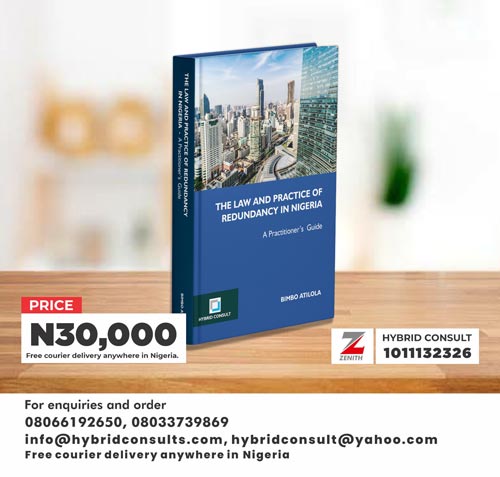 _______________________________________________________________________
"You Don't Need To Be Rich, You Just Need To Start" — Victoria Ezeigwe, Esq Launches Investment Handbook For Nigerians Starting With ₦5,000
_______________________________________________________________________
"You Don't Need To Be Rich, You Just Need To Start" — Victoria Ezeigwe, Esq Launches Investment Handbook For Nigerians Starting With ₦5,000

Get your copy today and take the first step toward financial growth:👉 https://selar.co/4f16676016
_______________________________________________________________________