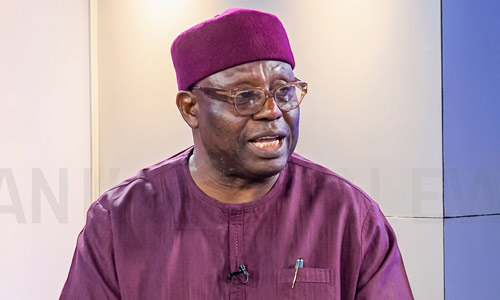
A former National Commissioner of the Independent National Electoral Commission, Mr. Festus Okoye, has said that the promise of ₦10 million by the Minister of the Federal Capital Territory, Nyesom Wike, to those who deliver wards to President Bola Tinubu could constitute bribery and conspiracy under the Electoral Act if the required legal ingredients are established.

Okoye, a lawyer and rights activist, also maintained that making the payment after an electoral victory would not, by itself, alter the legal position. He spoke during an appearance on Channels Television’s Politics Today, where he also warned against the use of the “rig and die” slogan and called for a completely new biometric voters register after the 2027 general elections.
Addressing Wike’s ₦10 million pledge, Okoye said the proper legal approach was to examine Section 125 of the Electoral Act and determine whether the elements of the offence had been established.
According to him, the provision contains four operative elements: knowledge, intention, a corrupt offer and inducement.
“Section 125 subsection 1(a) is very clear,” he said. “Any person who directly or indirectly, by himself or by any other person on his or her behalf, corruptly makes any gift, loan, offer, promise, procurement or agreement to or for any other person, in order to induce such a person to procure or to endeavour to procure the return of a person as a member of a legislative house or to an elective office… has committed an electoral offence.”
Okoye said the offence is described as “bribery and conspiracy”, adding that the penalty, as contained in Section 125(1)(d), is a maximum fine of ₦2 million, imprisonment for 12 months, or both upon conviction.
He, however, drew a distinction between corrupt inducement and legitimate election expenditure.
Okoye cited Section 125(3), which provides that the section does not apply to money paid or agreed to be paid for lawful expenses genuinely incurred in connection with an election.
He explained that if the ₦10 million was genuinely meant for lawful campaign expenses, including assisting party members in their work, logistics for movement or strengthening the party, it would not constitute bribery and conspiracy.
But he added that where the four legal ingredients are established, the conduct would fall within the ambit of bribery and conspiracy.
During the programme, Wike’s explanation was read to Okoye. The minister had said: “I did not tell them take this money and go and buy vote. I said go and work, show commitment, demonstrate that you really mean what you are talking about. When you win, come and we are going to reward you.”
The programme also noted that Wike had reaffirmed the pledge to give ₦10 million per ward.
Asked whether the promise itself amounted to an offence, Okoye said the answer depended on the circumstances.
“It depends,” he said. “You need to look at the context of the statement and also look at the ingredients of the offence.”
According to him, the prosecution would have to establish that the offer was made corruptly, with knowledge and the intention to induce conduct prohibited by the law.
On whether waiting until after victory before making the payment would change the legal position, Okoye said it would not.
“Oh, definitely,” he said when it was suggested that inducement did not necessarily have to be paid before the electoral act was carried out.
He explained that where an inducement is made, those involved deliver the electoral outcome and subsequently return for their reward, the transaction could still fall within Section 125.
Asked specifically whether payment after victory altered the legal position, Okoye said: “It doesn’t change the legal position.”
He maintained that what could make a difference was proof that the money was intended for lawful campaign expenses, party building or logistics.
Okoye also explained who could potentially incur liability under the provision.
He said the person who directly or indirectly makes the promise, gift or offer is captured under subsection 1(a), while the person who receives the inducement and acts on it is covered by subsection 1(b).
He added that anyone who advances or pays money with the intention that it should be spent on bribery at an election, or knowingly reimburses money spent on bribery, could fall under subsection 1(c).
Asked whether a candidate on whose behalf the promise was made could also be held liable, Okoye said the provision, on his reading, captures the person making the promise and the person receiving it and acting on it.
He therefore said that if Wike made the promise on behalf of President Tinubu, “President Tinubu cannot be liable; it is only Minister Wike and the person who receives” if they are found guilty.
Okoye also said it was not necessary for the money to reach an individual voter before an offence could potentially arise.
Asked how he would approach the matter if he were prosecuting it, Okoye said the first step would be to obtain the exact statement made and examine it against the ingredients of the offence.
“The first thing I need to do is to get the actual statement that the person made and to see whether these ingredients of the offence are available within the context of the statement that was made, and then I will determine what to do,” he said.
On who could initiate action, Okoye said the state could act if an offence had been committed.
He said law enforcement agencies that believed an offence might have been committed could investigate, while INEC could petition the relevant authorities, cause an investigation to be conducted and prosecute an offender.
The programme, however, stressed that it was not finding anybody guilty but merely examining what the law provides.
Okoye also strongly criticised the “rig and die” slogan being used by some politicians ahead of the elections.
Asked where a legitimate demand to resist electoral manipulation crossed the line into incitement, he said: “No individual can resort to self-help in this type of situation.”
He cited provisions of the Electoral Act dealing with vote buying and selling, saying anyone who buys, offers to buy, sells or offers to sell votes commits a criminal offence.
“The law is clear. If you buy or sell, you have committed a criminal offence, and no individual is permitted under the circumstances to take the law into his or her own hands. The law enforcement agencies are there. You have to first of all investigate. You have to make an arrest and you have to prosecute,” he said.
Okoye added that individuals must not encourage people to use violence or force against others during elections.
When it was suggested that only those intending to rig elections should be worried by the slogan, Okoye disagreed.
“No, no, no,” he said.
He described election day as a difficult environment in which people could easily be endangered, particularly because armed police and other armed security agencies do not remain within the immediate vicinity of polling units.
He warned that by the time security personnel intervened, damage could already have been done.
Okoye explained that electoral manipulation could take several forms, including vote buying, bypassing the voters register and the Bimodal Voter Accreditation System, unlawfully inserting foreign materials or votes into ballot boxes and, after votes have been counted, substituting the will of individuals for the will expressed by voters.
Rather than resorting to violence, he urged Nigerians to embrace what he described as “mandate protection”.
According to him, polling agents, domestic observers and others permitted to be present where election materials are distributed can inspect the materials, confirm that they are complete at polling units and take photographs and videos.
“What is permitted under the law is for voters, polling agents and domestic observers to be vigilant. The moment you notice that something wrong is happening, you report to the security agencies, and then they will take action,” he said.
He added that a presiding officer could ask the police to remove anyone who becomes a threat or distraction at a polling unit.
On the possibility of a citizen’s arrest, Okoye acknowledged the provision of the Police Act that permits a private person to arrest someone caught committing a criminal act.
He, however, said he would not encourage citizens to attempt arrests on election day because of the tension and large crowds that often gather at polling units.
According to him, such an attempt could cause voting to come to a halt.
He advised anyone who witnesses an alleged offence to report the matter to the presiding officer, security agencies and their political party, while taking note of the identity of the person involved.
Okoye was particularly emphatic in warning against the “rig and die” slogan.
“Rig and die is dangerous,” he said. “You can’t control it.”
He warned that innocent people could become victims once political supporters or thugs were encouraged to attack anyone accused of rigging an election.
“If you use that type of slogan, innocent persons may become victims, because the moment you encourage political thugs to attack whoever you claim is rigging an election, there is a stampede, and innocent people will be involved, polling officials will be involved,” he said.
Okoye also pointed to the peculiar challenges faced by election officials in difficult terrain, including riverine polling areas reachable only by boat, locations accessible only by climbing hills and communities located in forests.
He warned that violence in such areas could severely endanger presiding and assistant presiding officers.
Turning to Nigeria’s voters register, Okoye called for the creation of a new biometric register immediately after the 2027 general elections.
“My position is that immediately after the conduct of the 2027 general election, Nigeria must have a new biometric voters register,” he said.
According to him, efforts to clean up the existing register had continued for a long time without producing a satisfactory result.
Okoye recalled that between June 28, 2021 and July 31, 2022, INEC conducted Continuous Voter Registration and recorded about 12.2 million registrations.
After de-duplication, he said 2,780,756 records, representing 22.6 per cent, were removed as duplicates, leaving 9,518,188 valid registrations.
He also recalled that registration officers were identified as having abused the process, including 10 officers in one batch and 13 in another, while he referred to a total of 54 persons across 10 states.
Okoye faulted the failure to demonstrate consequences for misconduct.
“We did not demonstrate there is consequence for bad behaviour,” he said.
He added that he could not recall whether those officers were referred to security agencies for investigation and prosecution.
He urged INEC to “demonstrate courage” by dealing with such officers administratively and ensuring that those found to have abused their offices were investigated and prosecuted.
Okoye further said the existing register still contained the names of dead people and underage registrants.
He attributed part of the problem to the absence of a strong culture of claims and objections through which Nigerians report deceased persons for removal from the register.
While noting that continuous cleanup is carried out using the Automated Biometric Identification System, he said the existing register remained deficient.
“Our voters register as presently constituted is opaque and cannot be said to be a clean voters register,” he said.
He added that there was little that could be done before the 2027 election.
“The truth of the matter is that there is nothing we can do now. We have to go into the election with this current voters register,” he said.
Okoye also questioned whether the register, said to contain about 103 million voters in a country with a population exceeding 200 million, accurately reflected the true voting population.
He said some communities had engaged in what he called “community registration”, while some individuals had registered multiple times in different places.
He explained that the Automated Biometric Identification System first flags facial and fingerprint matches.
Where both match, he said, the record is isolated as invalid, while cases where the face is flagged but the fingerprint does not match are sent for “manual adjudication”.
“So there are still invalid and multiple registrants in our voters register,” he said.
On how INEC could rebuild public confidence ahead of the election, Okoye advised the Commission to be courageous, transparent and honest about the challenges confronting the electoral process.
He said INEC had allowed politicians and political parties to place excessive responsibility for electoral failures on the electoral body.
“The Commission has allowed politicians and political parties to blackmail it into believing that everything that goes wrong with our electoral system must be dumped at the footstep of the umpire. That is not true,” he said.
“The umpire is not the one that creates a toxic electoral environment before elections. The umpire is not the one that empowers thugs to go and snatch papers and rig, and rig, and rig elections.”
Okoye said the electoral umpire should avoid grandstanding and concentrate on exercising the powers granted to it by the Constitution, the Electoral Act and its own regulations and guidelines.
“What the electoral umpire should do is not to do grandstanding, but to pay attention to its constitutional powers, powers granted to it by the Electoral Act and also its regulations and guidelines, and act in accordance with these powers, and then be upfront with information,” he said.
[A MUST HAVE] Evidence Act Demystified With Recent And Contemporary Cases And Materials

Available now for NGN 40,000 at ASC Publications, 10, Boyle Street, Onikan, Lagos. Beside High Court, TBS. Email publications@ayindesanni.com or WhatsApp +2347056667384. Purchase Link: https://paystack.com/buy/evidence-act-complete-annotation
______________________________________________________________________ “Enhance Legal Practice With Authoritative Reports” — Alexander Payne Offers Comprehensive Law Reports, Spanning Over A Century Of Nigerian Jurisprudence Interested buyers are encouraged to place their orders and enquiries via:
0704 444 4777, 0704 444 4999, 0818 199 9888
Website: www.alexandernigeria.com
“A Comprehensive Guide To Evidence Law” — Releases Second Edition In Three Volumes, Covering 4,051 Cases
For enquiries and orders, contact: 08035526491 Email: jerryamadisilk@gmail.com
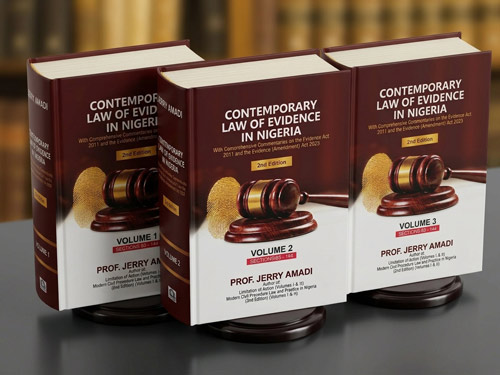 Prof. Jerry Amadi’s Evidence Law, Second Edition (2026), contains 3,314 pages in three volumes, covering the Evidence Act 2011, its 2023 amendment, and 4,051 Nigerian and English cases.