*Says “We Cannot Make Progress In This Country If We Don’t Tell Ourselves The Truth”

In one of the most dramatic and emotionally charged moments at a presidential event in recent memory, a prominent South-East traditional ruler directly confronted President Bola Ahmed Tinubu over the continued detention of Nnamdi Kanu, questioned the Ooni of Ife’s plan to honour Sunday Igboho, rejected the legitimacy of the so-called Southern Traditional Rulers Council, and warned that South-East youths see their leaders as sell-outs.
The monarch at the centre of the storm was Lawrence Agubuzu, the traditional ruler of Ezema Olo Community in Ezeagu Local Government Area of Enugu State. Speaking after several other royal fathers, including the Ooni of Ife, His Imperial Majesty Adeyeye Ogunwusi, had addressed the summit, Agubuzu began by acknowledging the health agenda and the presentation by Professor Mohammed Pate and his team.
“We were already committed to the health of our people. But having come now to Abuja and listened to Professor Mohammed Pate and his team, we are now more committed. So the traditional rulers of Nigeria will now go home and work harder than before.”
However, the monarch quickly signalled that he had more pressing matters on his mind. He told President Tinubu directly that he did not feel happy because the President had not been present during the morning session when several important speeches were delivered.
“I must tell you, Mr President, that personally, I don’t feel very happy because you were not here in the morning. There were several speeches.”
In one of the most striking and provocative segments of his address, Agubuzu accused the Ooni of Ife, Adeyeye Ogunwusi, of hypocrisy. He noted that the Ooni had delivered an opening address at the summit urging all traditional rulers to work as a family, as a team, and to see Nigeria as one. Agubuzu said he initially welcomed the message.
But then, the Enugu monarch exposed what he described as a glaring contradiction: the very same Ooni of Ife who preached national unity was, according to Agubuzu, making plans to confer a very high honour on Sunday Igboho, the Yoruba Nation agitator, whom Agubuzu described as the South-West counterpart of Nnamdi Kanu.
“I listened to the opening address by His Imperial Majesty, Ooni of Ife. He was urging all of us to work as a family, to work as a team, and to see Nigeria as one. This is good. But when you look at it, this same Imperial Majesty is arranging to confer a very high honour on Sunday Igboho — who, in my own part of Nigeria and the South-East, we see as a counterpart of Nnamdi Kanu.”
The statement drew loud reactions from the audience. Agubuzu then expressed deep personal anguish, saying the Ooni did not seem to comprehend the pain in his heart over Nnamdi Kanu’s imprisonment.
“My brother, fellow royal father, the Imperial Majesty does not seem to understand the pain in my heart when Nnamdi Kanu is in Sokoto.”
Agubuzu’s reference to Kanu being “in Sokoto” was a direct allusion to the fact that the IPOB leader, following his conviction and life sentence in November 2025, was moved from Abuja to a prison facility in Sokoto State in northern Nigeria to serve his term — a location far from his South-East homeland, which many Igbo leaders have viewed as an additional form of punishment and isolation.
Turning squarely to President Tinubu, who was physically present in the hall, Agubuzu issued a passionate and unequivocal demand for the release of Nnamdi Kanu from prison. He told the President that the matter rested squarely on his desk and gave him two options: release Kanu, or return him to Kenya or London, where he was originally taken from through what has been described as an extraordinary rendition.
“The ball stops in your court. Bring this man out. If we don’t want him in Nigeria, return him to Kenya or London, where they took him from.”
The demand was met with sustained applause from the audience. By referencing Kenya and London, Agubuzu was raising the longstanding controversy surrounding the manner of Kanu’s arrest — the IPOB leader was reportedly renditioned from Kenya to Nigeria in June 2021 under disputed circumstances, an action that his legal team and supporters have consistently described as unlawful.
Agubuzu reinforced his appeal, repeating his plea for the President to act.
“Please do something about this. We cannot make progress in this country if we don’t tell ourselves the truth. There’s no way.”
In what was perhaps the most emotionally raw portion of his speech, Agubuzu laid bare the credibility crisis confronting South-East leaders — traditional rulers, politicians, and elder statesmen — in the eyes of the region’s increasingly disillusioned and angry youth population.
He stated plainly that young people in the South-East are so agitated over the Kanu issue and other unresolved grievances that they have come to view their own leaders as sell-outs. He said that whenever South-East leaders travel to Abuja, the youths believe they have simply gone to collect money from the government and then keep quiet on the matters that truly affect the people.
“You see, some of us here are being asked to go and work, but the young people in the South-East are so agitated they can even beat us. They see us as sell-outs. We come to Abuja, they may think we’ve come to collect money and then keep quiet. So sad.”
Agubuzu’s candid admission was a rare public acknowledgment by a traditional ruler of the growing and potentially dangerous disconnect between the South-East’s established leadership and its youth population. It underscored the political consequences of leaving the Kanu issue unresolved, as it continues to erode trust and fuel resentment among young people in the region.
Beyond the Kanu issue, Agubuzu raised another significant point that challenged the very structure through which the Federal Government engages with traditional institutions in southern Nigeria.
He took strong exception to references to a “Southern Traditional Rulers Committee on Health” and the suggestion by Professor Pate that the health summit could become an annual event organised through such a body. Agubuzu declared bluntly that there is no legitimate entity known as the Southern Traditional Rulers Council and warned the government against channelling resources through people who claim to represent the South under that banner.
“The truth of the matter is that there’s nothing like Southern Traditional Rulers Council. If you come here, Pate, and you give money to people on that basis, it’s not correct. The South is not the North. We have our system. We need unity in diversity.”
He insisted that if the Federal Government wanted to engage with traditional rulers from the South-East, it should deal directly with the South-East as a distinct entity with its own structures and leadership — not through a blanket “Southern” umbrella body that he argued lacked the mandate to represent the region.
“So if you want to deal with us, deal with us in the South-East. If you have resources for us, give it to us. Don’t give it to people who come and say we are Southern Traditional Rulers Council. Democracy is a representative government. And anybody who goes to present himself without his people is not democratic.”
Despite the political storm his speech generated, Agubuzu concluded by returning to the original purpose of the health summit. He pledged that traditional rulers from the South-East would support the government’s health initiative and do all they could to advance healthcare in their communities.
However, he ended with a final, emotional appeal to the President, asking him to listen to the cries of the South-East people.
“Mr President, we’re going to support this health initiative, do all we can, but please listen to our cries. May God bless all of us.”
Nnamdi Kanu is the leader of the Indigenous People of Biafra (IPOB), a group leading the agitation for an independent state of Biafra, which it seeks to carve out from the South-East and parts of the South-South of Nigeria. IPOB has been outlawed by the Nigerian government and designated a terrorist organisation.
Kanu’s terrorism trial lasted a decade, from 2015, when he was first arrested, to November 2025. On November 20, 2025, Kanu was convicted of terrorism by a Federal High Court in Abuja, which found him guilty on all seven counts filed against him by the Nigerian government.
The trial judge, Justice James Omotosho, sentenced Kanu to life imprisonment and ordered that he be prevented from having access to mobile devices and broadcast equipment except under the watch of security operatives.
Following his conviction, the IPOB leader was moved from Abuja to a prison facility in Sokoto State to serve his prison term — a transfer that has been widely criticised by Igbo leaders and commentators who view the relocation to a facility far from the South-East as an additional form of punishment.
In February 2026, Kanu filed an appeal at the Court of Appeal against his conviction. The appeal is currently pending.
Since Kanu’s conviction and sentencing, prominent Igbo leaders have intensified calls for his release through a political solution rather than continued incarceration.
In November 2025, shortly after the sentencing, Governor Alex Otti of Abia State visited Nnamdi Kanu at the Sokoto prison facility. Before the visit, Governor Otti had publicly announced that he would activate plans to secure Kanu’s release from the prison facility barely 24 hours after the court sentenced the IPOB leader.
Agubuzu’s dramatic public appeal to President Tinubu at the health summit adds yet another voice — and a significant one, coming from the traditional institution — to the growing chorus of Igbo leaders demanding a resolution to the Kanu matter, whether through a presidential pardon, clemency, or some form of political arrangement.
The combination of Kanu’s pending appeal, the continued agitation by IPOB supporters, the frustration of South-East youths, and the increasing willingness of Igbo leaders at all levels — from governors to traditional rulers — to publicly demand his release signals that the issue remains one of the most politically charged and consequential in Nigerian politics today.

 ARTIFICIAL INTELLIGENCE FOR LAWYERS: A COMPREHENSIVE GUIDE
Reimagine your practice with the power of AI “...this is the only Nigerian book I know of on the topic.” — Ohio Books Ltd
Authored by Ben Ijeoma Adigwe, Esq., ACIArb (UK), LL.M, Dip. in Artificial Intelligence, Director, Delta State Ministry of Justice, Asaba, Nigeria.
Bonus:
Get a FREE eBook titled “How to Use the AI in Legalpedia and Law Pavilion” with every purchase.
ARTIFICIAL INTELLIGENCE FOR LAWYERS: A COMPREHENSIVE GUIDE
Reimagine your practice with the power of AI “...this is the only Nigerian book I know of on the topic.” — Ohio Books Ltd
Authored by Ben Ijeoma Adigwe, Esq., ACIArb (UK), LL.M, Dip. in Artificial Intelligence, Director, Delta State Ministry of Justice, Asaba, Nigeria.
Bonus:
Get a FREE eBook titled “How to Use the AI in Legalpedia and Law Pavilion” with every purchase.
How to Order: 📞 Call, Text, or WhatsApp: 08034917063 | 07055285878 📧 Email: benadigwe1@gmail.com 🌐 Website: www.benadigwe.com
Ebook Version: Access directly online at: https://selar.com/prv626
________________________________________________________________________ The Law And Practice Of Redundancy In Nigeria: A Practitioner’s Guide, Authored By A Labour & Employment Law Expert Bimbo Atilola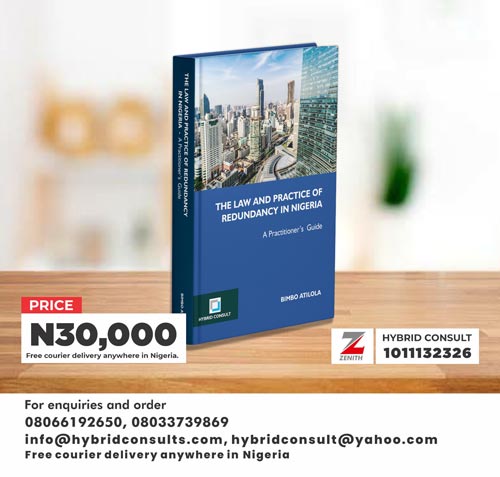 _______________________________________________________________________