By Grace Ehusani, Esq Of Greenfield Chambers


INTRODUCTION
Jurisdiction means either the authority or power of the court to determine a dispute between parties as well as the territory over which the legal authority of a court extends.
Jurisdiction is also the authority of the court over the subject of the legal questions giving rise to the proceedings-nature of subject matter. Jurisdiction could either be original, appellate, concurrent, and exclusive.
The court in the case of ADETAYO & ORS v. ADEMOLA & ORS (2010’) LPELR-155(SC) stated that the jurisdiction of any Court is derived from the statute creating the Court or from any other statute specifically conferring such jurisdiction on the Court. Also in the case of GARBA v. MOHAMMED & ORS (2016) LPELR-40612(SC) the court stated that:
“It is pertinent to note that the Courts are creations of statute. They derive their powers and jurisdiction either under the Constitution, which is the supreme, organic and fundamental law and grundnorm of this country or under specific statutes…The Court’s jurisdiction may also be limited or extended by statute. For a suit to be competent the plaintiff’s claims must fall within the jurisdiction conferred on the Court by the relevant statute”.
It therefore goes without saying that the jurisdiction of a court is dependent on the statute creating it or the statute that has called the court to act with respect to a particular subject matter.
Consequently, the court in the case of ALADEJOBI v. NBA (2013) LPELR-20940(SC) stated thus
“…what then is jurisdiction? It is said to be the authority which a Court has to decide matters that are litigated before it or to take cognizance of matters presented in a formal way for its decision. Such authority of the Court is controlled or circumscribed by the statute creating the Court itself or it may be circumscribed by a condition precedent created by a legislation which must be fulfilled before the Court can entertain the suit. It is the power and authority of a Court to hear and determine a judicial proceedings and power to render particular judgment in a cause of action”.
JURISDICTION OF THE AREA COURT OF THE FEDERAL CAPITAL TERRITORY
The jurisdiction of the Area Court is derived from the Federal Capital Territory Abuja Area Courts (Repeal and Enactment) Act 2010 which repealed the Area Courts Act of 2006.
Section 13 of the Act provides for the civil jurisdiction of the court. It states as follows:
“An Area Court shall have jurisdiction and power to the extent set out in the warrant establishing it, and subject to the provisions of this Act and of the Civil Procedure Code, in all civil causes in which all the parties are subject to the jurisdiction of the Area Court”.
Section 18 and 19 of the 2006 Act conferred Criminal Jurisdiction on the Area Court. However, it is worthy to note that the 2010 Act does not provide in clear terms for the criminal jurisdiction of the court. The 2010 actually expunged the criminal jurisdiction of the Area Court by the provision of S13 of the Act. In essence there is no provision for the court to exercise criminal jurisdiction.
The courts have also held on several occasions since the enactment of the 2010 Act that the Area Court of the Federal Capital Territory lacks criminal Jurisdiction.
In the unreported case of Mr. Fedrich Chukwu v Hon. Ahmed A. Fathi & Anor, SUIT NO: M/4501/2020, Hon Justice Babangida Hassan gave an order of certiorari quashing the criminal summonses ordered against the applicant by the1st respondent (Area Court Dei-Dei) Abuja for lack of criminal jurisdiction.
Also, in the unreported case of Adamu Abdullahi & Anor v COP & 2Ors, SUIT NO: M/2621/2019, Hon Justice Modupe Osho Adebiyi reechoing the decision of her learned brother Hon Justice Suleiman B. Belgore in Barr Anugom Ifeanyi Chukwu v The Grand Khadir Sharia Court of Appeal & 2Ors, SUIT NO: FCT/HC/CV/2107/14 held that the Area Court of the Federal Capital Territory does not have the jurisdiction over criminal matters.
Many have argued that by the provisions of S494(1) of the Administration of Criminal Justice Act which recognizes the Area Court as one of the courts to exercise criminal jurisdiction, the Area Court of the Federal Capital Territory has jurisdiction to try criminal matters. However, it was held by Hon Justice Modupe Osho Adebiyi in Adamu Abdullahi & Anor v COP & 2Ors (supra) that the ACJA is not an enabling Act. It is an administrative Act which deals with practice and procedure in criminal court and cannot be relied on by the Area Court to assume Jurisdiction.
Conclusively, it is safe to say that the Area Court of the Federal Capital Territory lacks jurisdiction over criminal matters. By the provision of the enabling Act of 2010, the Area court cannot and should not assume jurisdiction over criminal matters.
JURISDICTION OF DISTRICT/MAGISTRATE COURT OF THE FEDERAL CAPITAL TERRITORY
The District Court Act CAP. 495 Laws of The Federal Capital Territory of Nigeria 2007 is the Act that established the District Court of the Federal Capital Territory.
It is clearly seen from the enacting statement that the purpose of enacting the act was amongst other things “…for other purpose relating to the administration of civil justice”. This establishes that the main objective of creating the District Court is for the administration of civil justice. As such, Part IV of the Act provides extensively for the civil jurisdiction of the court. It therefore implies that the District Courts of the Federal Capital Territory have no jurisdiction to try criminal matters.
The Magistrate Court on the other hand operates like the “Criminal Courts” of the District Courts. It has criminal jurisdiction over offences like misdemeanors. However, its jurisdiction is limited in terms of the number of years to which it can sentence an offender or the amount of fine it can impose on an offender.
CONCLUSION
By virtue of the Federal Capital Territory Area Court (Repeal and Enactment) Act 2010, the criminal jurisdiction of the Area Court has been removed. It can only exercise jurisdiction over civil matters like the District Courts. However the Magistrate Court has criminal jurisdiction subject to the limitations placed by the enabling Act and the Administration of Criminal Justice Act.
[A MUST HAVE] Evidence Act Demystified With Recent And Contemporary Cases And Materials

Available now for NGN 40,000 at ASC Publications, 10, Boyle Street, Onikan, Lagos. Beside High Court, TBS. Email publications@ayindesanni.com or WhatsApp +2347056667384. Purchase Link: https://paystack.com/buy/evidence-act-complete-annotation
______________________________________________________________________ “Enhance Legal Practice With Authoritative Reports” — Alexander Payne Offers Comprehensive Law Reports, Spanning Over A Century Of Nigerian Jurisprudence Interested buyers are encouraged to place their orders and enquiries via:
0704 444 4777, 0704 444 4999, 0818 199 9888
Website: www.alexandernigeria.com
Interested buyers are encouraged to place their orders and enquiries via:
0704 444 4777, 0704 444 4999, 0818 199 9888
Website: www.alexandernigeria.com
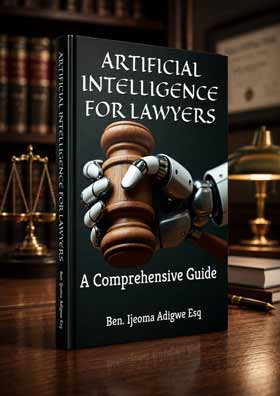 The book also examines Nigeria's legal ecosystem, focusing on the LPELR and NBA AI Guidelines. As a bonus, every purchase comes with a FREE eBook titled: How to Use the AI Features in LegalPedia and LawPavilion.
Ohio Books Ltd praises the publication, stating:
"....this is the only Nigerian book I know of on the topic."
How to Order:
📞 Call, Text, or WhatsApp: 08034917063 | 07055285878
📧 Email: benadigwe1@gmail.com
🌎 Website: www.benadigwe.com
Ebook Version: Access it directly online at https://selar.com/prv626
Authored by Ben Ijeoma Adigwe Esq., ACIarb (UK), LL.M, Dip. in Artificial Intelligence, Director at the Delta State Ministry of Justice, Asaba, Nigeria.
______________________________________________________________________
The book also examines Nigeria's legal ecosystem, focusing on the LPELR and NBA AI Guidelines. As a bonus, every purchase comes with a FREE eBook titled: How to Use the AI Features in LegalPedia and LawPavilion.
Ohio Books Ltd praises the publication, stating:
"....this is the only Nigerian book I know of on the topic."
How to Order:
📞 Call, Text, or WhatsApp: 08034917063 | 07055285878
📧 Email: benadigwe1@gmail.com
🌎 Website: www.benadigwe.com
Ebook Version: Access it directly online at https://selar.com/prv626
Authored by Ben Ijeoma Adigwe Esq., ACIarb (UK), LL.M, Dip. in Artificial Intelligence, Director at the Delta State Ministry of Justice, Asaba, Nigeria.
______________________________________________________________________