*Says “Capturing Awka Was One Of The Toughest Battles We Fought, And It Was Also The One In Which We Made The Costliest Mistakes”

Former Head of State, General Abdulsalami Abubakar (retd.), has given fresh insight into the events that deepened the animosity between the then Military Governor of the Eastern Region, Lt.-Col. Emeka Odumegwu Ojukwu, and the then Head of State, Lt.-Col. Yakubu Gowon, before the outbreak of the Nigerian Civil War, while also revealing the systematic duplicity of Nigeria’s political class including the disclosure that some politicians who publicly championed the cause of Chief MKO Abiola during the June 12 crisis were secretly working with the government, and that others collected money from both Abiola and his opponent, the late Bashir Tofa, during the 1993 presidential election.
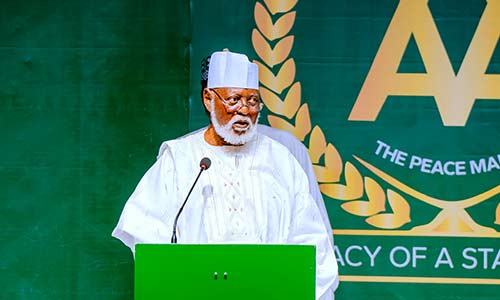
The disclosures are contained in Abubakar’s 264-page autobiography titled Call of Duty, publicly presented at the Aso Rock Villa, Abuja, during activities marking his 84th birthday.
According to the former Head of State, Ojukwu’s refusal to recognise Gowon as Nigeria’s new leader after the killing of Major General Johnson Aguiyi-Ironsi was rooted in his insistence that military hierarchy should be followed in choosing Ironsi’s successor.
Abdulsalami recalled that after the January 1966 coup led by Major Chukwuma Kaduna Nzeogwu, in which several prominent Northern leaders were killed, ethnic tension worsened across the country.
He said there were complaints among Northern officers over what they perceived as jubilation or arrogance following the killing of Northern leaders, while some also alleged that Igbo officers were being promoted above others in the military.
“There were complaints about the reported hubris over the killing of the northern leaders. Some Northern officers also complained that Igbos were being promoted above others in the military,” Abdulsalami wrote.
“Quickly anti-Igbo sentiments exploded in the North, leading to protests against Aguiyi-Ironsi, mainly in Kano, Kaduna and Jos. Riots broke out and Igbos were targeted and killed, with their properties set on fire in places like Kano, Sokoto and Kaduna. It was a disturbing period for young, passionate Nigerians like me.”
Abdulsalami said the crisis took a more dangerous turn when some senior Northern officers overthrew and killed Aguiyi-Ironsi. Following Ironsi’s death, Gowon emerged as Head of State, but Ojukwu refused to recognise his authority.
He said Ojukwu maintained that in the absence or death of Aguiyi-Ironsi, the proper person to take over should have been Brigadier Babafemi Ogundipe, who was then the Chief of Staff, Supreme Headquarters.
“Lt. Colonel Emeka Odumegwu Ojukwu, the Governor of the Eastern Region, refused to recognise the new head of state, insisting that in the absence or death of Aguiyi-Ironsi, the next in command was Brigadier Babafemi Ogundipe, the Chief of Staff, Supreme Headquarters,” he wrote.
“Ojukwu refused to pledge loyalty to Gowon. Tensions were building across the nation. Communal and ethnic clashes continued. Killings did not stop in the North and Igbos were being evacuated and returned to the East. Revenge killings also took place in the East.”
Abdulsalami said the continued killings, evacuation of Igbos from the North and retaliatory attacks in the East pushed the country closer to war.
He recalled that on May 30, 1967, Ojukwu declared the Republic of Biafra, saying he believed Igbos were being victimised and marginalised in Nigeria and that secession had become the only solution.
According to Abdulsalami, several efforts were made to stop the secession, including meetings and agreements, but none succeeded. He specifically mentioned the Aburi Accord, saying it failed to resolve the political crisis.
“All efforts to prevent secession failed. Meetings and agreements, including the famous Aburi Accord, did not serve any useful purpose. A political solution was not looking likely. Economic sanctions also failed,” he wrote.
He said Nigeria eventually went to war in 1967, with Gowon insisting on keeping the country united, and that Gowon’s famous declaration, “To keep Nigeria one is a task that must be done,” became the defining slogan of the Federal side during the war.
Abdulsalami said that, looking back, he believes the Civil War could have been prevented if anger, rising tempers and retaliatory killings had not blocked opportunities for reconciliation.
“To this day, I believe that the Civil War, like most other conflicts in life, could have been prevented. I feel that rising tempers, anger, and the cycle of retaliations didn’t leave room for understanding and reconciliation,” he stated.
He said the crisis became a clash between one side seeking to break away and another insisting on preserving Nigeria’s unity and sovereignty.
The former Head of State noted that many have blamed the war partly on the youthfulness and temperament of the leaders at the time, but said the country must continue to learn from the bitter experience.
“There was one side wanting to break away and the other insisting on maintaining the unity and sovereign integrity of the country. A lot of argument has been made about the fact that our leaders were very young and hot-blooded. Whatever the case, I want to believe we learned valuable lessons from the war,” he said.
Abdulsalami added that he hoped Nigeria would never again experience such a conflict, stressing that the country was fortunate to have survived the war, reconciled and made peace.
“I want to hedge a bet that we would never go to war again. We have a bitter experience to learn from. I would also say we were lucky as a country to survive the war. We were able to reconcile and make peace. Those who felt they were being marginalised eventually returned to the fold,” he stated.
Abdulsalami also recalled one of the costliest military mistakes made by Federal troops during the war after the capture of Awka in present-day Anambra State.
According to him, after Federal troops captured Onitsha in February 1968, the division commander, Colonel Murtala Muhammed, believed victory had effectively been secured. Abdulsalami said Muhammed lined up vehicles and ordered troops and ammunition to move, believing the war was almost over. He described the move as a tactical miscalculation because Biafran forces were still prepared to strike.
“Capturing Awka in present-day Anambra State was one of the toughest battles we fought. It was also the one in which we made the costliest mistakes,” he wrote.
“When we captured Onitsha in February 1968, Colonel Muhammed, our division commander, felt we were done and dusted. He believed victory was already assured. Believing the war was over, he lined up vehicles and asked us to move with all our troops and ammunition. It was a tactical miscalculation. Indeed, it was an error.”
Abdulsalami said Biafran forces attacked with rockets and bombs, causing vehicles and fuel tankers to explode. He described the scene as terrifying, adding that many soldiers died while he narrowly escaped.
“We didn’t know the Biafrans had other plans, attacking us with rocket fire and bombs. Our vehicles caught fire. The tankers supplying us with fuel for our operational vehicles also exploded. It was a most terrifying scene. Many soldiers died. I was lucky to escape,” he stated.
In Chapter 16 of Call of Duty, Abdulsalami delivers a devastating assessment of Nigeria’s political class, describing Nigerian politicians, irrespective of party affiliation, as “a tribe on their own” who publicly inflame ethnic and religious divisions while privately meeting to wine and dine together.
Abdulsalami revealed that some politicians who publicly championed the cause of Chief MKO Abiola during the June 12 crisis were secretly working with the government, while others collected money from both Abiola’s camp and his opponent, the late Bashir Tofa, during the 1993 presidential election. His revelations involved those of Tofa, the candidate of the National Republican Convention who contested against Abiola in the June 12, 1993, presidential election, which Abubakar said the late politician shared with him personally.
He wrote: “The late Alhaji Bashir Tofa told me a story to illustrate this. He said some politicians had visited him, requesting some money for the mobilisation of supporters.
“They assured him that they would deliver the votes in their respective wards to him. He gave them what they demanded. Tofa later visited the state chairman of Abiola’s party, the SDP, and was dumbfounded to see the same set of people there.
“He eventually lost Kano and even his own ward to Abiola. Such is the way of politicians.”
Abdulsalami also recounted a personal experience from the 1980s, when he was Chief Instructor at the Nigerian Defence Academy and witnessed first-hand the duplicity of politicians embroiled in the crisis that tore apart the Peoples Redemption Party.
He wrote that when the PRP split into factions loyal to Mallam Aminu Kano and Alhaji Abubakar Rimi, respectively a crisis that led to the impeachment of Governor Balarabe Musa of Kaduna State in 1981 he visited a friend’s guest house only to find politicians from both warring camps chatting, laughing and dining together.
“I was shocked. These were politicians who, in public, were pretending not to have any point of connection, and the masses were fighting each other because of them. Here, they were hobnobbing, away from public view,” he wrote.
He stated the encounter hardened his view of Nigeria’s political class. According to him, later that same day, he watched a politician from the Aminu Kano faction pour insults on Rimi on national television, only to recognise him as one of the men he had seen hours earlier at the gathering.
Abdulsalami wrote that the pattern of duplicity went back even further, to the First Republic.
“A politician who was very active in the First Republic told me that regardless of the parties most politicians of the North belonged to back then, they all used to visit the Premier, Sir Ahmadu Bello.
“Occasionally, they would meet, eat and drink, and the Premier would give them some token while charging them to work for the welfare of their people.
“But this camaraderie did not stop them from going on radio, television or the newspapers to hurl insults and abuses at one another.”
Abdulsalami, who said he applied the lessons directly to the June 12 impasse, revealed that the duplicity was not incidental but systematic.
He wrote: “I saw a similar drama during the June 12 crisis. Ordinary Nigerians did not know what was going on behind the scenes. Some of those they thought were for Abiola were actually with the government.”
On the annulment of the June 12 elections, Abdulsalami said he was serving as Chief of Policy and Plans at Army Headquarters when General Ibrahim Babangida halted the transition programme.
He disclosed that while he was personally close to Babangida from their childhood days, he held no position in the transition structure and was not a member of the Armed Forces Ruling Council.
“I was not even a member of the transition programme, Council (AFRC), the highest ruling body in the Armed Forces. I was close to General Babangida from our childhood days because I was in the know of everything going on in his government,” he stated.
He said he could have privately asked Babangida why the election was annulled, but was “not obligated to explain anything” to him as he was not a key actor in the political drama.
Abdulsalami closed the chapter with a stark warning to ordinary Nigerians not to be fooled by the politicians who publicly inflame divisions only to privately reconcile around food, drink and money.
“I believe Nigerians must no longer allow politicians to fool them and cause division along ethnic and religious lines.
“Nigerians must know that even when politicians disagree among themselves in the open, they still meet somewhere to wine and dine.
“The truth, irrespective of the divisiveness which the politicians promote today, is that they are together.
“From my experience of the Nigerian political environment, my conclusion has always been that it is the people, the masses, who really do not understand that they are only pawns in the hands of politicians.”
The public presentation of Call of Duty at the Aso Rock Villa, Abuja, in marking General Abdulsalami Abubakar’s 84th birthday, comes barely a week after the public presentation of My Life of Duty and Allegiance, the autobiography of former Head of State General Yakubu Gowon, at the Bola Ahmed Tinubu International Conference Centre in Abuja.
Together, the two memoirs by two of Nigeria’s most consequential former Heads of State provide an exceptional eyewitness record of the events that shaped the Nigerian Civil War, the June 12 crisis, the transitions of the 1990s, and the country’s long, troubled relationship with its political class.
From Abdulsalami’s account of Ojukwu’s refusal to recognise Gowon, to Gowon’s own account of going to the Soviet Union and a Lebanese black-marketeer for arms after Western refusals; from Abdulsalami’s revelations about politicians collecting money from both Tofa and Abiola, to Gowon’s revelations about being a “kept man” in exile sustained by his wife sewing bed sheets; from Abdulsalami’s costly tactical miscalculation after Onitsha to Gowon’s enduring slogan that “to keep Nigeria one is a task that must be done” the two books together amount to an unprecedented gift of memory and reflection to the Nigerian historical record.
For a country once again navigating sharp ethnic, religious and political tensions ahead of the 2027 general elections, Abdulsalami’s central conclusion that politicians publicly divide and privately unite, and that the masses are too often the pawns of those they regard as champions reads as a warning that is at once historical and uncomfortably contemporary.
As the former Head of State puts it in Call of Duty: “It is the people, the masses, who really do not understand that they are only pawns in the hands of politicians.”
[A MUST HAVE] Evidence Act Demystified With Recent And Contemporary Cases And Materials

Available now for NGN 40,000 at ASC Publications, 10, Boyle Street, Onikan, Lagos. Beside High Court, TBS. Email publications@ayindesanni.com or WhatsApp +2347056667384. Purchase Link: https://paystack.com/buy/evidence-act-complete-annotation
______________________________________________________________________ “Enhance Legal Practice With Authoritative Reports” — Alexander Payne Offers Comprehensive Law Reports, Spanning Over A Century Of Nigerian Jurisprudence Interested buyers are encouraged to place their orders and enquiries via:
0704 444 4777, 0704 444 4999, 0818 199 9888
Website: www.alexandernigeria.com
Interested buyers are encouraged to place their orders and enquiries via:
0704 444 4777, 0704 444 4999, 0818 199 9888
Website: www.alexandernigeria.com