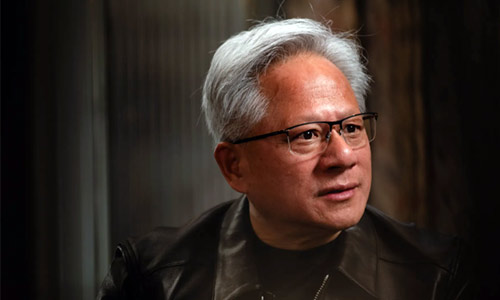
Jensen Huang, the billionaire co-founder and Chief Executive Officer of Nvidia, has resigned from the American artificial intelligence chipmaker following reports of two extramarital affairs, including an alleged relationship with a Chinese businesswoman suspected by United States authorities of having links to Beijing’s intelligence operations.

The resignation, announced on Thursday, November 12, 2026, marks a major leadership shake-up at one of the world’s most valuable technology companies and comes amid investigations into possible national security implications arising from the reported relationship.
Nvidia confirmed that Huang had stepped down as President, Chief Executive Officer and a member of its Board of Directors with immediate effect, ending more than three decades of leadership at the company he co-founded in 1993.
The company announced that its Chief Financial Officer, Colette Kress, would assume responsibility as interim Chief Executive Officer while the board begins the process of selecting a permanent successor.
Kress will continue serving as Executive Vice President and Chief Financial Officer while carrying out her interim leadership responsibilities.
The board said it would consider both internal and external candidates in its search for a new chief executive.
Nvidia also appointed Harvey Jones, a board member and former chief executive of Synopsys, as its first board chairman.
Huang’s departure followed mounting pressure over reports concerning his relationship with Alice Huang, a Chinese businesswoman and former executive associated with Singapore-based cloud computing company Megaspeed.
United States authorities reportedly suspect that Alice Huang, who is not related to Jensen Huang, was involved in intelligence activities connected to the Chinese government.
The allegations have raised questions about whether Nvidia’s commercial dealings and access to advanced artificial intelligence technology may have been exposed to foreign intelligence interests.
Megaspeed, an Nvidia cloud partner, has also reportedly faced scrutiny over suspicions that it facilitated access to advanced Nvidia chips by Chinese companies despite United States export restrictions.
According to reports, investigators are examining alleged transactions involving approximately $7.5 billion in chip sales to China.
However, the allegations concerning espionage and possible circumvention of export restrictions remain matters of investigation and have not been established as findings of criminal wrongdoing against Huang.
The Chinese government has denied the espionage allegations.
The controversy escalated after reports emerged that Huang had also been involved in an extramarital relationship with Kimberly Powell, Nvidia’s Vice President of Healthcare, who reportedly worked under his supervision.
The New York Times reported on Wednesday, November 11, that Huang and Powell had been involved in a relationship, citing people familiar with the matter.
According to the report, the two were seen behaving affectionately at a hotel during a company conference in March.
Huang did not publicly address the specific allegation involving Powell, while Nvidia did not provide a substantive response to the report at the time.
The disclosure intensified scrutiny of Huang’s leadership and reportedly prompted Nvidia’s directors to meet on Wednesday to consider whether he should continue as chief executive.
Earlier, Huang had publicly acknowledged being unfaithful to his wife in a message to employees released by Nvidia on November 8.
“I was unfaithful to my wife. My actions hurt her and our children. There is no excuse for what I did. I am deeply sorry,” he stated.
Huang also accepted personal responsibility for the consequences of his conduct, acknowledging that his actions had affected the trust placed in him by his family, colleagues and shareholders.
In the message, he pledged to cooperate with the company’s investigation into the national security concerns surrounding the reports.
Nvidia’s board had previously announced the commencement of an independent investigation into whether its founder and chief executive had been targeted by a foreign intelligence operation.
The investigation was placed under the supervision of independent directors, with external legal advisers engaged to examine the allegations.
At the time, the board stated that it had no reason to believe Nvidia’s confidential information or United States national security had been compromised.
However, the emergence of additional reports concerning Huang’s personal relationships increased pressure on the company’s leadership.
The board’s meeting on Wednesday followed reports that directors were considering removing Huang from his position and appointing an interim chief executive.
The company’s subsequent announcement of his resignation on Thursday brought that uncertainty to an end, although questions concerning the investigations remain unresolved.
Huang, 63, co-founded Nvidia in 1993 and transformed the business from a manufacturer of graphics processors primarily associated with video games into a leading supplier of computing technology used to develop and operate artificial intelligence systems.
Under his leadership, Nvidia became a central participant in the global AI industry, supplying processors used by major technology companies, cloud computing providers, data centres and research institutions.
The company’s technology has also become a central issue in the economic and strategic competition between the United States and China, particularly as Washington imposes restrictions on the export of advanced AI chips.
Huang had advocated maintaining access to the Chinese market, arguing for commercial engagement even as American policymakers expressed concerns about the national security implications of advanced semiconductor exports.
His reported relationship with Alice Huang therefore generated heightened scrutiny because of concerns about possible foreign intelligence influence and the company’s role in the global supply of sensitive technology.
United States President Donald Trump had previously expressed support for Huang during the controversy.
Trump described the Nvidia chief as having done an excellent job for the United States and indicated that Huang had told him he did not know the woman was allegedly involved in espionage.
The President said he believed Huang’s explanation, although the allegations continued to attract attention from lawmakers, investors and Nvidia’s board.
The leadership crisis also triggered a sharp reaction in financial markets.
Nvidia shares fell by more than 10 per cent in premarket trading on Thursday following reports of Huang’s departure and the growing uncertainty surrounding the company.
The decline added to losses recorded after the initial allegations emerged, with investors reassessing the risks associated with the departure of a founder who had become closely identified with Nvidia’s business strategy and technological direction.
Market analysts warned that Huang’s departure could create uncertainty over the company’s long-term execution, even though demand for AI processors remained strong.
Michael Feldman, a portfolio manager at ClearBridge Investments, said the greatest concern was not necessarily an immediate breakdown of Nvidia’s technology roadmap but the ability of the company to maintain the coordination that Huang had provided across its operations.
“The risk is execution. Jensen has been the chief conductor of an extraordinarily complex system,” Feldman said.
He explained that the coordination of technology development, suppliers, customers and infrastructure investments had become an important competitive advantage for Nvidia.
The leadership transition also comes as investors question the sustainability of the enormous investments being made in artificial intelligence infrastructure.
Nvidia has invested substantial resources in cloud providers, technology suppliers and AI companies, creating commercial relationships that extend beyond its direct sales of computing hardware.
Analysts have consequently warned that uncertainty over its leadership could affect investor confidence across the wider artificial intelligence industry.
The departure also raises questions about Nvidia’s future approach to United States semiconductor export policies and its commercial relationship with the Chinese market.
Although Huang remains a major shareholder, with a reported stake of approximately 3.61 per cent, he will no longer serve on the company’s board.
For Kress, who has served as Nvidia’s Chief Financial Officer for more than a decade, the appointment presents the challenge of maintaining operational stability while the company navigates leadership succession, shareholder concerns and continuing investigations.
Nvidia’s leadership transition comes shortly before the company is scheduled to release its next financial results on November 17, 2026.
The company has indicated that the earnings announcement will proceed as scheduled.
[A MUST HAVE] Evidence Act Demystified With Recent And Contemporary Cases And Materials

Available now for NGN 40,000 at ASC Publications, 10, Boyle Street, Onikan, Lagos. Beside High Court, TBS. Email publications@ayindesanni.com or WhatsApp +2347056667384. Purchase Link: https://paystack.com/buy/evidence-act-complete-annotation
______________________________________________________________________ “Enhance Legal Practice With Authoritative Reports” — Alexander Payne Offers Comprehensive Law Reports, Spanning Over A Century Of Nigerian Jurisprudence Interested buyers are encouraged to place their orders and enquiries via:
0704 444 4777, 0704 444 4999, 0818 199 9888
Website: www.alexandernigeria.com
“A Comprehensive Guide To Evidence Law” — Releases Second Edition In Three Volumes, Covering 4,051 Cases
For enquiries and orders, contact: 08035526491 Email: jerryamadisilk@gmail.com
 Prof. Jerry Amadi’s Evidence Law, Second Edition (2026), contains 3,314 pages in three volumes, covering the Evidence Act 2011, its 2023 amendment, and 4,051 Nigerian and English cases.