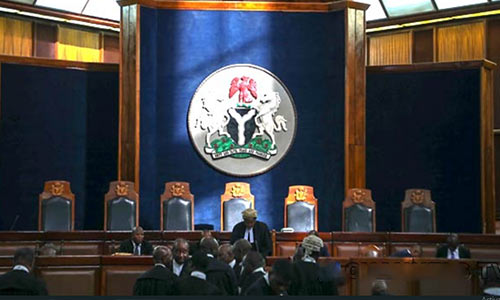
– Appeal No: Sc/CV/268/2021 Delivered On 24/01/2025.

- On Pg. 4 – 5 of the CTC his Lordship stated as follows:
Appellant distilled four issues for determination as follows:
- Whether the lower Court was right to hold that a garnishee cannot raise absence of jurisdiction where the judgment debtor is not contesting the judgment sought to be enforced. (Distilled from ground 1 of the Notice of Appeal).
- Whether the lower Court ought to have invalidated the garnishee order absolute pronounced by the trial Court without consent of the Attorney-General of the Federation which is a condition precedent for exercising jurisdiction over the garnishee proceedings. (Distilled from ground 2 of the Notice of Appeal).
- Whether the lower Court was right in invoking its powers under Section 15 of the Court of Appeal Act and Order 20 Rule 11 of the Court of Appeal Rules, 2016 to determine the garnishee matter. (Distilled from ground 3 of the Notice of Appeal).
- Whether the lower Court was right or justified in relying on Section 124 of the Evidence Act, 2011 to reject Appellant’s denial of having accounts in judgment debtor’s names and to hold that judgment debtors are MDAs (Ministries, Departments and Agencies) whose accounts are with Appellant under the Federal Government Treasury Single Account Policy. (Distilled from ground 4 of the Notice of Appeal).
In the 1st Respondent’s brief settled by Eko Ejembi Eko, SAN, the 1st Respondent distilled 3 issues for determination as follows:
- Whether the Court below was right when it held that the Appellant is not a public officer in the context of the appeal and as such the consent of the Attorney-General of the Federation was not required for attachment of funds in its custody in the garnishee proceeding.
- Whether the lower Court was right in relying on Section 124 of the Evidence Act, 2011 to reject Appellant’s denial of having accounts in the names of the judgment debtors and to hold that the judgment debtors are MDAs (Ministers, Departments and Agencies) whose accounts are with the Appellant under the Treasury Single Account Policy.
- Whether the Appellant has shown sufficient reason why the Supreme Court should set aside the concurrent judgments of both the trial and the Appellate Court.
- On Pg. 6 – 11 of the CTC his Lordship stated as follows:
In the lead judgment, issues 1 & 2 as formulated by the Appellant in this appeal were discountenanced and struck out. This position in the lead judgment was predicated on the finding that the said issues were incompetently raised at the Court below and in this Court having not been raised as a procedural issue at the trial. As set out above, issues 1 & 2 in the Appellant’s brief relate to the question as to whether the garnishee proceedings at the trial Court was competent on account of the 1st Respondent’s failure to seek and obtain the Attorney-General of the Federation’s consent before commencing the proceedings. From the record of appeal, Mr. Eko, Esq., (as he then was) argued the motion ex parte for Garnishee Order Nisi on 10/12/18 at the trial Court. In the course of his written address in support of the motion, he raised the issue himself following which the trial Court granted the Order Nisi. On page 10 – 11 of the Record, Mr. Eko in the written address stated as follows:
“Recent authorities of the apex Court of the land have also held that in a garnishee proceedings where funds of government agencies such as the judgment debtors are sought to be garnished the consent of the Attorney-General of the Federation is no longer a prerequisite as the Court held that the relationship that exists between the CBN and government agencies is merely that of banker customer relationship and as such the funds in custody of the banker can be garnished to fulfil a judgment debt via garnishee proceedings. See CENTRAL BANK OF NIGERIA v. INTERSTELLAR COMMUNICATIONS & ORS (UNREPORTED) at PP.46-77, the Supreme Court per OGUNBIYI JSC”.
Mr. Eko also made this point orally as recorded by Tsoho J. (as he then was) in the proceedings on the Order Nisi held on 10/12/18 on page 35 of the Record. His words were:
“In making this application, we wish to emphasize that the Central Bank of Nigeria in the circumstances is only acting as a Banker in a Banker-Customer relationship and the consent of the HAGF is required for the enforcement of Judgment. We rely on the case of CBN vs INTERSTELLA COMMUNICATION & ORS.” (Unreported) per Ogunbiyi, JSC.
However, the learned trial Judge did not at any point in the Ruling on the Order Absolute give an opinion on that point. The ruling was based on the fact that the affidavit to show cause was out of time and consequently had to be discountenanced. Tsoho J. (as he then was) stated as follows:
“I therefore endorse the submission of Eko Ejembi Eko Esq. of Learned Counsel for the Applicant that the Garnishee’s Affidavit To Show Cause was filed well outside the time stipulated by the Rules of Court. As no step has been taken to regularize same, it is incompetent and disregarded in this proceedings. In effect, the averments in the affidavit in support of the Applicant’s Motion Exparte for Garnishee Order Nisi is deemed not contested”.
After the trial Court issued the Garnishee Order Absolute on 21/1/2019, the Appellant filed a notice of appeal wherein it raised the issue of the failure of the Respondent to obtain the AGF’s consent before the garnishee proceedings was commenced in its Ground 3 on pages 45-50 of the record in the said notice of appeal. Issues were joined by the parties in their respective briefs of argument filed at the Court below on this point. Appellant’s issue 3 in its brief at the Court below was formulated from this Ground 3 while the 1st Respondent’s issue 2 was predicated on the said Ground 3. None of the Respondents at the Court below objected to the competence vel non of the said issue 3 as formulated in the Appellant’s brief or the said Ground 3 in the Notice of Appeal against the trial Court’s decision. Accordingly, the Court below went on to determine the issue in a manner that made its opinion inchoate on the specific point submitted to it by the parties for determination as follows:
“In the instant case, it is not on record that the judgment creditor or judgment debtor are fighting the judgment debt on appeal. Where the judgment debtor does not fight the judgment on appeal, the garnishee whose role is only to keep the money of the appellant cannot raise issues in the enforcement to challenge the enforcement procedure adopted by the judgment creditor. In that circumstance it is not the business of the garnishee to plead that the trial Court has no jurisdiction because the fiat of the Attorney General was not obtained before the enforcement of the judgment given against a judgment debtor”.
However, the correct finding of the Court below was not the specific point put before it.
Before this Court in this appeal, none of the Respondents have objected to the competence of issues 1 & 2 in the Appellant’s brief before the Court which is predicated on Ground 2 of the Notice of Appeal which has been struck out in the lead judgment. Both parties have joined issues on this point in their briefs herein. No doubt, ab initio, it is important to point out that it has always been the position of the Nigerian Courts to adopt the adversarial mode of jurisprudence in the determination of disputes submitted to it. The Court does not make a habit of making out a case on behalf of any side. Rather, it focuses on and resolves the issues presented to it by the parties. See SODIPO v. LEMNINKAINEN & ANOR (1986) LPELR-3087 (SC), EHOLOR v. OSAYANDE (1992) LPELR-8053 (SC).
As none of the parties argued that issues 1 & 2 in the Appellant’s brief before us were incompetent, I think it would amount to a breach of the Appellant’s right to fair hearing to discountenance and strike out the said issues without giving it an opportunity to defend their competence at least at the hearing of this appeal. See CHITRA KNITTING v. AKINGBADE (2016) LPELR-4043 (SC).
As I pointed out earlier, these issues were first raised by the 1st Respondent at the trial Court when it sought the Garnishee Order Nisi. I am therefore of the view that they were competently raised at the Court below and subsequently in this Court.
On a second point of law, the Sheriffs and Civil Process Act is a substantive law. The adjectival Law attached to it is the Judgment Enforcement Rules made pursuant to it. The Appellant is not challenging the jurisdiction of the Court on this issue on the basis of the procedural rules in the Judgment Enforcement Rules, but on the basis of the substantive law as stated in Section 84 of the S&CPA. Failure to adhere to substantive law in initiating an action even where not raised at the trial Court can be raised as a matter of jurisdiction at any time in the appellate process. This is a matter of inherent jurisdiction to hear the case without the consent of the Attorney-General which tantamounts in law to the fact that the garnishee action is statute barred by Section 84 of the S&CPA. Section 84 of the S&CPA debars by a condition a right from being enforced and is not merely a rule or mode of how to enforce the right. It is thus a substantive issue of jurisdiction. Usually the issue of procedural jurisdiction when not raised timeously can be ignored by the Courts while the issue of substantive jurisdiction as envisaged by the very wordings of Section 84 of the S&CPA cannot be waived. The question of defect in the procedure adopted by a party is different from one of substantive law. See MOBIL PRODUCING v. LASEPA & ORS (2002) LPELR-1887 (SC).
- On Pg. 34 – 36 of the CTC his Lordship stated as follows:
This was a pre-independence legislation to protect the colonial administration and its coffers. Both the 1960 independence Constitution and the 1963 Republican Constitution did nothing to disturb the provisions of Section 84 of the S&CPA or make it a constitutional provision. It appears that prior to 1979, it was rarely activated and was never subject to judicial interpretation.
This provision obviously held sway until the 1979 Constitution came into force. In Section 251, the said Constitution provided:
Section 251(1)(2)(3)
(1) The decisions of the Supreme court shall be enforced in any part of the Federation by all authorities and persons, and by courts with subordinate jurisdiction to that of the supreme Court.
(2) The decisions of the Federal Court of Appeal shall be enforced in any part of the Federation by all authorities and persons, and by courts with subordinate jurisdiction to that of the federal court of Appeal.
(3) The decisions of a High Court, and of all other courts established by this Constitution shall be enforced in any part of the Federation by all authorities and persons, and by other courts of law with subordinate jurisdiction to that of the High Court and those other courts, respectively.
The wordings of this provisions are clear. They meant that there was no need for the consent of any other authority but the Court to enforce a Court judgment.
Unhappy with this position, the Federal Military Government, in 1993, passed Decree 107. That Decree amended Section 251 of the 1979 Constitution by adding a new subsection 4 which read:
(4) Notwithstanding the provisions of this section, no person shall enforce a judgment against a ministry or extra-ministerial department without the fiat of Attorney-General of the Federation or the Attorney-General of a State whether or not he was, in either case, a party to the proceedings.
There is no doubt that the Military Government amended the 1979 Constitution to include this provision because it was aware that the provision of Section 84 of the S&CPA alone was not sufficient to override the clear wordings of Section 6(b) and 251(1) – (3) of the 1979 Constitution. Thus, the provision of Section 84 of the S&CPA had to be given constitutional backing.
- On Pg. 49 – 50 of the CTC his Lordship stated as follows:
At the risk of repeating a fact ad nauseum, it is clear that subsection 4 has been deleted. My Lords, there is no doubt that it was deleted because the legislators of the 1999 democratic constitution perceived that the said subsection was a vestige of military rule and colonialism. This means that we are now back to where we were before Decree 107 was passed.
- On Pg. 61 – 64 of the CTC his Lordship stated as follows:
In my view, if Section 84 of the S&CPA had existed since 1945 and Decree 107 was promulgated in order to give it constitutional flavor by incorporating it as Section 251(4) of the 1979 Constitution in 1993 by the Military Junta, the law makers definitely did so because they recognized the point that Section 84 of the S&CPA (on its own) was not only inferior to the 1979 Constitution but also in conflict with it.
It is therefore my view that standing on its own as it is today, and not being made a provision of the 1999 Constitution, it cannot be validly argued that it is not in conflict with the constitution.
Following the mischief rule of interpretation, there would have been no point in deleting it from the 1999 Constitution if the constitutional law makers intended that the provision should still be part of our laws in this day and age.
My Lords, this brings me to the hallowed twin doctrines of the supremacy of the Constitution (already fleetingly referred to by me and the Law Lords in some of the cases cited above) and separation of powers. Section 1 of the Constitution of the Federal Republic of Nigeria (1999) (as altered) provides clearly thus:
- (1) This Constitution is supreme and its provisions shall have binding force on all authorities and persons throughout the Federal Republic of Nigeria.
(2) The Federal Republic of Nigeria shall not be governed, nor shall any person or group of persons take control of the Government of Nigeria or any part thereof, except in accordance with the provisions of this Constitution.
(3) If any other law is inconsistent with the provisions of this Constitution, this Constitution shall prevail, and that other law shall to the extent of the inconsistency be void.
See SARAKI v. FRN (2016) LPELR-40013 (SC).
Thus, the Constitution is the Supreme law of the land. It is the grundnorm i.e. it is the basic law from which all other laws of the society derive their validity.
In AGI v. PDP & ORS (2016) LPELR-42578 (SC), the Court reiterated the point that no other law, legislation, be it regulation, rules or guidelines of whatever nature can come into effect so as to undermine the effect of a constitutional provision.
As regards the powers of the Court in a constitutional democracy, my Lords, Section 287 of the Constitution of the Federal Republic of Nigeria 1999 (as altered) makes amble provisions as follows:
287 (1) The decisions of the Supreme Court shall be enforced in any part of the Federation by all authorities and persons, and by courts with subordinate jurisdiction to that of the Supreme Court.
(2) The decisions of the Court of Appeal shall be enforced in any part of the Federation by all authorities and persons, and by courts with subordinate jurisdiction to that of the Court of Appeal.
(3) The decisions of the Federal High Court, the National Industrial Court, a High Court and of all other courts established by this Constitution shall be enforced in any part of the Federation by all authorities and persons, and by other courts of law with subordinate jurisdiction to that of the Federal High Court, the National Industrial Court, a High Court and those other courts, respectively.
Your Lordships will find that the definition of authority and government as provided by Section 318 of the Constitution of the Federal Republic of Nigeria 1999 (as altered) puts it beyond conjecture that the Attorney General of the Federation is one of the persons referred to in the dictates of Section 287; Section 318 defines authority and government respectively thus: “authority” includes government”.
While government was defined thus: “government” includes the Government of the Federation, or of any State, or of a local government council or any person who exercises power or authority on its behalf.
- On Pg. 64 – 65 of the CTC his Lordship stated as follows:
My Lords, the presidential system of democracy in existence in Nigeria is defined by the separation of the executive branch headed by the President who unilaterally choses his team outside the legislature. The head of government is elected to work alongside but not as a part of the legislature like the parliamentary system. It is trite that separation of powers is a constitutional principle introduced to ensure that the three major institutions of the State, namely the legislative, executive and the judiciary are not concentrated in one single body whether in functions, personnel or powers. The division ensures that the powers of each branch of government are not in conflict with others. The intention behind a system of separated powers is to prevent the concentration of powers by providing for checks and balances. This has been meticulously done in the 1999 Constitution (as altered). Nowhere in the 1999 Constitution (as altered) have the powers of the judiciary been made subject to the powers of the executive.
- On Pg. 66 – 76 of the CTC his Lordship stated as follows:
That in my opinion is what the applicability of Section 84 of the S&CPA has done. This Court in NIGERIA AGIP OIL CO. LTD v. NKWEKE & ANOR (2016) LPELR-26060 (SC) held that when the exercise of power by a person or authority is alleged to have been done outside the provisions of the Constitution or that such exercise is in direct conflict with the spirit of the Constitution, then that exercise of power is said to be unconstitutional. There is no doubt that Section 84 of the S&CPA seeks to limit the exercise of the execution of a valid Court judgment, in that case, such an inferior legislation, outside the Constitution is null and void to the extent of its obvious inconsistency with Section 287 of the Constitution. It is both incongruous and ludicrous that the monetary judgments of the Courts where it involves the government must be subject to the AG or AGF as the case may be, who by the wordings of Section 84 of S&CPA seems at liberty to withhold or grant consent according to his whims and caprice thus subjecting the judgment of the Courts to the supervisory authority of the AGF. I have read and repeated here all the laudable reasons given in the past for entrenching this legislation. I cannot agree that the embarrassment to government where government money is claimed by a judgment creditor is sufficient reason for a single functionary of the Executive arm of government at the State (AG) or Federal (AGF) levels to supervise the judiciary which is the obvious implication of Section 84 of S&CPA. One must rue the day and shudder at the spectre of a monetary judgment of the Supreme Court of Nigeria being subject to the supervision of the AG or AGF pursuant to Section 84 of the S&CPA. It detracts from Section 287 which imposes a duty on all authorities and persons to enforce the decisions of the Courts and also creates a mandatory duty on the office of the AGF and other persons and institutions to automatically enforce the judgments of the Courts unless there is a stay and an appeal against that judgment. In the comity of nations, it is more embarrassing for the judiciary of Nigeria to be seen as a toothless bulldog whose judgments can be ignored at the will of the executive. It is equally very embarrassing that a foreign judgment creditor would be told that after going through the judicial process to get his rights, he has to go to back to the executive for permission to enforce it.
The further argument in favour of this provision I have noticed in previous judgments is that the government would be inundated with frivolous and merely gold-digging judgment debts. How can that be so when at every step of the litigation process in our jurisprudence there are provisions to stay execution of a judgment and to promptly appeal. This case under review is a perfect example. After filing the Affidavit to show cause, the Appellant’s Counsel did not go back to Court on the return date when the affidavit was considered by the Court and the Respondent (then applicant) was able to persuade the Court to grant the Garnishee Order Absolute as an undefended application. The MDA’s must defend their institutions by deploying all means possible to defend and shield it from spurious judgment debt, not hide behind the bogeyman of Section 84 of the S&CPA because the AG & AGF would be in a position to ignore the judgment.
My Lords, on another wicket, the provision in Section 84 is so broad, it appears to give the AGF a discretion as to whether or not to grant consent. This is not a circumstance similar to where the law requires a condition precedent before an action can be filed. For instance, most government establishment statutes require that the government department be given pre-action notice which gives the government or MDAs time to come to terms to resolve the dispute without resort to litigation. My Lords, we must distinguish between administrative pre-conditions set up by the executive to give the executive an opportunity to resolve a dispute before it is submitted to the judiciary e.g. in chieftaincy, tax matters etc.
In such an event, the aggrieved party, after the required notice, has access to the Courts even if the MDAs ignores his pre-action notice. However, Section 84 is drafted in such a manner that suggests that without obtaining the AGF’s consent, no judgment can be enforced. This also debunks the argument that it is a mere procedural conditional precedent within the absolute control of a judgment creditor to take like all other condition precedents to litigation embedded in other statutes. In the case of Section 84 of the S&CPA, the judgment creditor initiates the steps while the AG may or may not close the circle to ensure that the consent is granted. In all other statutes prescribing conditions precedent to initiate litigations, the condition precedent are within the exclusive control of the litigant. For example, reference to arbitration, reference to mediation, appeal to an administrative review board, issuance of pre-action notice etc; once the litigant complies, he can go to Court where pre-action notice is ignored, or reference to arbitration is ignored by the other party, as it is his exclusive purview to comply.
The difference between the two scenarios was amply stated in NNPC v. FAWEHINMI (1998) 7NWLR Pt. 559 Pg. 598 cited copiously in GOVT, AKWA IBOM v. POWERCOM (SUPRA). The main question in NNPC v. Fawehinmi (supra) an appeal from the decision of the Federal High Court was whether Section 12(2) of the NNPC Act was compatible with Section 6(6)(b) and Section 33(1) of the 1979 Constitution and Article 3(1) & (2) of the African Charter on Human and Peoples Rights. In essence, it had to do with the constitutionality of the pre-action notice required in Section 12(2) of the NNPC Act. The decision of Govt of Akwa Ibom v. Powercom (supra) did not state clearly the full opinion of the Court of Appeal on this issue. The full opinion of Ayoola JCA (as he then was) expressed in NNPC v. Fawehinmi (supra) not fully quoted in Govt of Akwa Ibom v. Powercom (supra) is as contained on pages 611 – 613 of the NWLR as follows:
“It is expedient at the onset, to put Section 6(6)(b) of the Constitution in its proper perspective for the determination of this appeal. In most written constitutions, there is a delimitation of the power of the three independent organs of government, namely: the executive, the legislature and the judiciary. Section 6 of the Constitution which vests judicial powers of the Federation and the States in the courts and defines the nature and extent of such judicial powers does not directly deal with the right of access of the individual to the Court. The main objective of Section 6 is to leave no doubt as to the definition and delimitation of the boundaries of the separation of powers between the judiciary on the one hand and the other organs of government on the other, in order to obviate any claim of the other organs of government, or even attempt by them, to share judicial powers with the courts. Section 6(6)(b) of the Constitution is primarily and basically designed to describe the nature and extent of judicial powers vested in the courts. It is not intended to be a catch-all, all-purpose provision to be pressed into service for determination questions ranging from locus standi to the most uncontroversial questions of jurisdiction. An enactment should not be held to infringe the provisions of Section 6, generally, or Section 6(6)(b), in particular, unless it does one or more of the following:
(i) provide for the sharing of judicial powers of the State with any other body than the courts in which it is vested by the Constitution;
(ii) purport to remove judicial power vested in the court or redefine it in a manner as to whittle it; or,
(iii) limit the extent of the power vested. In short, for an enactment to infringe the provisions of Sections 6(1) and (6)(b) of the Constitution it must amount either to a total or partial usurpation of judicial powers vested in the courts by the Constitution; or, it must have purported to divest the courts of the exercise of judicial powers.
Statutes which are legislative judgment fall in the first category, while statutes which preclude judicial review of executive decisions and actions and legislative actions may fall within the latter category. Other than in consonance with the Constitution itself, legislative provisions which preclude the judiciary from exercising its judicial powers violate the separation of powers principle enshrined in section 6 of the Constitution. It is because such enactment bars the individual’s access to a court that it may offend section 33(1) as well. In this wise, sections 6 and 33(1) may be seen as complementing one the other. It is pertinent to mention, in passing, that in so far as section 33(1) permits tribunals to determine civil rights and obligations, section 6(6)(b) should be read subject to section 33(1) of the Constitution. The provisions of the Constitution that guarantee access to the court are to be found in section 33 of the Constitution. The distinction between the vesting of judicial power and the guarantee of freedom of access to the court should be borne in mind to avoid confusing interpretation and application of section 6 of the Constitution. Not every infringement of section 33(1) of the Constitution should be held, ipso facto, to constitute an infringement of section 6 of the Constitution. Where an enactment regulates the right of access to a court in manner as to constitute an improper obstacle to access to court, such should more appropriately be regarded as an infringement of section 33 than an infringement of section 6 of the Constitution. Furthermore, the procedure for challenging an infringement of section 33(1) is not the same as that for challenging a contravention of section 6 of the Constitution.
An infringement of section 6 or section 33(1) of the Constitution is not constituted merely because an enactment regulates access to the courts by prescribing steps to be fulfilled before the jurisdiction of the court can be invoked. Where an enactment interposes the discretion of another person or organ between the desire of the individual to approach the court for redress and the commencement of proceedings, the court will readily strike down such enactment as an infringement of section 6. Decisions such as Bakare v. Attorney-General of the Federation & ors (1990) 5 NWLR (Pt. 152) 516 concerning sections 3 & 4 of the Petition of Rights Act (Cap. 149) LFN 1990) and Adediran & Anor v. Interland Transport Ltd (infra) concerning relator actions for public nuisance illustrate the point and can readily be understood as cases of interposition of a decision of a person not a judicial officer between the right of an individual and its exercise. Where the statute does not interpose such discretion the courts will not readily strike down the enactment as constituting an infringement either of section 6 or section 33(1) of the Constitution, merely because it regulates the exercise of the right of access to a court, without an inquiry into the legal, or practical, propriety of the regulation. Although section 33(1) of the Constitution seems couched in absolute terms, the right of access to court cannot be regarded as unqualified. By virtue of section 33(1) an individual has the right of access to a court in the sense that he must be able to have the matter in dispute brought before a court for determination without any improper legal or practical obstacles being placed in his way. The right so stated does not, however, ipso facto mean that regulation of access to a court is precluded. Such regulations abound in the rules of procedure and in procedural legislation. The only and not unimportant requirement is that any regulation of the right of access to a court must have a legitimate aim and the extent and nature of such regulation must be reasonably proportionate to that aim. It goes without saying that regulation of the right which in effect subverts of (sic) injures the substance of the right cannot be proper or legitimate.” (Underline mine).
My Lord Onalaja JCA agreed with his Lordship while Pats Acholonu JCA (as he then was) disagreed and held that the Courts should not accord special privileges to prospective defendants in order to remove them from the orbit of the Constitution. His Lordship held that any restraint impeding access to the Courts is unconstitutional. The point l’ve been laboring to make was made by Ayoola JCA (as he then was) above to the effect that where the impediment depends on the discretion of an individual outside the Courts, then that impediment to access to justice is ipso facto unconstitutional.
My Lords, this is one of the bane of commercial transactions between companies, individuals and government MDA’s in Nigeria. I have never been particularly convinced that the so called “embarrassment” to the government warrants the judiciary’s enforcement of a provision that substantially erodes its stature as the final arbiter of disputes at whatever level. In the past, I had been moved more by the argument that the provision of Section 84 is just one of these procedural or administrative condition precedent and it should be applied as such. However, on deeper introspection and going through the history of the legislation, it is easy to appreciate that it gives unfettered discretion to the AG or AGF to deny access to justice and it is a bogeyman waiting at the door of the Courts to kidnap the Court’s judgment which may or may not be released after payment of ransom (that is the application for consent) leaving the kidnapped judgment creditor gnashing his teeth waiting for the AG or AGF to exercise his discretion. If Section 84 were worded in such a manner that the judgment creditor were merely to notify the AG and after a stipulated period, the AG must comply and if the AG did not comply, the judgment creditor can initiate garnishee proceedings, then, it would be a mere procedural condition precedent which would not contravene Section 287 and thus unconstitutional.
As I said earlier, the principles of separation of powers as enshrined in the Constitution must be sustained by this Court.
- On Pg. 76 – 78 of the CTC his Lordship stated as follows:
In ODE v. A.G. BENUE (2011) LPELR-4774 (CA) the Court held that the provisions of Section 84 S&CPA are to “ensure sound public administration and were a matter of public policy aimed at protecting public funds”. As I stated earlier, that had been the refrain of most Court decisions on this issue.
That case supports the argument that the requirement of AG’s consent (if not used as an arbitrary veto to render a judgment of Court nugatory) cannot be unconstitutional. Consent per se, not unreasonably withheld nor inordinately refused, cannot be objectionable where the AG provides a reasonable excuse e.g. need to make fiscal appropriation to settle the debt from public revenue as required by Section 81 of the Constitution and Sections 17-22 of the Fiscal Responsibility Act. For the AG to authorize payment from public revenue without appropriation under Section 81 of the Constitution will be to override and usurp the power of the purse, exclusively vested by the Constitution in the National Assembly. E.g. where AG cites lack of an extant appropriation to authorize payment, failure to include the liability in the next succeeding budget for appropriation will justify enforcement after the next budget has been passed into law. The argument is that the waiting period for this (inclusion in the budget) to happen, suffices to save the government the embarrassment which direct enforcement might otherwise expose the government to.
This argument seems to put the administrative convenience of government over and above the provisions of the Constitution. Since the beginning of a formal Constitution in Nigeria, the provision of Section 287 has existed in various forms to protect the enforcement and integrity of judicial pronouncements. As stated earlier, all the fanciful scenarios painted in the above argument as deliberated, blurs the lines of separation of powers. The executive knows that it would have judgment debts within a fiscal year and should have made the appropriate budgetary allocations in that regard. If we are talking government accounting, as an excuse to disobey the Constitution, we might want to remember that in every budget of government, there is always provision for judgment debts. Also, there is special expenditure and contingency votes. Finally, the judgment debt, may only be honored in the appropriate account to the extent of the balance in the account for that fiscal year.
As I said earlier, the AG & the AGF must protect agencies of government from gold-digging claims. It does not lie in the hands of the judiciary to seek to defeat its own purpose in the tripartite government arrangement and balance of power by looking at whether or not the executive has put its house in order.
Under Section 84, the AG or AGF may just ignore the application for consent or the judgment itself after it has been brought to his attention. Can it be the law that such a judgment cannot be enforced until the AG or AGF deems it fit to withhold or give his consent. Section 287 of the Constitution envisages that once the dispute has been submitted to the Courts and the parties have had their day in Court and a judgment has been lawfully given, after that point, the judgment having the imprimatur of the judiciary, the consequences of the litigation can no longer be moderated by the executive through the AG or AGF. This is an apt case of where the Constitution commands, discretion terminates.
I am of the view that Section 84 of the S&CPA is in conflict with Sections 1, 3, 6 and 287 of the 1999 Constitution (as altered) and I hereby strike it down from our statute books. I am of the view that the trial Court had requisite jurisdiction to entertain the garnishee proceedings without prior consent of the AGF. These issues are resolved in favour of the 1st Respondent.
- On Pg. 86 of the CTC his Lordship stated as follows:
Where a Garnishee Order Nisi is granted on the basis of a general statement of a judgment creditor that monies of a judgment debtor are in the hands of the garnishee and the affidavit to show cause filed by the garnishee denying liability is that it has no such funds, it behooves or the liability shifts back to the judgment creditor to further show (not in general terms) the evidence that the garnishee in fact is in custody of the funds of the judgment debtor. In the absence of this further evidence, the Court is obliged to discharge the garnishee.
- On Pg. 87 of the CTC his Lordship stated as follows:
Where however there is no further affidavit from both sides except a statement of general belief by both parties, their affidavit evidence is cancelled out and the onus of proof that the garnishee is in possession of the funds of the judgment debtor remains that of the judgment creditor. Apart from the above, it is to be observed that the current practice of counsel filing garnishee proceedings against numerous banks in a hit or miss endeavor to get hold of the judgment debt from whosoever must be deprecated. Judgment Creditors must do their due diligence before they commence garnishee proceedings to ensure that they file proceedings against persons actually holding money belonging to the judgment debtor.
[A MUST HAVE] Evidence Act Demystified With Recent And Contemporary Cases And Materials

Available now for NGN 40,000 at ASC Publications, 10, Boyle Street, Onikan, Lagos. Beside High Court, TBS. Email publications@ayindesanni.com or WhatsApp +2347056667384. Purchase Link: https://paystack.com/buy/evidence-act-complete-annotation
______________________________________________________________________ “Enhance Legal Practice With Authoritative Reports” — Alexander Payne Offers Comprehensive Law Reports, Spanning Over A Century Of Nigerian Jurisprudence Interested buyers are encouraged to place their orders and enquiries via:
0704 444 4777, 0704 444 4999, 0818 199 9888
Website: www.alexandernigeria.com
Interested buyers are encouraged to place their orders and enquiries via:
0704 444 4777, 0704 444 4999, 0818 199 9888
Website: www.alexandernigeria.com