*As Isiagu-Hijab Debate Rekindles Culture, Dress Regulation Concerns

A growing body of opinion within the Nigerian Bar is urging the Council of Legal Education (CLE) to restore, or at minimum properly review, the Professional Ethics prize withdrawn from the 2026 best graduating student of the Nigerian Law School, with the controversy now widening into a broader debate over cultural identity, professional dress regulation and consistency in the treatment of different forms of personal expression.
In a statement dated August 19, 2026 and signed by Aderonke Osho, Secretary to the Council and Director of Administration, the CLE said it had withdrawn the prize after considering a photograph circulated online in which the recipient was dressed in attire it considered inconsistent with “professional standards and decorum.”
“The Council considered the circumstances surrounding the award of the prize for the best graduating student in professional ethics and approved the withdrawal of the prize from the recipient, arising from the circulation of a photograph online depicting the recipient in attire considered inconsistent with the professional standards and decorum,” the statement said.
The Council did not identify the recipient, describe the photograph in its announcement or specify the particular provision of any dress code allegedly breached.
Published records from the 2026 Call to Bar ceremonies identified Ogechi C. Ifezie of the Lagos Campus as the first-prize winner in Professional Ethics and course leader in the subject. However, because the disciplinary statement did not expressly name her, the connection rests on the previously published award records rather than an express identification by the Council.
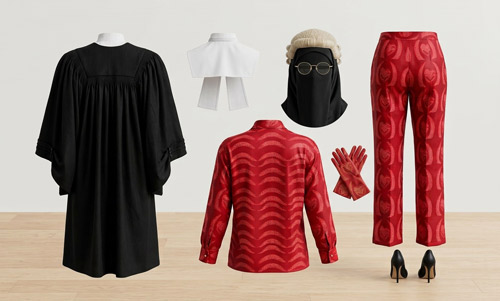
Images which subsequently circulated online showed a young woman wearing the traditional legal wig, bib and black gown over a red Isiagu-patterned outfit, fuelling arguments over whether Nigerian cultural attire can coexist with the profession’s inherited dress traditions.
For those calling for a review, the controversy is not simply about whether lawyers should obey professional dress rules. Their argument is that the Council should identify the precise rule, show that it applied to the circumstances, demonstrate that the affected graduate was afforded an opportunity to respond and explain why withdrawal of an academic prize was the appropriate sanction.
The debate has also revived comparisons with the profession’s handling of hijab and other religious clothing.
Supporters of Ifezie argue that if Nigerian legal institutions have, in different circumstances, had to grapple with accommodating religious identity within professional dress, then similar seriousness should be given to questions of indigenous cultural expression.
They point specifically to the contrast between Isiagu an indigenous Nigerian fabric associated particularly with Igbo cultural identity and the wig and gown, which were inherited from the English legal tradition.
Their argument is not necessarily that Isiagu and hijab raise identical legal questions. Religious freedom and cultural expression can engage different constitutional and regulatory considerations. Rather, they contend that the comparison exposes a deeper question: what principle determines which expressions of identity can coexist with professional attire and which are regarded as incompatible with decorum?
Some lawyers commenting on the controversy have argued that accommodating hijab or niqab in professional spaces while sanctioning an indigenous cultural garment could create an appearance of inconsistent treatment unless the distinction is grounded in a clear and published rule.
Others reject that comparison, maintaining that students and lawyers are taught the prescribed mode of dressing and should comply with existing standards until those standards are formally amended.
One commentator argued that because the legal profession itself was inherited from the English system, practitioners accepting the profession must also accept its prescribed regalia and disciplinary rules.
Another said reform should come through amendment of existing rules rather than through individual acts that may amount to defiance of the current dress code.
Those supporting Ifezie, however, say that position leaves unanswered the question of whether every inherited feature of the profession should remain beyond review merely because it has existed for decades.
They argue that Nigeria inherited the wig and gown from England, but the profession is now administered by Nigerian institutions, populated overwhelmingly by Nigerian lawyers and regulated within Nigeria’s constitutional and cultural environment.
On that view, questioning whether indigenous fabrics can be incorporated into professional attire is not necessarily an attack on professional dignity. It is part of a wider conversation about whether dignity must continue to be defined exclusively by conventions inherited from another legal culture.
The dispute also raises a question of proportionality.
Even if the Council establishes that the photograph breached an existing dress rule, those supporting a review argue that there remains a separate question as to whether withdrawal of an academic prize was a proportionate response.
The prize recognised performance in Professional Ethics during the Law School examination. Critics therefore question the connection between an alleged dress infraction occurring in a photograph and the cancellation of recognition for academic performance already earned.
Professional Ethics, they argue, deals fundamentally with honesty, integrity, competence, confidentiality, client care and professional conduct. A dress violation, even if established, does not necessarily erase the examination performance for which the prize was awarded.
The matter has consequently produced four central questions for the Council: Which exact rule was breached? What process preceded the decision? Was the affected graduate heard? And why was withdrawal of the prize considered proportionate to the alleged misconduct?
The issue of consistency has become equally significant.
The profession has over the years confronted questions surrounding religious dress, including demands for accommodation of hijab within legal attire. The current Isiagu controversy now places indigenous cultural expression alongside that continuing conversation.
Those supporting the graduate say the answer should not be to set one culture or religion against another. Instead, they argue that professional regulators should formulate objective, transparent standards capable of explaining when, why and to what extent modifications to conventional legal attire are permissible.
Without such clarity, they contend, professional dress regulation risks appearing dependent on subjective assessments of what individual decision-makers consider sufficiently “professional.”
The Council’s August statement also does not indicate whether the graduate received prior written notice, whether she appeared before any disciplinary panel, whether she was invited to make representations or whether any internal review or appeal mechanism exists.
It also does not state whether the prize would now pass to the candidate who placed second in Professional Ethics or simply remain withdrawn.
The withdrawal came weeks after a separate Council directive warning candidates awaiting Call to Bar against improperly wearing legal wigs and gowns or presenting themselves publicly as qualified practitioners before formal admission to the Bar.
That earlier intervention operated as a general warning. The present case, however, involves disciplinary action affecting an academic distinction already announced and conferred.
Those supporting the Council maintain that a serious profession is entitled to prescribe standards of appearance and discipline for persons entering the Bar and that an award carrying the imprimatur of the Council may reasonably be expected to reflect conduct consistent with those standards.
But supporters of a review contend that the existence of regulatory authority does not remove the requirements of clarity, fairness and proportionality.
They also warn against reducing the controversy to a choice between discipline and indiscipline.
For them, the more important question is whether Nigeria’s legal profession can preserve professional dignity while making room for Nigerian cultural identity, just as modern legal institutions have been required to confront questions of religious accommodation and other forms of personal identity.
The case has therefore become more than a dispute over one photograph or one prize.
It now raises a broader question for the profession: can a legal system inherited from Britain develop distinctly Nigerian expressions of professional identity without sacrificing the standards and discipline expected of the Bar?
Those seeking a review say the immediate remedy remains straightforward: the Council should cite the applicable rule, disclose the process followed, clarify whether the affected graduate was heard, explain the proportionality of the sanction and provide clear prospective guidance on the place of indigenous and religious attire within professional dress.
If the decision is justified by an existing and properly communicated rule, they argue, the Council should say so clearly.
If not, they contend that restoring the prize and reviewing the dress standard would present an opportunity for the legal profession to distinguish genuine professional discipline from mere adherence to inherited convention.
[A MUST HAVE] Evidence Act Demystified With Recent And Contemporary Cases And Materials

Available now for NGN 40,000 at ASC Publications, 10, Boyle Street, Onikan, Lagos. Beside High Court, TBS. Email publications@ayindesanni.com or WhatsApp +2347056667384. Purchase Link: https://paystack.com/buy/evidence-act-complete-annotation
______________________________________________________________________ “Enhance Legal Practice With Authoritative Reports” — Alexander Payne Offers Comprehensive Law Reports, Spanning Over A Century Of Nigerian Jurisprudence Interested buyers are encouraged to place their orders and enquiries via:
0704 444 4777, 0704 444 4999, 0818 199 9888
Website: www.alexandernigeria.com
Interested buyers are encouraged to place their orders and enquiries via:
0704 444 4777, 0704 444 4999, 0818 199 9888
Website: www.alexandernigeria.com