Nigeria Customs Service personnel operating at the seaports are reputedly the only ones still physically sorting out goods for inspection, thus fuelling corruption and other bottlenecks, ANNA OKON reports

To an average operator doing business at the Nigerian seaports, the most harrowing part of the experience is the cargo clearing process.
This is of course the first painful ordeal when placed in line with the challenge of eventually moving the cargo out of the port and then attempting to return the empty container to the terminals.
The ordeal is faced by agents and importers who have to wait for hours on end as Customs officers physically examine their cargoes in the absence of scanners.
Scanners are used for cargo inspection in most climes.
Cargo scanning is a non-invasive method of inspecting and identifying goods in transit to specified destinations. It is frequently used to scan freight shipping containers and this means that scanners can be mounted on trucks to scan vehicles, containers and other objects, without opening them.
This it achieves by producing X-ray images of the scanned objects. Not only does cargo scanning quicken the cargo clearing process, it is also more efficient than physical inspection because of its ability to detect contraband and other illegal goods, which may escape physical detection.
Physical examination, a difficult, dangerous task
In the books of the NCS, there are two categories of cargoes-the Fast Track goods that do not need to go through 100 per cent physical examination and another category of goods that must be examined 100 per cent physically.
The fast-track is further categorised into Green, Blue and Red; for goods that need to be investigated and those that can be given clearance without investigation.
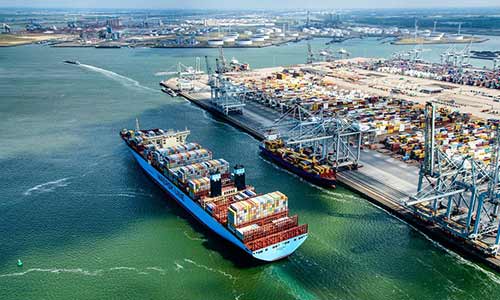
The ports handle over 1.5 million 20-foot containers yearly and out of this, less than 200,000 go through the fast track channel, leaving about 1.3 million TEUs for the physical examination process.
For the examining officer, physical cargo inspection can be life threatening.
“The stacking of goods in containers are most times done in very disorganized fashion,” an official at one of the major seaport terminals in Lagos, who did not want to be named, told our correspondent.
“If you examine a container carrying clothes for instance, an importer may decide to conceal a motorbike on top of the consignment.
“The examining officer has to crawl deep inside the container to move the items out one after the other. While he is lying on the floor of the container, the motorbike or even car could fall and crush him.
“Many officers have sustained injury this way; some have even lost their lives.”
Physical examination of one container takes an average of three to five hours and the regulators only work from 8 am to 5pm.
On a good day, there are more than 40 containers waiting on the examination bay at Lagos port and more than 60 at Tin Can Island port.
It is after the examination that the importer is cleared to move the consignment to the gate of the terminal.
However, the agent could avoid his cargo being subjected to the physical test by parting with some money.
This in itself, the tendency for corruption among Nigerians and the distrust in the Customs, is the reason why containers that have been duly cleared by Customs to leave a terminal gate gets examined by the same Customs outside the terminal gate.
This usually causes obstruction at the entrance.
“The reason why there is always a buildup of trucks at the gate entrance is because the goods inside have not been evacuated so. It becomes difficult to accept trucks coming in with empties or to pick cargo because there is no space inside,” the official told our correspondent.
In November, operators of Lagos major cargo terminal, APMT, raised an alarm over massive flooding of the port with containers.
The firm said in a statement that the number of containers inside the terminal had led to congestion, warning that if the containers were not cleared soon enough, the volume increase could lead to high yard density which could impact berthing of vessels resulting in vessel queues.
Stakeholders blame corruption
Stakeholders have argued that the process at the seaport is not supposed to be that solution defying.
“The airports exist in Nigeria and they deploy scanners to examine goods and luggage,” Captain Tajudeen Alao, Chairman, Master Mariners Association of Nigeria said.
Alao maintained that Nigeria was aware that if it tried the physical examination for cargoes at the airport, by now, its airports would be empty.
He wondered why it was that scanners could be bought and used at the airports in Nigeria but the country “finds it so difficult to deploy scanners at the seaports.”
It is not even a question of cost, the stakeholders argued.
“The cost of an average scanner is about $600,000. Ten of that can serve all the ports in Lagos and that would amount to $6m.
“It is not rocket science. There is certainly something behind their reluctance to deploy scanners.” Rear Admiral Godwill Ombo, a veteran in the maritime sector remarked.
Expressing the same sentiment, a maritime logistics expert, Mr Tunji Olaosun, attributed the practice to corruption.
Olaosun said the use of scanners would make it hard for corrupt Customs officers to have physical contact with agents where they could be bribed for easy passage of goods.
He said Nigerian ports were the only places where physical cash still exchanged hands and people refused to embrace cashless policy.
“They know that the cash could be traced,” he said.
His theory is reinforced by recent stories of operators taking millions of naira in cash to the port to carry out transactions and in some cases losing the cash to robbers.
History of scanners at seaports
In 2006, cargo scanners were acquired by service providers, namely Coctena Destination Inspection Limited, SGS Scanning Nigeria and Globalscan System. Each of them was allotted specific Customs commands they were to supply the scanners to.
The contract, which was based on build, own, operate and transfer terms, also provided that the service providers were to provide training services and technical support to the NCS on risk management, valuation and classification.
Cotecna, a leading, testing, inspection and certification company with over 40 years’ experience, was charged with the task of managing the scanners. The contract, which ran for six years, ended in December 2012 but while it lasted, the number of containers scanned daily went up to 150.
At the expiration of the initial six-year contract, the Federal Government opened a transition contract agreement with the service providers to ensure a seamless transfer of functional scanners to the NCS. This new contract was extended to November 2013.
A Transition Implementation Committee on Destination Inspection Scheme was constituted by the then Coordinating Minister of Finance, Ngozi Okonjo-Iweala, in July 2013 to oversee the transfer.
By the end of 2013, the transition process was completed and the scanners handed over to the NCS. Unfortunately, this giant leap in modernising the NCS did not last very long. A year after the handover, the scanners had stopped functioning and Nigerian ports and borders were once again returned to the analogue era of 100 per cent physical examination.
Berating the government for this incident, the Chief Operating Officer of Automedics, Mr Gbola Oba, wondered why the government did not spare resources to send some Customs officers on further training overseas to learn how to operate the scanners.
“Why spend so much money on scanners without taking time to build the manpower that could handle the equipment?
“What would it have cost them to send Customs technicians abroad for further training on how to handle the scanners and after that, regularly upgrade their training on how to handle subsequent modern equipment?” he asked.
For years, there has been this huge debate, back and forth process on scanners acquisition while the Nigerian ports keep bursting at the seams with cargo volumes and Customs continue their 100 per cent physical examination of cargoes.
The 100 per cent cargo examination itself has gained intensity because of the deep-seated distrust of his men and importers by the Customs Comptroller General, Col. Hameed Ali(retd.).
Needless to add that Nigeria has lost huge volume of cargoes to other neighbouring ports from this practice and the general deplorable situation at its ports.
Culled from Punch
[A MUST HAVE] Evidence Act Demystified With Recent And Contemporary Cases And Materials

Available now for NGN 40,000 at ASC Publications, 10, Boyle Street, Onikan, Lagos. Beside High Court, TBS. Email publications@ayindesanni.com or WhatsApp +2347056667384. Purchase Link: https://paystack.com/buy/evidence-act-complete-annotation
______________________________________________________________________ “Enhance Legal Practice With Authoritative Reports” — Alexander Payne Offers Comprehensive Law Reports, Spanning Over A Century Of Nigerian Jurisprudence Interested buyers are encouraged to place their orders and enquiries via:
0704 444 4777, 0704 444 4999, 0818 199 9888
Website: www.alexandernigeria.com
Interested buyers are encouraged to place their orders and enquiries via:
0704 444 4777, 0704 444 4999, 0818 199 9888
Website: www.alexandernigeria.com