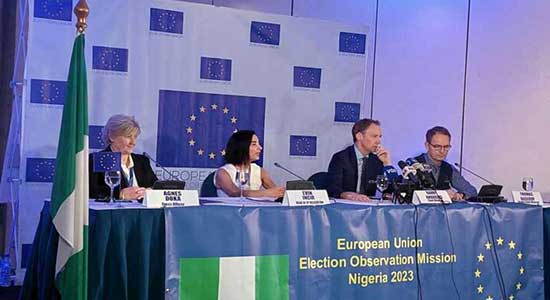
The European Union Election Observation Mission to Nigeria (EU EOM) has explained how insufficient planning, insecurity, naira and fuel shortages marred the February 25th presidential and national assembly elections.

In the summary of its preliminary statement, the EU EOM said: “On 25 February, Nigerians went to the polls in highly anticipated presidential and National Assembly elections that the Independent National Electoral Commission (INEC) kept on schedule despite a volatile and challenging environment.
“Fundamental freedoms of assembly and movement were largely respected, yet the full enjoyment of the latter was impeded by insufficient planning, insecurity and the prevailing naira and fuel shortages. Abuse of incumbency by various political officeholders distorted the playing field and there were widespread allegations of vote buying. Media provided extensive coverage of the three leading campaigns, while disinformation interfered with voters’ right to make an informed choice on election day.”
The EU EOM further said INEC’s operational capacity was hampered by the ongoing fuel and naira shortage.
Insecurity, the EU EOM stated, prevented INEC from accessing some Local Government Areas (LGAs), particularly in the South.
“Attacks on INEC premises, including just days before polling, hindered preparations in affected areas while instilling fear in voters. Overall, stakeholders had expressed confidence in INEC’s independence, professionalism, and voter information efforts, but this decreased ahead of the elections.
“INEC lacked efficient planning and transparency during critical stages of the electoral process, while on election day, trust in INEC was seen to further reduce due to delayed polling processes and information gaps related to much-anticipated access to results on its Results Viewing Portal (IReV),” the EU EOM also said.
The EU EOM added that in the lead-up to elections, the widely welcomed Electoral Act 2022 introduced measures aimed at building stakeholder trust.
It however said the Electoral Act 2022 left some important gaps in terms of accountability and INEC’s power to enforce the law.
“Weak points include a lack of INEC empowerment to enforce sanctions for electoral offences and breaches of campaign finance rules. Positively, INEC benefited from more timely financing than for previous contests. Other new provisions also aimed to enhance the transparency of results.
“The introduction of the Bimodal Voter Accreditation System (BVAS) and the IReV for the 2023 elections was perceived as an important step to ensure the integrity and credibility of elections. However, delayed training of technical personnel, an inadequate mock testing exercise, and a lack of public information on the election technologies diminished expectations and left room for speculation and uncertainty.
“During the early stages of collation, presidential result forms from polling units were not displayed on the IReV, while Senate and House of Representative results were slowly published. Presidential election result forms started to be uploaded after 10 pm on election day, raising concerns and reaching only 20 per cent by noon on 26 February. Later the same evening, INEC explained the delay with ‘technical hitches,’” the EU EOM further said.
[A MUST HAVE] Evidence Act Demystified With Recent And Contemporary Cases And Materials

Available now for NGN 40,000 at ASC Publications, 10, Boyle Street, Onikan, Lagos. Beside High Court, TBS. Email publications@ayindesanni.com or WhatsApp +2347056667384. Purchase Link: https://paystack.com/buy/evidence-act-complete-annotation
______________________________________________________________________ “Enhance Legal Practice With Authoritative Reports” — Alexander Payne Offers Comprehensive Law Reports, Spanning Over A Century Of Nigerian Jurisprudence Interested buyers are encouraged to place their orders and enquiries via:
0704 444 4777, 0704 444 4999, 0818 199 9888
Website: www.alexandernigeria.com
Interested buyers are encouraged to place their orders and enquiries via:
0704 444 4777, 0704 444 4999, 0818 199 9888
Website: www.alexandernigeria.com