
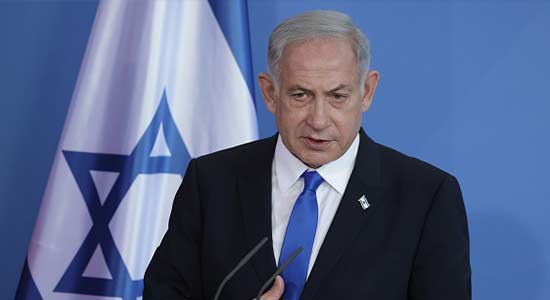
Israeli Prime Minister Benjamin Netanyahu and his main challenger, Gadi Eisenkot, have both declared their intention to form the next government following a closely contested parliamentary election in which neither political bloc secured a clear majority, according to exit polls.

The election, held on Tuesday, October 27, 2026, witnessed the highest voter turnout in decades, with Israelis voting on the future of Netanyahu’s leadership amid deep divisions over national security, the war in Gaza, relations with Iran and the country’s political direction.
Exit polls released by Israel’s three main television networks projected approximately 51 parliamentary seats each for Netanyahu’s right-wing bloc and Eisenkot’s opposition alliance, leaving both camps short of the 61 seats required to command a majority in the 120-member Knesset.
The projections followed earlier indications that the opposition had gained an advantage, but the final exit polls suggested a closely divided electorate and the possibility of prolonged negotiations over the formation of a government.
Netanyahu, Israel’s longest-serving prime minister, addressed supporters at a convention centre in Jerusalem shortly after 3 a.m. on Wednesday, calling for the formation of a strong right-wing government.
The 77-year-old leader urged parties representing the country’s Jewish nationalist majority to unite behind his political camp.
He called for a “strong government of the right,” insisting that the “Jewish and Zionist majority must unite.”
However, Netanyahu stopped short of directly declaring victory, delivering an unusually brief address despite the uncertainty surrounding the election outcome.
Instead, he highlighted Israel’s military operations against regional adversaries and raised the possibility of further action against Iran in cooperation with United States President Donald Trump.
“Israel has a unique opportunity with our partner President Trump to forever eliminate the existential threat of Iran,” Netanyahu told supporters.
His remarks came amid concerns that further military confrontation could influence the political negotiations following the election.
Eisenkot, a former Israeli military chief who emerged as Netanyahu’s principal challenger, also addressed supporters in Tel Aviv, declaring that the election represented a rejection of the incumbent prime minister’s leadership.
“The public has voted for change,” Eisenkot said.
“A worthy leader would accept the people’s vote of no confidence and announce his retirement from political life today.”
The 66-year-old opposition leader warned Netanyahu against using national security developments to influence the political process or strengthen his position during negotiations over the formation of a government.
“Netanyahu, don’t you dare use Israel’s security for your political needs,” Eisenkot declared.
He also addressed Israel’s security establishment, insisting that military and intelligence institutions owed their loyalty to the state rather than any individual political leader.
Eisenkot described Netanyahu as “a caretaker prime minister, without a mandate or the people’s trust.”
The former military chief pledged to work quickly towards forming a government and warned that holding another election would be a mistake.
His remarks followed voter turnout of nearly 78 per cent, the highest recorded in Israel since 1999.
The election was widely regarded as a referendum on Netanyahu’s leadership following years of political controversy, military conflicts and growing international criticism of Israel’s actions in Gaza and the occupied West Bank.
Netanyahu has overseen a pronounced shift towards right-wing politics during his long period in power, while his government has faced criticism over its handling of security challenges and relations with Palestinians.
The October 7, 2023, attack by Hamas and Israel’s subsequent military offensive in Gaza remained central issues during the campaign.
Eisenkot, despite positioning himself as an alternative to Netanyahu, shares several of the prime minister’s security positions and supported Israel’s military offensive in Gaza following the Hamas attack.
However, he has promised a more inclusive political environment within Israel and pledged to restrain extremist Israeli settlers accused of attacking Palestinians in the occupied West Bank.
One of the most notable developments in the election was the sharp increase in support for Arab Israeli political parties.
Exit polls projected that Arab parties could secure between 17 and 18 parliamentary seats, following a surge in voter participation among Arab communities.
Some Arab Israeli communities recorded exceptionally high turnout, driven partly by opposition to Netanyahu and the rhetoric of his far-right political allies.
The increased participation could prove decisive in determining whether either of the two major blocs can secure enough parliamentary support to govern.
Mansour Abbas, a prominent Arab Israeli political leader, said Netanyahu’s right-wing bloc had suffered a major setback and indicated that he was open to cooperating with Eisenkot.
Abbas expressed the view that the right had “suffered a major loss” in the election.
However, Eisenkot had stated during the campaign that he would not form a government with Arab Israeli lawmakers as coalition partners.
Netanyahu also suggested that any government dependent on Arab parliamentary votes would lack political legitimacy.
Despite these positions, Arab lawmakers could potentially support an Eisenkot-led minority government during parliamentary votes without formally joining the governing coalition.
Such an arrangement could allow the opposition to govern even without securing a conventional parliamentary majority through coalition membership.
However, failure to reach an agreement could force Israel into another election.
The possibility of a unity government between Netanyahu and Eisenkot has also generated opposition from influential figures within Israel’s far-right political movement.
Itamar Ben Gvir, a prominent far-right politician and supporter of hardline policies towards Palestinians, warned Netanyahu against forming a unity government with Eisenkot.
“It would be a terrible mistake,” Ben Gvir said.
Exit polls suggested that Ben Gvir’s political camp had not performed as strongly as some observers had anticipated.
Political analysts noted that the hardline rhetoric of Netanyahu’s allies may have contributed to the unusually high turnout among Arab Israeli voters.
Gideon Rahat, a political scientist at the Hebrew University of Jerusalem, suggested that Ben Gvir had inadvertently encouraged Arab voters to participate in greater numbers.
Rahat, however, cautioned against interpreting the exit polls as a decisive victory for either political bloc.
“Even if Netanyahu lost, that doesn’t mean Eisenkot won,” he said.
The uncertainty surrounding the election comes as Israel faces increasing diplomatic pressure over its military operations in Gaza, the conflict involving Iran, settlement expansion and violence in the occupied West Bank.
Netanyahu is also facing an arrest warrant issued by the International Criminal Court in connection with the Gaza conflict, alongside domestic corruption charges.
The prime minister denies wrongdoing in the corruption proceedings.
His political future could have implications for the continuation of those proceedings and Israel’s relations with international institutions.
Eisenkot, meanwhile, entered the election as a relatively new figure in party politics despite his extensive military background.
The son of working-class Moroccan Jewish immigrants, he would become Israel’s first prime minister of Middle Eastern or North African descent if he succeeds in forming a government.
His personal experience of the Gaza conflict also featured prominently during the election campaign.
Before casting his vote, Eisenkot privately visited the grave of his son, Gal, who was killed while fighting in Gaza.
The death of his son has attracted sympathy from many Israelis and shaped public perceptions of his leadership.
The election also attracted considerable interest among Israelis living abroad, with tens of thousands estimated to have returned to the country to participate in the vote.
Among them was 55-year-old Eilana Zisblit, who travelled from Canada, where she had lived for almost three decades, to support a centre-right party within Eisenkot’s political alliance.
“The country is going in a really, really bad direction. Both for Jews and Arabs living in the country, and for Jews living abroad,” she said.
She warned that urgent political change was necessary, adding that the time to act was “now, or the country really won’t survive anymore”.
With both major political blocs projected to secure approximately 51 seats each, attention has shifted to coalition negotiations and the potential role of smaller parties in determining Israel’s next government.
The projected 17 to 18 seats for Arab Israeli parties could make them influential in the parliamentary calculations, although disagreements over coalition participation remain unresolved.
Neither Netanyahu nor Eisenkot has secured the parliamentary majority required to govern, and the outcome will depend on the final election results and subsequent negotiations.
[A MUST HAVE] Evidence Act Demystified With Recent And Contemporary Cases And Materials
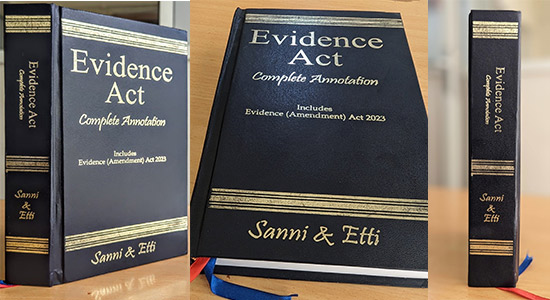
Available now for NGN 40,000 at ASC Publications, 10, Boyle Street, Onikan, Lagos. Beside High Court, TBS. Email publications@ayindesanni.com or WhatsApp +2347056667384. Purchase Link: https://paystack.com/buy/evidence-act-complete-annotation
______________________________________________________________________ “Enhance Legal Practice With Authoritative Reports” — Alexander Payne Offers Comprehensive Law Reports, Spanning Over A Century Of Nigerian Jurisprudence Interested buyers are encouraged to place their orders and enquiries via:
0704 444 4777, 0704 444 4999, 0818 199 9888
Website: www.alexandernigeria.com