*Says Lagos Waterfront Demolitions Are Illegal

Senior Advocate of Nigeria and prominent human rights lawyer, Femi Falana, has criticised the Nigerian Senate for what he describes as deliberate delays in the passage of the Electoral Act Amendment Bill, warning that postponements could jeopardise the credibility of the 2027 general elections.
Falana also condemned the Lagos State Government’s demolition of waterfront communities, describing them as illegal in light of a Supreme Court decision that state governments have no control over inland waterways.
Speaking in an interview with Arise News on Sunday, Falana expressed dismay at the Senate’s decision to set up yet another committee to review the bill, despite the House of Representatives having passed it in December 2025.
“Clearly, from the conduct of both chambers of the National Assembly, it is very clear that the members simply want the status quo retained. This rigmarole is meant to give the impression to Nigerians that the proposed Electoral Act is being addressed,” Falana remarked.
For the second time in one week, the Senate failed to pass the Electoral Act Amendment Bill. After every other matter on the order paper was stepped down to allow lawmakers deliberate on the report of its Electoral Committee, the Senate went into a closed-door session for more than two hours.
When the doors reopened, Senate President Godswill Akpabio announced the decision to set up another committee to make greater inputs and properly compile the opinion of lawmakers regarding the Electoral Act Amendment Bill.
The high-powered committee, chaired by Senator Adeni Adigbo-Mire, Chairman of the Senate Committee on Judiciary, Human Rights and Legal Matters, was given two days to complete the assignment and revert to the Senate for further deliberation on Tuesday.
Other members include Senators Adamu Aguero, Waziri Tambuwal, Adams Oshiomhole, Mohammed Goje, Tony Nwoye, and Titus Zam.
The Electoral Act Amendment Bill introduces significant reforms, including provisions for electronic transmission of election results in real time from each polling unit, simultaneously with physical collation of results; increase in fine for vote-buying and selling from N500,000 to N5 million with a ten-year ban on perpetrators from contesting elections; voting rights for inmates; and a term of two years imprisonment for persons who financially or materially induce delegates to influence the outcome of party conventions.
Falana argued that these changes are necessary to close longstanding loopholes in Nigeria’s electoral process. He recalled that crucial reforms, such as the establishment of an electoral offences commission recommended as far back as 2008, remain unimplemented.
He emphasised the need to codify electronic accreditation and transmission of results into law, especially after controversies in previous elections.
“Last election, we were subjected to a national disgrace when three leading presidential candidates claimed to have won. That election petition lasted 10 months. Now, we now want those provisions amended so that it won’t be optional. Why will it take two years to put that in the law?” he queried.
Falana warned that from the look of things, the bill would be passed belatedly, noting that under the law and the ECOWAS Protocol on Democracy and Good Governance, an electoral act cannot be amended six months to the election.
“With the way things are going, you can be very sure that the delay will be so dangerous that we may just be told we need to allow the status quo to remain. This is what this rigmarole is all about. I think there are anti-democratic elements that are not prepared to allow any change in the status quo,” he said.
Falana urged Nigerians and civil society groups to intensify pressure on lawmakers, stating, “Unless Nigerians are mobilised to pressure the National Assembly, the new electoral bill will not be passed. There is no indication that it will be passed unless we act.”
On the demolition of waterfront communities in Lagos, Falana declared that the exercises are completely illegal, citing a Supreme Court decision that state governments have no control over inland waterways in the country.
“So going to any waterfront to demolish or displace people is illegal completely,” Falana stated.
Falana disclosed that he has been involved in demolition cases in Lagos for the past 35 years, recalling the case of Maroko where 300,000 people were displaced.
“The place that was said to be submerged was some field and the land was distributed to the rich. We got many of those who were displaced to take over the completed buildings — that’s Jakonde estate in Abesan and Ikota — and they took over. We went to court that the government could not force them out, having turned them into squatters in the house. The court made an order: if you want to get them, go to court,” Falana said.
He added that those residents are now being ejected by the government.
Falana cited multiple court orders against the Lagos State Government in eviction cases:
In the case of Makoko, a Federal High Court order by Justice Ogazi not only stopped the Lagos State Government but awarded damages against the government.
In the case of another waterfront, Justice Yoni Banjo gave a judgment in 2017 directing that if the government wants to eject residents, it must dialogue with those affected and discuss resettlement plans with them.
“Not less than ten cases have been lost by the government in eviction cases — illegal demolition, illegal acquisition,” Falana stated.
Falana said Section 17 of the Constitution provides that all actions of the government shall be humane.
“So you can’t go to a community in the dead of the night, tear gas them to wake them up and confuse them, and while they are running out of scatter, you begin to demolish their properties. It’s not part of our law,” he said.
“Our people are entitled to the right to dignity. Our people are entitled to right to housing. If the government wants to demolish, no problem, but you must discuss and place them in some other place.”
He cited historical examples of humane resettlement, including Surulere, which was a slum developed by the late Azikiwe Nnamdi when he was a minister under the colonial regime in the 1950s, and the Jakonde government which resettled traders and mechanics from the heart of Lagos to Oworo, about 24 hectares of land.
On the Oworonshoki situation, Falana disclosed that in November last year, the Governor of Lagos State “surreptitiously” gave the Certificate of Occupancy on the 24-hectare land — originally allocated for resettlement by the Jakonde government — to a private entity.
“Those who were affected had been protesting. In August this year, there was an attack on the community. Six people were killed. Nobody in government in Lagos State or the police commiserated with the bereaved families. So, they joined the protest,” Falana said.
On the arrest of protesters who demonstrated against the demolitions, Falana said the organisers complied with the provisions of Section 83(4) of the Police Establishment Act, which requires protesters to notify the police so that adequate security can be provided.
“The organiser of the protest took a letter to the commissioner of police. He rejected the letter and had to call him. They have complied with the provision of the law,” Falana said.
He stated that the police commissioner led the police team, there was no disturbance on the street, and the protesters walked peacefully from under the bridge in Ikeja to Alausa, where they sat on the floor at the House of Assembly complex and demanded that the government address them.
“That is not a criminal offense under our law,” Falana said.
He condemned the use of tear gas on the peaceful protesters, stating that some of the injured are still in the hospital.
On allegations that the protesters were singing anti-government songs, Falana referenced the Court of Appeal decision in Otonwankwa v. The State, where the court advised people in government: “If you feel too irascible and you become so intolerant, please cover your ears with cotton wool. Because criticism is indispensable in a democratic society.”
“Were they expecting them to be singing hallelujah or be praising the government?” Falana queried.

Get your copy today and take the first step toward financial growth:👉 https://selar.co/4f16676016
_______________________________________________________________________ ARTIFICIAL INTELLIGENCE FOR LAWYERS: A COMPREHENSIVE GUIDE
Reimagine your practice with the power of AI “...this is the only Nigerian book I know of on the topic.” — Ohio Books Ltd
Authored by Ben Ijeoma Adigwe, Esq., ACIArb (UK), LL.M, Dip. in Artificial Intelligence, Director, Delta State Ministry of Justice, Asaba, Nigeria.
Bonus:
Get a FREE eBook titled “How to Use the AI in Legalpedia and Law Pavilion” with every purchase.
ARTIFICIAL INTELLIGENCE FOR LAWYERS: A COMPREHENSIVE GUIDE
Reimagine your practice with the power of AI “...this is the only Nigerian book I know of on the topic.” — Ohio Books Ltd
Authored by Ben Ijeoma Adigwe, Esq., ACIArb (UK), LL.M, Dip. in Artificial Intelligence, Director, Delta State Ministry of Justice, Asaba, Nigeria.
Bonus:
Get a FREE eBook titled “How to Use the AI in Legalpedia and Law Pavilion” with every purchase.
How to Order: 📞 Call, Text, or WhatsApp: 08034917063 | 07055285878 📧 Email: benadigwe1@gmail.com 🌐 Website: www.benadigwe.com
Ebook Version: Access directly online at: https://selar.com/prv626
________________________________________________________________________ The Law And Practice Of Redundancy In Nigeria: A Practitioner’s Guide, Authored By A Labour & Employment Law Expert Bimbo Atilola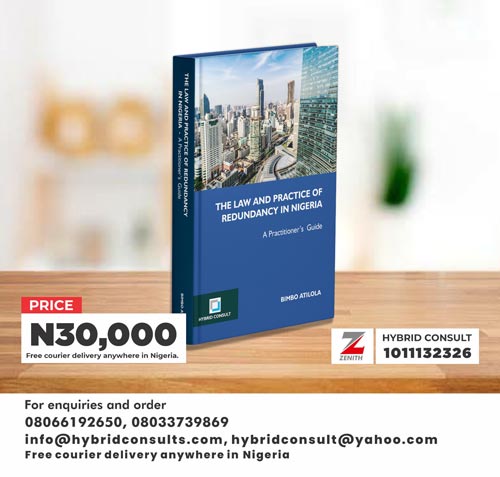 _______________________________________________________________________
[A MUST HAVE] Evidence Act Demystified With Recent And Contemporary Cases And Materials
_______________________________________________________________________
[A MUST HAVE] Evidence Act Demystified With Recent And Contemporary Cases And Materials