
The Supreme Court of Nigeria on Thursday set aside the controversial status quo ante bellum order earlier made by the Court of Appeal in the protracted leadership dispute rocking the African Democratic Congress, holding that the preservative directive could not validly subsist after proceedings had been concluded.

In a unanimous decision delivered by a five-member panel headed by Justice Mohammed Lawal Garba, the apex court held that the Abuja Division of the Court of Appeal acted beyond its jurisdiction when it directed the ADC to maintain the status quo ante bellum after it had already dismissed the appeal before it.
The court held that once the Court of Appeal dismissed the appeal, it no longer had the basis to issue a consequential order directing parties to maintain the status quo ante bellum. “Giving such an order in an appeal it had already dismissed was unnecessary, unwarranted and improper,” the Supreme Court held in unequivocal terms.
The judgment followed an appeal filed by the David Mark-led faction of the ADC in the ongoing leadership dispute within the party. The apex court also dismissed the preliminary objection filed by lawyers representing the Nafiu Gombe faction against the appeal.
Delivering the lead judgment, Justice Mohammed Garba acknowledged that courts possess inherent powers to make preservative orders to protect the subject matter of litigation, but stressed that such orders cannot survive once proceedings have been “fully, conclusively and finally concluded.” The apex court subsequently allowed the appeal and nullified the order sustaining the status quo ante bellum in the dispute involving rival factions of the ADC leadership.
The judgment arose from the protracted legal battle over the party’s leadership structure, including the legitimacy of appointments and congresses conducted by opposing factions within the party.
In his reasoning, Justice Garba explained that the trial court’s directive maintaining the status quo ante bellum was essentially a preservative order intended to prevent parties from taking steps capable of foisting a fait accompli on the court while proceedings were ongoing. He, however, held that such powers must be exercised only in relation to live proceedings, declaring that once proceedings have been “fully, faithfully, conclusively and finally concluded,” there would be “nothing left for that court to preserve.”
The apex court also addressed the competence of the appeal filed in the matter and the constitutional basis relied upon by the appellants. Justice Garba held that Section 241(1)(f)(ii) of the 1999 Constitution, which provides for appeals as of right in certain interlocutory decisions relating to injunctions, did not apply in the circumstances of the case.
He held that the trial judge neither granted nor refused an application for injunction but merely issued procedural directives aimed at preserving the subject matter of the dispute pending hearing. The court further ruled that because the grounds of appeal were not purely on points of law, leave of court was required before the appeal could validly be filed.
The justice stressed that obtaining leave in such circumstances was a “condition precedent” to the validity and competence of the appeal, adding that the competence of a notice of appeal goes to the jurisdiction of the court and once defective, the entire appeal becomes incompetent.
Despite those findings, the apex court proceeded to examine the propriety of the preservative orders made by the lower courts and ultimately held that sustaining the status quo ante bellum after the relevant proceedings had ended was unnecessary and legally unsustainable.
The Supreme Court consequently set aside the order and directed that pending processes before the lower court be determined in accordance with the law. It also rejected the argument challenging the jurisdiction of the Court of Appeal, holding that the appellate court acted within its powers in entertaining the matter.
However, the apex court held that the appeal succeeded only in part, as it rejected the aspect challenging the ex parte order made by the Federal High Court for service of processes in the suit filed by aggrieved members of the party. The apex court consequently directed the parties to return to the Federal High Court for continuation of hearing in the substantive case.
The decision comes amid a prolonged battle for control of the ADC’s national structure between the David Mark-led leadership and the faction linked to Nafiu Gombe. The dispute had earlier prompted the Independent National Electoral Commission to remove Mark and Rauf Aregbesola from its portal and website as ADC National Chairman and National Secretary, respectively, on 1st April, citing the Court of Appeal’s judgment.
INEC had said that, in line with the order for the maintenance of status quo ante bellum, it would not recognise any of the warring factions until the legal dispute was determined. With the Supreme Court now setting aside that order, the matter will return to the Federal High Court, where the substantive leadership dispute is expected to continue.
TheNigeriaLawyer recalls that the dispute is rooted in a suit filed at the Federal High Court by Nafiu Bala Gombe, who challenged the emergence of former Senate President David Mark as national chairman of the ADC. In the suit, Gombe asked the court to restrain Mark’s faction from parading itself as the party’s leadership and to compel INEC to recognise him instead.
Upon hearing the matter, the Federal High Court ordered all parties to maintain the status quo pending the determination of the substantive suit, in order to prevent actions that could undermine the judicial process. Dissatisfied with the proceedings at the trial court, Mark’s faction approached the Court of Appeal, challenging the jurisdiction of the Federal High Court to hear the case.
However, the Court of Appeal dismissed the appeal and upheld the proceedings at the trial court, affirming that the Federal High Court was competent to entertain the suit. The appellate court further directed all parties, including INEC, to maintain the status quo to avoid rendering the outcome of the case useless.
Following the ruling, INEC announced that it would not recognise any faction of the ADC and proceeded to remove the names of Mark and his executive from its official portal, citing compliance with the court’s directive. The Mark-led faction subsequently escalated the matter to the Supreme Court, again challenging the jurisdiction of the lower courts and the propriety of the orders made in the case.
INEC’s decision had effectively left the ADC without a recognised leadership at a crucial period in the build-up to the 2027 general elections. With the Supreme Court’s verdict now setting aside the Court of Appeal’s status quo ante bellum order, the substantive leadership dispute returns alive to the Federal High Court, where the political and legal contest for the soul of the ADC is expected to enter a fresh and decisive phase.
 Interested buyers are encouraged to place their orders and enquiries via:
0704 444 4777, 0704 444 4999, 0818 199 9888
Website: www.alexandernigeria.com
Interested buyers are encouraged to place their orders and enquiries via:
0704 444 4777, 0704 444 4999, 0818 199 9888
Website: www.alexandernigeria.com
 Reimagine your practice with the power of AI “...this is the only Nigerian book I know of on the topic.” — Ohio Books Ltd
Authored by Ben Ijeoma Adigwe, Esq., ACIArb (UK), LL.M, Dip. in Artificial Intelligence, Director, Delta State Ministry of Justice, Asaba, Nigeria.
Bonus:
Get a FREE eBook titled “How to Use the AI in Legalpedia and Law Pavilion” with every purchase.
Reimagine your practice with the power of AI “...this is the only Nigerian book I know of on the topic.” — Ohio Books Ltd
Authored by Ben Ijeoma Adigwe, Esq., ACIArb (UK), LL.M, Dip. in Artificial Intelligence, Director, Delta State Ministry of Justice, Asaba, Nigeria.
Bonus:
Get a FREE eBook titled “How to Use the AI in Legalpedia and Law Pavilion” with every purchase.
How to Order: 📞 Call, Text, or WhatsApp: 08034917063 | 07055285878 📧 Email: benadigwe1@gmail.com 🌐 Website: www.benadigwe.com
Ebook Version: Access directly online at: https://selar.com/prv626
_______________________________________________________________________ [A MUST HAVE] Evidence Act Demystified With Recent And Contemporary Cases And Materials
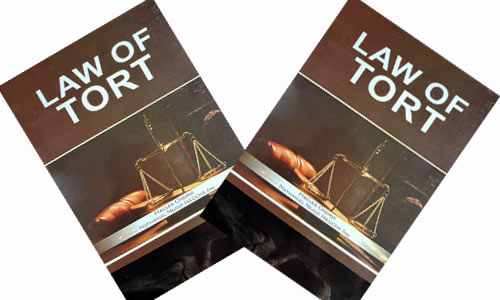 The book, titled The Law of Torts in Nigeria: A Functional Approach, authored by Professor Hagler Sunny Okorie Ph.D and Ikeocha, Nathaniel Ngozi Esq, offers law students, practitioners, and academics a comprehensive guide to understanding and applying tort law in Nigerian courts. Interested buyers can place orders via the following contact numbers: 08028636615, 08037667945, 08032253813, or +234 902 196 2209.