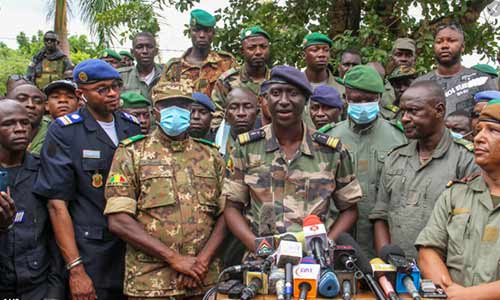
Hopes that soldiers behind Mali’s coup would swiftly restore civilian rule and tackle jihadism and ethnic violence are fading fast as the army expands its role.

Many in the large Sahel country hailed the August 18 putsch as the precursor of a “new Mali” — a nation that would emerge stronger and more stable, its institutions better placed to confront the country’s many ills.
Young army officers toppled president Ibrahim Boubacar Keita after weeks of protests sparked largely by his failures to roll back a jihadist insurgency and root out perceived corruption.
Threatened by international sanctions, the junta handed power to a caretaker institution which is supposed to last for up to 18 months until elections are held.
But disenchantment at the slow pace of reforms is growing, fuelled by anger that figures with army links dominate the body.
Political parties, swiftly ousted from the decision-making process, have almost unanimously denounced the methods of the military.
“It would appear that this has been manipulation,” said Boubacar Diawara, an expert on public law and governance.
Mali is “a fragile country built like a house of cards,” he said. “The junta had the possibility of consolidating the foundations, but they did not do it.”
Nepotism and inaction remain. Hospitals are overwhelmed with Covid-19 cases, while social discontent is mounting and many public service employees are on indefinite strike.
The number of jihadist attacks has declined but there is no evident connection with any political changes in Bamako, the southern capital far from territory frequented by armed Islamists.
The latest controversy arose with the creation of the National Transition Council (CNT), designed to take the place of parliament for the transition.
— Programmed for failure? —
The criteria for appointing the 121 members of the CNT and even the true identity of some of those named remain obscure. Others have been given seats without showing any prior interest.
Filmmaker Boubacar Sidibe is a victim of this.
He was a CNT candidate who was accepted, his name placed on file with his date of birth and profession. But when he sat in his place at the inaugural session, a man with the same name introduced himself and stated that seat 101 was reserved for “the military quota.” Sidibe was shown out.
“We’re bringing to the table the same procedural irregularities that we denounced in the past,” said Abdourhamane Ben Mamata Toure, former director of training at the National School of Administration, which has produced top civil servants.
“We pre-programmed the failure of the reforms we want to carry out. The most basic principle is that of trust, and we have already stumbled over it,” he said.
The military now virtually has a stranglehold over the institutions of transition.
Among the coup leaders, Colonel Assimi Goita obtained a tailor-made role as powerful vice president of the transitional government; Colonel Malick Diaw was promoted president of the CNT; and Colonel Sadio Camara and Colonel Major Ismael Wague respectively took charge of the strategic ministries of defence and of reconciliation.
Thirteen of Mali’s 20 regional governors are now soldiers following a spate of nominations in November.
— ‘Military from the start’ —
Mali’s transitional president Bah Ndaw and Prime Minister Moctar Ouane are civilians, but when the head of state recently disappeared for several days, speculation swirled that he had been sidelined or had even quit.
“Today it’s Goita who makes all the choices. Bah Ndaw is there to sign the decrees and that’s all,” said governance expert Diawara.
Former justice minister Mamadou Ismaila Konate said people who protest at the militarisation of the regime “have only themselves to blame”.
“We let Assimi Goita pick the president, the prime minister, three-quarters of the government and virtually all of the CNT.”
“Even the Queen of England and the Pope are not capable of appointing so many figures of the state,” he observed.
A Western diplomat took a more measured view, saying: “Those who condemn excessive militarisation forget that the transition was military from the start, and this didn’t bother many people at the time.”
Apart from the United States, which suspended all military assistance for the duration of the transition, Mali’s foreign partners have taken diplomatic note of the situation. Many argue a case for pragmatism.
“There are possibilities for reform, take advantage of them!” suggested one diplomat.
[AFP]
[A MUST HAVE] Evidence Act Demystified With Recent And Contemporary Cases And Materials

Available now for NGN 40,000 at ASC Publications, 10, Boyle Street, Onikan, Lagos. Beside High Court, TBS. Email publications@ayindesanni.com or WhatsApp +2347056667384. Purchase Link: https://paystack.com/buy/evidence-act-complete-annotation
______________________________________________________________________ “Enhance Legal Practice With Authoritative Reports” — Alexander Payne Offers Comprehensive Law Reports, Spanning Over A Century Of Nigerian Jurisprudence Interested buyers are encouraged to place their orders and enquiries via:
0704 444 4777, 0704 444 4999, 0818 199 9888
Website: www.alexandernigeria.com
Interested buyers are encouraged to place their orders and enquiries via:
0704 444 4777, 0704 444 4999, 0818 199 9888
Website: www.alexandernigeria.com