By Lawal Ogienagbon

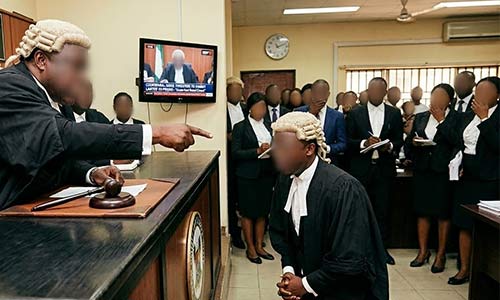
The courtroom is a sacred place. It is the temple where the judge holds sway as priest. From his elevated bench inside the court, His Lordship surveys everything going on around him. Many judges can be funny in the course of proceedings, while the mien of others can be intimidating. If you are in the court of a lively judge, you will feel like going to the place every day to watch proceedings.
The court is a public place; you can go in and come out, as long as you do not breach its protocols. You do not chat in court, nor talk while the judge is talking. You rise and take a bow when His Lordship comes in. When he calls the court to order, everywhere must be silent. This perfect silence may give you the creeps as a first timer because it makes the courtroom look surreal. You see people all around but you cannot talk to them. When you try to start a conversation you are met with silence.
The only voices you hear are those of the judge and a lawyer; or a lawyer examining or cross-examining a witness. Or a member of the audience specifically asked by the court to shed light on some issues. The court belongs to the judge. He directs proceedings without recourse to any other authority. No matter how big a lawyer is or for how long he has been practicing, he is subject to the judge’s authority. So, a lawyer must be careful when appearing in court.
He can only assert his rights and privileges as a lawyer to the extent that he does not cross the judge’s path. A wise lawyer knows how to handle a judge in order to have his way. If he speaks with respect and comports himself, he can make a stone-faced judge to grant his wish. It is all a matter of approach. It is a grave mistake for any lawyer to think he can bully a judge in order to have his way. Any lawyer who tries that may be on his way to jail or kneeling down!
Kneeling down was a common punishment in schools those days. Every little thing before you know it you will hear a loud voice behind you: “kneel down there, hands up and close your eyes”. In many cases that loud voice belongs to a senior, who may not be more than a year ahead of you. But senior na senior as we used to say in my alma mater. Seniority was respected; whether it is by one year ‘only’, it did not matter.
What matters is that the person telling you to kneel down is your senior. If you do not comply, you will find yourself in a hot pot of soup. His classmates will rally round him and force you to serve the punishment after descending on you with slaps and blows. While doing this, they will be shouting on top of their voices “do you think 365 days is a joke?” By then, many other students would have gathered to watch the spectacle. The only saving grace may be the intervention of those senior to your own senior who will prevail on him to let you go.
As he releases you, you will hear him muttering “do you think I bought my seniority? When you become a senior, you will know what it means for your junior not to obey you. Next time, you obey first before complain”. This was usually the baptism of fire for Form One students by their Form Two counterparts who are their senior just by “365 days”. This scenario played out in my mind as I read the story of the lawyer asked to “kneel down” in court by a judge. The judge must have gone to school in those good old days of corporal punishment. As I read the story, I was looking forward to His Lordship ending it with “hands up and close your eyes”.
He never did, perhaps because of the intervention of other lawyers in court. In most cases, judges never get to punish lawyers for contempt in the face of the court. Immediately, a judge makes up his mind to wield the big stick, other lawyers will rise in unison, pleading for the errant lawyer. Many times, their lordships are moved and they allow the matter to rest. Punishment for contempt is at the discretion of the judge, but it must be done strictly in accordance with the law.
There is no law that prescribes “kneeling down” as punishment for contempt, but if a judge decides to give it as a sentence for being rude to him, the offending person can only pray for help to come from somewhere before he serves the punishment. In court, the judge is the lord who applies the law the way he deems fit. I believe that Justice Muhammed Umar was not thinking of any legal provision when he decided to punish Marshall Abubakar for contempt of court. His Lordship appeared to have been only interested in twisting the lawyer’s ears for disrespecting the court.
We should not be too legalistic about this issue. I am a stickler for the law, but at the same time, nobody, not even a lawyer, should hide under the ambit of the law to disrespect a judge in his own court. How many of those throwing the law at Justice Umar would have condoned such a thing if they were in his shoes? The judge is the master of his court, and not the lawyer. If a lawyer wants a favour, he should know how to approach the court. He cannot speak in a tone that suggests that he can do or say anything under the guise of arguing his case and get away with it.
Thank God for the lawyers that saved the day. Otherwise, Justice Umar would have made Abubakar to “kneel down” in open court, and the heavens would not have fallen. Yes, on the strength of law, Abubakar may get the punishment nullified on appeal, but at what cost to him and his career? By then, Justice Umar would have made his point that in his own court there is no room for legal theatrics. The beauty of the law profession is the respect for seniority and authority. What has happened to that?
The bench and bar do not need this kind of drama, which in many cases are enacted by lawyers playing to the gallery, just to impress their clients. Respect begets respect. Judges should respect lawyers and vice versa. The lesson from this episode is that no matter how small a lawyer thinks the judge is, His Lordship rules the roost in his court. It is not a matter of law, but of honour and respect. I rise.

 ARTIFICIAL INTELLIGENCE FOR LAWYERS: A COMPREHENSIVE GUIDE
Reimagine your practice with the power of AI “...this is the only Nigerian book I know of on the topic.” — Ohio Books Ltd
Authored by Ben Ijeoma Adigwe, Esq., ACIArb (UK), LL.M, Dip. in Artificial Intelligence, Director, Delta State Ministry of Justice, Asaba, Nigeria.
Bonus:
Get a FREE eBook titled “How to Use the AI in Legalpedia and Law Pavilion” with every purchase.
ARTIFICIAL INTELLIGENCE FOR LAWYERS: A COMPREHENSIVE GUIDE
Reimagine your practice with the power of AI “...this is the only Nigerian book I know of on the topic.” — Ohio Books Ltd
Authored by Ben Ijeoma Adigwe, Esq., ACIArb (UK), LL.M, Dip. in Artificial Intelligence, Director, Delta State Ministry of Justice, Asaba, Nigeria.
Bonus:
Get a FREE eBook titled “How to Use the AI in Legalpedia and Law Pavilion” with every purchase.
How to Order: 📞 Call, Text, or WhatsApp: 08034917063 | 07055285878 📧 Email: benadigwe1@gmail.com 🌐 Website: www.benadigwe.com
Ebook Version: Access directly online at: https://selar.com/prv626
________________________________________________________________________ The Law And Practice Of Redundancy In Nigeria: A Practitioner’s Guide, Authored By A Labour & Employment Law Expert Bimbo Atilola _______________________________________________________________________