The Gambia Bar Association (GBA) has raised concerns over the alleged delay by the country’s judiciary in assigning and hearing a constitutional suit challenging the appointment and eligibility of the Chief Justice, Edi M.O. Faal, warning that the continued inaction could undermine public confidence in the administration of justice.

The association disclosed that more than three months after it instituted the suit on July 31, 2026, the case had neither been assigned to a Supreme Court Justice for directions nor listed for hearing.
In a statement issued on Monday, November 9, 2026, the GBA described the delay as deeply troubling, particularly because the suit concerns the constitutional qualifications and eligibility of the country’s highest judicial officer, who is named as the second defendant.
The association stressed the constitutional importance of the office of the Chief Justice, including its position in the presidential line of succession, arguing that a challenge concerning the legitimacy of such an office deserved prompt judicial consideration.
According to the GBA, it had expected the Supreme Court to issue procedural directions during the judicial vacation to enable the parties to file their submissions and ensure that pending applications could be heard promptly when the courts resumed in October.
However, the association maintained that no meaningful judicial action had been taken since the case was filed.
It disclosed that its lawyers wrote formally to the Registrar of the Supreme Court on October 26, 2026, requesting the urgent assignment and progression of the proceedings.
The Registrar reportedly responded on October 30, confirming that the case file had been received and forwarded to the Chief Justice for directives.
According to the association, the Registrar indicated that the directives would be communicated “if and when received.”
The GBA described the response as inadequate, questioning why a case challenging the Chief Justice’s own appointment and constitutional eligibility should remain subject to his administrative directions.
It argued that the Chief Justice’s personal interest in the outcome of the proceedings made it inappropriate for him to exercise any discretionary control over the assignment, progression or determination of the case.
“The Chief Justice has a direct personal interest in proceedings challenging the constitutionality of his own appointment. He ought not to exercise any judicial authority or discretionary control over the assignment, progression or determination of those proceedings,” the association stated.
The GBA maintained that the matter should instead be placed before independent Justices of the Supreme Court who have no personal interest in its outcome.
It further complained that the Registrar’s October 30 response neither provided a hearing date nor clarified whether any procedural requirements remained outstanding.
The association disclosed that its lawyers sent another letter on November 3 seeking clarification and urgent action but had yet to receive a response.
The GBA also revealed that the Attorney General had applied for the Chief Justice’s recusal from the proceedings, adding that it did not oppose the application.
“Both sides have therefore taken the position that the Chief Justice should not sit in this matter,” the association stated.
While acknowledging the Chief Justice’s general administrative authority as head of the judiciary, the GBA argued that the circumstances required a distinction between routine administrative responsibilities and decisions capable of influencing the proceedings.
It explained that although the receipt and forwarding of case files could be regarded as administrative functions, decisions concerning the assignment of judges, the hearing of applications and the constitution of judicial panels could directly affect how a case proceeds.
“Receiving or forwarding a file is administrative. Giving directions on pending applications, deciding when and whether the case is listed, and constituting the panel are acts that shape how the case is heard. A party to the case should not do any of those things,” the association stated.
The GBA further argued that allowing a party with a personal interest in litigation to exercise such authority would undermine the principle that no person should be a judge in their own cause.
It insisted that its request was not for the Registry to determine the constitutional dispute but for the matter to be assigned to an independent judicial officer who could issue appropriate procedural directions.
“The GBA does not ask the Registry to decide any issue. It asks that the case be placed before an independent Justice of the Supreme Court for directions, and then listed and heard. The GBA will not accept that access to the Supreme Court depends on the discretion of an interested party,” the statement added.
The association also raised concerns about what it described as similar delays affecting other cases filed before the Supreme Court in recent months.
According to the GBA, several matters, including those involving urgent applications, had allegedly remained unattended in the Chief Justice’s office.
“Incidentally, there are several other cases filed in the past few months, some with urgent applications that need to be heard, suffering the same fate, gathering dust in the office of the Chief Justice. Justice delayed is justice denied,” it stated.
The association warned that the approaching end of the current judicial term in December could further complicate the situation, potentially pushing the constitutional challenge into another judicial term without the matter being mentioned in court.
It expressed concern that the continued failure to assign and list the suit was creating a perception that the proceedings were being deliberately delayed.
“Whether intended or otherwise, the practical consequence is the same: a matter going to the constitutional legitimacy of the highest judicial office remains in abeyance, without judicial consideration,” the association said.
The GBA explained that it instituted the constitutional challenge as part of its responsibility to defend the Constitution, uphold the rule of law and protect the independence and integrity of the judiciary.
It stressed that it was not seeking a predetermined judicial outcome but wanted the constitutional questions raised in the suit to be considered and determined by an independent and impartial court.
The association also warned that any directive or interference concerning the listing, hearing or constitution of the court by a party to the proceedings or anyone with a personal interest in the outcome could raise serious fair-hearing concerns.
“Should that occur, the GBA reserves the right to rely on it as a ground for alleging a denial of justice and to seek all appropriate relief,” it warned.
Consequently, the association demanded that the judiciary publicly clarify whether any directives had been issued concerning the case and, if none had been issued, explain the reasons for the delay.
It also called for the immediate placement of the case file before an independent Supreme Court Justice for preliminary directions, followed by the listing and hearing of the pending applications.
The GBA emphasised that its statement was directed at the procedural delay and the handling of the case rather than the substantive merits of the constitutional challenge to Chief Justice Faal’s appointment.
It maintained that the question of the Chief Justice’s constitutional eligibility should be determined by the court through a fair and independent judicial process.
The association warned that it reserved the right to pursue any legitimate action necessary if the case was not urgently assigned, listed and heard.
[A MUST HAVE] Evidence Act Demystified With Recent And Contemporary Cases And Materials

Available now for NGN 40,000 at ASC Publications, 10, Boyle Street, Onikan, Lagos. Beside High Court, TBS. Email publications@ayindesanni.com or WhatsApp +2347056667384. Purchase Link: https://paystack.com/buy/evidence-act-complete-annotation
______________________________________________________________________ “Enhance Legal Practice With Authoritative Reports” — Alexander Payne Offers Comprehensive Law Reports, Spanning Over A Century Of Nigerian Jurisprudence Interested buyers are encouraged to place their orders and enquiries via:
0704 444 4777, 0704 444 4999, 0818 199 9888
Website: www.alexandernigeria.com
“A Comprehensive Guide To Evidence Law” — Releases Second Edition In Three Volumes, Covering 4,051 Cases
For enquiries and orders, contact: 08035526491 Email: jerryamadisilk@gmail.com
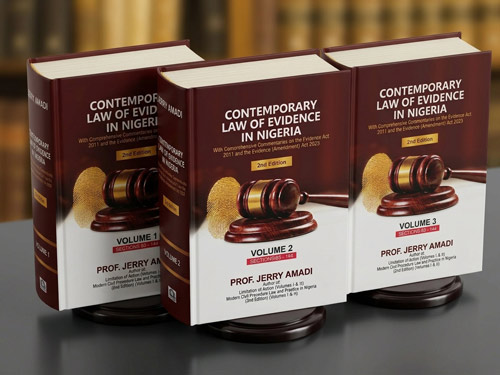 Prof. Jerry Amadi’s Evidence Law, Second Edition (2026), contains 3,314 pages in three volumes, covering the Evidence Act 2011, its 2023 amendment, and 4,051 Nigerian and English cases.