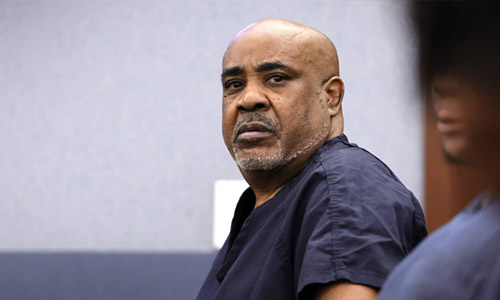
A Las Vegas jury has found former gang leader Duane “Keffe D” Davis guilty of first-degree murder with use of a deadly weapon over the 1996 drive-by shooting that killed legendary rapper Tupac Shakur, bringing a major courtroom conclusion to one of the most closely followed murder cases in American music history.

Davis, 63, was convicted on Monday after a nearly two-week trial in Clark County, Nevada, with jurors unanimously accepting prosecutors’ case that he helped orchestrate the killing even though he was not accused of firing the fatal shots.
Under Nevada law, a person who aids, assists or facilitates a murder can be held criminally liable for the killing even if that person was not the gunman.
Prosecutors described Davis as a “shotcaller” for the South Side Compton Crips in Los Angeles and argued that he organised the attack as retaliation after Shakur and members of his entourage assaulted Davis’ nephew, Orlando “Baby Lane” Anderson, at the MGM Grand Hotel in Las Vegas.
Davis was the only surviving person prosecutors said had been inside the vehicle from which the shots that killed Shakur were fired.
As the verdict was read, Davis, dressed in black, stood silently beside his lawyers before sitting with his hands clasped on the table while jurors were individually polled and each confirmed the guilty verdict.
Tupac’s sister, Sekyiwa “Set” Shakur, was visibly emotional in court, while Davis’ son covered his face with one hand as the verdict was announced.
District Judge Carli Kierny ordered Davis to remain in custody pending sentencing on October 13.
He faces a possible life sentence and has indicated that he intends to appeal the conviction.
Shakur was 25 years old when he was shot in Las Vegas on September 7, 1996. He died six days later from his injuries.
The rapper was travelling in a vehicle with Death Row Records co-founder Marion “Suge” Knight when another vehicle pulled alongside them and gunfire erupted. Knight survived the shooting.
Prosecutors told the jury that the killing was the culmination of a violent confrontation earlier that night at the MGM Grand Hotel.
Chief Deputy District Attorney Binu Palal argued during closing submissions that Davis “went hunting” for Shakur and Knight after they were seen on hotel surveillance footage participating in an assault on Anderson.
Jurors were shown grainy security footage of the hotel fight and heard testimony from several former law enforcement officers about the confrontation and the events that followed.
The prosecution ultimately agreed to dismiss the gang enhancement portion of the charge because of difficulties connected with the availability of witnesses, but continued to pursue the first-degree murder case.
A significant part of the prosecution relied on statements Davis himself had made over several years about the killing.
In 2008, Davis entered into a proffer agreement with federal investigators who were examining the killing of Christopher Wallace, better known as The Notorious B.I.G.
Davis maintained that he believed the agreement protected him from prosecution over statements he gave investigators.
Prosecutors, however, argued that the agreement did not grant him blanket immunity from future prosecution if evidence established his involvement in Shakur’s killing.
During interviews conducted under the arrangement, Davis reportedly provided investigators with information about the shooting, including where occupants of the vehicle were seated and details of gang confrontations prosecutors said ultimately led to Shakur’s death.
Prosecutors also relied heavily on Davis’ 2019 memoir, Compton Street Legend, in which he discussed his alleged role in events surrounding Shakur’s killing.
Authorities said publication of the book helped revive the investigation into the decades-old murder.
During closing arguments, prosecutor Marc DiGiacomo Bilal pointed to Davis’ repeated public statements as powerful evidence against him.
“For nearly 18 years, Duane Davis has told the police, television, books, YouTube interviewers, anybody that will listen,” the prosecutor told jurors.
“He has told you he is responsible for the murder of Tupac Shakur. Tell him you hear him. Find him guilty.”
Davis’ defence team argued that those statements were unreliable and had been exaggerated or fabricated to generate money, publicity and notoriety.
Defence attorney Michael Sanft repeatedly challenged prosecutors over what he described as the absence of physical evidence directly placing Davis at the murder scene.
The defence argued that investigators had not produced receipts, telephone records, photographs or similar evidence independently establishing that Davis was in Las Vegas at the time of the shooting or that he supplied the weapon used to kill Shakur.
Retired Las Vegas homicide detective Dan Long, who appeared as the defence’s final witness, testified about difficulties investigators encountered while attempting to verify some of the details Davis provided during a 2009 police interview.
Sanft argued that Davis had made inconsistent accounts over the years.
“When you think about Mr. Davis’ statements, they all conflict,” Sanft told the jury.
“They conflict with the book, and they conflict with the past. And the only thing that we have that we can agree on is that Tupac Shakur was shot and killed on Sept. 7, 1996, in Las Vegas, Nevada.”
The jury nevertheless accepted the prosecution’s case and returned a unanimous guilty verdict.
Shakur’s murder had remained unresolved for almost three decades, with investigators encountering conflicting accounts, reluctant witnesses and difficulties connecting developments in Las Vegas with gang rivalries in Compton, California.
Former law enforcement officers testified that Las Vegas detectives travelled to Southern California on numerous occasions during the investigation but repeatedly encountered unreliable informants and what investigators described as a culture of silence surrounding the shooting.
The passage of almost 30 years also complicated the prosecution as witnesses died, memories faded and physical evidence became increasingly difficult to obtain.
Davis’ own public statements eventually became central to the renewed investigation that led to his arrest, prosecution and conviction.
The verdict does not end the legal proceedings. Davis is due to be sentenced on October 13 and has indicated that he will challenge his conviction on appeal.
For the family and supporters of Tupac Shakur, however, Monday’s verdict marks the first murder conviction arising from the September 1996 shooting that ended the life of one of hip-hop’s most influential artists.
[A MUST HAVE] Evidence Act Demystified With Recent And Contemporary Cases And Materials

Available now for NGN 40,000 at ASC Publications, 10, Boyle Street, Onikan, Lagos. Beside High Court, TBS. Email publications@ayindesanni.com or WhatsApp +2347056667384. Purchase Link: https://paystack.com/buy/evidence-act-complete-annotation
______________________________________________________________________ “Enhance Legal Practice With Authoritative Reports” — Alexander Payne Offers Comprehensive Law Reports, Spanning Over A Century Of Nigerian Jurisprudence Interested buyers are encouraged to place their orders and enquiries via:
0704 444 4777, 0704 444 4999, 0818 199 9888
Website: www.alexandernigeria.com
Interested buyers are encouraged to place their orders and enquiries via:
0704 444 4777, 0704 444 4999, 0818 199 9888
Website: www.alexandernigeria.com