*Says “Section 12(7) Of Legal Practitioners Act Is Unconstitutional To Extent It Allows Direct LPDC Appeals”

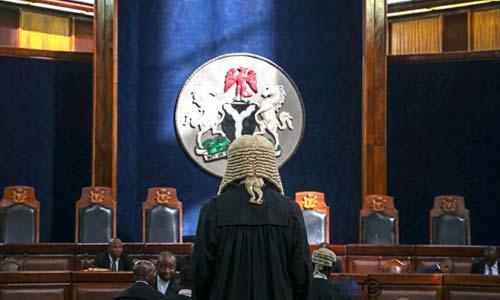
The Supreme Court has held that it lacks jurisdiction to entertain a direct appeal from a direction of the Legal Practitioners Disciplinary Committee (LPDC), declaring that section 12(7) of the Legal Practitioners Act, to the extent that it purports to confer such a right, is inconsistent with the Constitution and therefore void.
In a judgment delivered on Friday, 26 June 2026 in Ben Mene-Ejegi v Nigerian Bar Association & Legal Practitioners Disciplinary Committee, appeal number SC/481/2018, a seven-member panel of the court held by a majority of five to two that the only constitutionally recognised route by which an appeal against a direction of the LPDC may reach the Supreme Court is through the Court of Appeal.
The lead judgment was delivered by Honourable Justice Mohammed Baba Idris, JSC, with Honourable Justices Tijjani Abubakar, Emmanuel Akomaye Agim, Chidiebere Nwaoma Uwa and Moore Aseimo Abraham Adumein concurring. Honourable Justices Obande Festus Ogbuinya and Habeeb Adewale Olumuyiwa Abiru dissented.
The Complaint Before The LPDC
The appellant, a legal practitioner practising in Warri, was arraigned before the LPDC on a two-count complaint of receiving the sum of ₦1,600,000.00 from one Mr. Tosan Olukpe by false pretence, as the purchase price for land situate at Ajah-Etan Close, Warri, which did not belong to him, thereby conducting himself in an infamous manner contrary to Rule 1 of the Rules of Professional Conduct for Legal Practitioners 2007, punishable under section 12(1) of the Legal Practitioners Act. The second count alleged that he refused to refund the sum despite repeated demands.
The case of the Nigerian Bar Association was that in 2010, Mr. Olukpe purchased land in Warri from one Mr. Akuya, and that during the execution of the Deed of Conveyance which the appellant prepared, the appellant showed him a fishpond and other parcels of land at Ajah-Etan Close, representing that they belonged to him and were available for sale. Mr. Olukpe agreed to purchase a specified parcel for ₦1,600,000.00 and made payment to the appellant, who acknowledged receipt on the letterheaded paper of his law firm.
When Mr. Olukpe attempted to develop the land, he was informed that the appellant was not the owner and was forcibly ejected. He demanded a refund, which the appellant resisted by offering an alternative parcel of land, which was rejected. Mr. Olukpe thereafter lodged complaints with the Police and the NBA, and following investigation the association found a prima facie case of professional misconduct.
In his defence, the appellant contended that he had informed the complainant that the land was family land still undergoing survey and not yet fully available for sale, and that despite that disclosure the complainant chose to pay the purchase price. He said the transaction was later disrupted when the land was reclaimed by the family, that he had made efforts to provide alternative land which was refused, and that he was not accorded a fair hearing during the NBA investigation. He admitted that the sum of ₦150,000.00 had been refunded to the complainant by members of his family.
The LPDC found both counts proved, directed the Chief Registrar of the Supreme Court to strike the appellant’s name off the Roll of Legal Practitioners, and ordered him to refund the sum of ₦1,600,000.00 to the complainant through the NBA within thirty days. He appealed to the Supreme Court.
The Court Raises The Question Itself
In the course of the appeal, the Supreme Court raised suo motu the question whether an appeal lies directly from a direction of the LPDC to the Supreme Court, in view of its decision in Osuji v LPDC (2025) 17 NWLR (Pt 2014) 317. Counsel for the parties were invited to, and did, file supplementary briefs addressing the jurisdictional question.
Notably, all three parties argued in favour of the court’s jurisdiction. The appellant traced the legislative history of appeals under the Act and submitted that the Legal Practitioners (Amendment) Decree No. 21 of 1994 restored the right of direct appeal to the Supreme Court, relying on Okike v LPDC (2005) 3-4 SC 49, where the court held that section 233(1) of the Constitution had not, expressly or impliedly, ousted its jurisdiction to hear such appeals.
The NBA, relying on sections 11 and 12(7) of the Act, submitted that following the decision in LPDC v Fawehinmi (1985) 2 NWLR (Pt 7), amendments culminating in Decree No. 21 of 1994 restored the right of direct appeal, and that the court had consistently exercised such jurisdiction in a plethora of cases.
The LPDC aligned itself with those submissions, relying on Akintokun v LPDC (2014) 13 NWLR (Pt 1423) 1, where the court held that Decree No. 21 of 1994 has not been repealed and remains part of the extant laws of the Federation, and that its omission from the Laws of the Federation of Nigeria 2004 does not amount to a repeal by virtue of section 2 of the Revised Edition (Laws of the Federation of Nigeria) Act 2007. Further reliance was placed on Nwalutu v NBA (2019) 8 NWLR (Pt 1673) 174 at 192, to the effect that an omission in a legislative compilation does not extinguish the legal force of a validly enacted statute that has not been expressly repealed.
The court observed that notwithstanding those submissions, the parties did not make substantial submissions on the effect of section 12(7) of the Act as against its compatibility with the appellate jurisdiction vested in the court by the Constitution.
Sections 233 And 240 Read Side By Side
The court reiterated the settled principle that courts are creatures of the Constitution or of statute, and that their jurisdiction is circumscribed by the enabling provisions creating them, citing Murtala & Anor v INEC & Ors (2024) LPELR-79942 (SC).
Addressing its original jurisdiction, the court noted that section 232(2) of the Constitution permits the National Assembly to confer additional original jurisdiction on it by statute, save in criminal matters, and held that “it is manifest that the provision does not extend, either expressly or by implication, to appellate jurisdiction.”
The court then examined section 233, which confers jurisdiction on the Supreme Court to hear appeals from the Court of Appeal, juxtaposing it with section 240, which permits appeals to the Court of Appeal from a range of courts and tribunals.
Reading the two provisions side by side, the court held that while the appellate jurisdiction of the Court of Appeal is expressly made subject to the Constitution and extends to appeals from the courts and tribunals enumerated therein as well as such other courts or tribunals as may be prescribed by an Act of the National Assembly, the provision relating to the Supreme Court is distinctly and more restrictively couched.
Their Lordships reasoned that the Constitution contemplates a broader and more flexible appellate jurisdiction for the Court of Appeal, capable of statutory expansion, whereas the appellate jurisdiction of the Supreme Court is rigidly confined to appeals emanating from the Court of Appeal alone, with no corresponding constitutional allowance for enlargement by legislative intervention.
Applying the maxim expressio unius est exclusio alterius, the court held that while the National Assembly may expand the appellate jurisdiction of the Court of Appeal by statute, it has no corresponding power to confer additional appellate jurisdiction on the Supreme Court.
Section 12(7) Held Void
The court concluded that any statutory provision, including section 12(7) of the Legal Practitioners Act, which purports to confer a right of direct appeal from the LPDC to the Supreme Court must yield to the supremacy of the Constitution, and that by virtue of section 1(3) of the 1999 Constitution such a provision is null and void to the extent of its inconsistency.
It accordingly held that section 12(7) of the Act, to the extent that it purports to confer a direct appeal from the LPDC to the Supreme Court, is inconsistent with sections 233 and 240 of the Constitution and is void.
Okike v LPDC Overruled
Turning to its earlier decision, the court clarified that in Okike v LPDC, where it had held that it possessed jurisdiction to entertain appeals directly from the LPDC, the constitutional implications of sections 233(1) and 240 were not examined, and the exhaustive nature of the court’s appellate jurisdiction did not receive the detailed and holistic consideration the issue demanded. Had the relevant provisions been considered together, the court said, the conclusion reached may well have been different.
Conscious of its position as the apex court whose decisions are final, the court reiterated that it does not lightly depart from its previous decisions merely because another view appears preferable, and that the doctrine of stare decisis remains a cardinal pillar of Nigerian jurisprudence.
It held, however, relying on Bucknor-Maclean v Inlaks Ltd (1980) 8-11 SC 1 and the approving adoption therein of the dictum of Lord Morris in Conway v Rimmer (1968) AC 910, that “though precedent is an indispensable foundation … there may be times when a departure from precedent is in the interest of justice and the proper development of the law.”
The court restated the circumstances in which it may depart from a previous decision as set out in Akintokun v LPDC, and held that the power to depart is not dependent upon an invitation by counsel but inheres in its constitutional status as the final judicial authority in the Federation.
Applying those principles, the court held that no Act of the National Assembly can enlarge its appellate jurisdiction beyond the limits expressly prescribed by the Constitution, and overruled Okike v LPDC to that extent.
The appeal was consequently held to be incompetent and struck out for want of jurisdiction.
The Dissent Of Ogbuinya And Abiru, JJSC
In their dissenting opinion, Honourable Justices Ogbuinya and Abiru observed that all the parties were agreed that the Supreme Court can exercise jurisdiction over an appeal flowing from a direction of the LPDC, each placing high premium on Okike v LPDC, where the full court interpreted section 12(7) of the Act alongside section 233(1) of the Constitution and unanimously held that it possessed such jurisdiction.
Quoting the pronouncement of Uwais, CJN, of blessed memory, they noted that the Supreme Court had all along exercised jurisdiction in disciplinary matters pertaining to the conduct of legal practitioners, both before and after the 1979 and 1999 Constitutions, neither of which expressly or impliedly ousted that jurisdiction, and that the court jealously guards its jurisdiction and does not readily allow it to be ousted.
Their Lordships acknowledged that some eight years later, the full court in Aladejobi v NBA (2013) 15 NWLR (Pt 1376) 66 and in Akintokun v LPDC declined jurisdiction over appeals arising from directions of the LPDC that had not passed through the Appeal Committee of the Body of Benchers as prescribed by sections 11(7) and 12(1) of the Act.
Relying on the reasoning of Honourable Justices Mohammed and Kekere-Ekun, JJSC, in Akintokun, however, they found that the issue determined in those two cases was distinct from, and did not overrule, the issue determined in Okike, which turned on a different statutory question and remains “extant and … good law for what it decided.”
They noted further that the decision of a five-member panel in Osuji v LPDC, relied upon in the lead judgment, was itself anchored on Aladejobi and Akintokun, and could not on that account be treated as having displaced Okike.
After an elaborate comparative survey of the doctrine of departure from previous decisions, drawing on Bucknor-Maclean v Inlaks Ltd and Bronik Motors Ltd v Wema Bank Ltd (1983) NSCC Vol 14, 226, Their Lordships concluded that none of the conditions for departure was satisfied, that Okike v LPDC remains a valid and subsisting decision binding on all under the doctrine of stare decisis, and that the Supreme Court retains jurisdiction to entertain appeals directly from directions of the LPDC.
Representation
P. Akpavie appeared for the appellant. Y.S. Bawa appeared for the 1st respondent, and M. Adjeh for the 2nd respondent.
[A MUST HAVE] Evidence Act Demystified With Recent And Contemporary Cases And Materials

Available now for NGN 40,000 at ASC Publications, 10, Boyle Street, Onikan, Lagos. Beside High Court, TBS. Email publications@ayindesanni.com or WhatsApp +2347056667384. Purchase Link: https://paystack.com/buy/evidence-act-complete-annotation
______________________________________________________________________ “Enhance Legal Practice With Authoritative Reports” — Alexander Payne Offers Comprehensive Law Reports, Spanning Over A Century Of Nigerian Jurisprudence Interested buyers are encouraged to place their orders and enquiries via:
0704 444 4777, 0704 444 4999, 0818 199 9888
Website: www.alexandernigeria.com
Interested buyers are encouraged to place their orders and enquiries via:
0704 444 4777, 0704 444 4999, 0818 199 9888
Website: www.alexandernigeria.com