On the 11th of July 2017 the Lagos State Government joined other Western States to declare Monday the 12th of June 2017 as a public holiday in commemoration of the annulled June 12 elections of 1993 which till date is largely regarded as the freest and fairest elections conducted in Nigeria’s history. The declaration was contained in a public notice signed by the Secretary to the State Governor.

There are a few arguments as to whether the State Governor can actually declare or purport to declare a public holiday and in the event that he does whether it is binding on all persons in the state or only state workers.
The first argument is predicted on the provisions of Section 4 of the Constitution of the Federal Republic of Nigeria 1999 (As Amended) which provides that the National Assembly shall have power to make laws with respect to any matter included in the Exclusive Legislative List set out in Part I of the Second Schedule to this Constitution. Subsection (7) of the section further provides that the Powers of the State legislative houses to make laws does not extend to any matter included in the Exclusive Legislative List.
Clearly by section 4 any matter set out in the Exclusive Legislative List cannot be legislated upon by the State Government and “Public Holidays” is contained under item 51 of the Exclusive Legislative list.
However, the above provision is only to the extent that State Legislative houses cannot confer or legislate on the issues pertaining to public holidays. It misconceived to interpret the provision to mean that the Governor of a state cannot enforce or be conferred with powers by a legislation of the National Assembly to declare a public holiday. This conferment of powers to declare public holidays is what the National Assembly did in the enactment of the Public Holidays Act of 1979.
The Public Holidays Act repeals all State laws on public holidays and makes a single legislative provision on public holidays which is uniformly applicable in the whole of the Federation.
Under the Act the following days are recognized public holidays:
1. New Year’s Day, Good Friday, Easter, Worker’s Day (1st of May), National Day (1st of October), Christmas Day, Any Day declared as Id el Fitr, Any day declared as Id el Kabir, Any day declared as Id el Maulud. (These holidays apply throughout Nigeria).
2. Any days which the President by public notice appoints as a special day to be kept as public holiday in Nigeria or in any part of Nigeria. (These holidays may apply throughout Nigeria or in any state or region where the declarations limits it to (See Section 1, 2 and & of the Act).
3. Any days which the Governor of a State by public notice appoint as a special day to be kept as public holiday in the State concerned or any part of the State. (These holidays apply to the State where it is declared or any part of the state where the declaration limits the holiday to) See. Sections 2(2) of the Act.
It is also important to state that even if the day is declared as a work free day rather than described as a public holiday, it still is regarded under the Act as a public holiday. See Section 2(3).
Therefore the argument that the State cannot declare a public holiday is not the position of the law as even though the state legislative houses cannot legislate on public holidays, the Governor of a State has been empowered by an Act of the National Assembly, made pursuant to the National Assembly’s law making power over public holidays under the Exclusive Legislative List, to declare a day as Public Holliday in his State.
Doubtlessly however, this power has its pro’s and its cons. While it may be beneficial for persons in the state to mark a day which they regard as special to the state, the power to declare public holidays may sometimes be subject to abuse and some days declared as holidays may not warrant the declaration. In Rivers State for instance, the State Government declared January 27th of every year as a public holiday to mark the validation of Nyesom Wike as the Governor. In Abia there were reports that the State Governor declared July 1st and July 4th of 2016 as public holidays to honour Late Hon. Ojo Maduekwe, a move which many believed was aimed at thwarting the swearing of the governor elect.
These issues notwithstanding the law as it is has given the Governors the powers to declare holidays in their respective states.
On the second question of whether or not a State declared public holiday is to be observed by employees in private establishment, as far as the Act goes, Section 4 states that “No person shall be compellable to do any act on a day appointed by or under the provisions of this Act to be kept as a public holiday which he would not be compellable to do on a Sunday”. This provision includes public holidays declared in and operating in states.
Therefore once a day is declared as a public holiday a person cannot be compelled to work on such day. The reality however is that a private employer can also not be compelled to retain an employee. An employee who is sanctioned or has his employment terminated on the sole basis that he did not attend work on a day declared by the State government as public holiday, may be able to seek redress. It is however different in the case of a staff of the Federal Government who is working in any State of the federation, as such person is not bound by a declaration of public holiday in the State, as he is under the authority of the Federal Government and not bound by State work-related declarations.
In conclusion, the declaration of June 12 as a public holiday by the Lagos State government and indeed other regional governments aligns with legislative and constitutional provisions relating to the exercise of powers to declare public holidays. Having been declared, employees within the state (Not being under the Federal Government) can enjoy the holidays as they are entitled to enjoy a Sunday and indeed other federal holidays. The significance of June 12 in Nigeria’s political history cannot be over emphasized and it is high time the Federal government sees the need to give special recognition to the day and what it connotes in the Nigerian electoral process and democracy of today.
Oliver Omoredia Esq.

Get your copy today and take the first step toward financial growth:👉 https://selar.co/4f16676016
_______________________________________________________________________ The Law And Practice Of Redundancy In Nigeria: A Practitioner’s Guide, Authored By A Labour & Employment Law Expert Bimbo Atilola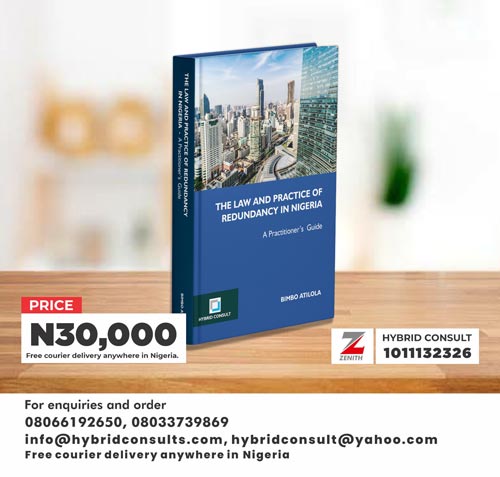 _______________________________________________________________________
[A MUST HAVE] Evidence Act Demystified With Recent And Contemporary Cases And Materials

Available now for NGN 40,000 at ASC Publications, 10, Boyle Street, Onikan, Lagos. Beside High Court, TBS. Email publications@ayindesanni.com or WhatsApp +2347056667384. Purchase Link: https://paystack.com/buy/evidence-act-complete-annotation
______________________________________________________________________ ARTIFICIAL INTELLIGENCE FOR LAWYERS: A COMPREHENSIVE GUIDE
Reimagine your practice with the power of AI “...this is the only Nigerian book I know of on the topic.” — Ohio Books Ltd
Authored by Ben Ijeoma Adigwe, Esq., ACIArb (UK), LL.M, Dip. in Artificial Intelligence, Director, Delta State Ministry of Justice, Asaba, Nigeria.
Bonus:
Get a FREE eBook titled “How to Use the AI in Legalpedia and Law Pavilion” with every purchase.
ARTIFICIAL INTELLIGENCE FOR LAWYERS: A COMPREHENSIVE GUIDE
Reimagine your practice with the power of AI “...this is the only Nigerian book I know of on the topic.” — Ohio Books Ltd
Authored by Ben Ijeoma Adigwe, Esq., ACIArb (UK), LL.M, Dip. in Artificial Intelligence, Director, Delta State Ministry of Justice, Asaba, Nigeria.
Bonus:
Get a FREE eBook titled “How to Use the AI in Legalpedia and Law Pavilion” with every purchase.
How to Order: 📞 Call, Text, or WhatsApp: 08034917063 | 07055285878 📧 Email: benadigwe1@gmail.com 🌐 Website: www.benadigwe.com
Ebook Version: Access directly online at: https://selar.com/prv626