
By John Ajose

1. Introduction
On 11 July 2024, the Supreme Court of Nigeria delivered what was hailed, and rightly so, as the emancipation proclamation of the third tier of government. In Attorney-General of the Federation v Attorney-General of Abia State & 35 Ors,(1) the apex Court held that the allocations of the 774 local government councils from the Federation Account should henceforth be paid directly to the councils, that no State Governor may receive, withhold or spend those funds, and that a council run by an unelected caretaker committee is a council the Constitution does not know. Applause rang from Abuja to the remotest council secretariat. The long night of the State-Local Government Joint Account, it was announced, was over.
More than two years on, the night has not ended; it has only been rebranded. Between July 2024 and June 2026, the councils were allocated ₦10.479 trillion from the Federation Account,(2) yet in Kaduna, Kano, Plateau, Benue and elsewhere, that money still passes through the hands of the State before it reaches the council, if it reaches it at all.(3) The President-General of the Nigeria Union of Local Government Employees has put the matter in three words: “Nothing has changed.”(4)
The Constitution commands that the decisions of the Supreme Court “shall be enforced in any part of the Federation by all authorities and persons”.(5) The difficulty this article confronts is that the Constitution does not say “how,” and the judgment did not supply the means. It is a judgment without machinery. The question, therefore, is not whether the States are bound, for they plainly are, but what the law can do with a State that has decided not to be.
It is against this background that I examine the judgment, the anatomy of the resistance, the reasons the judgment has proved so easy to evade, and the machinery that must be built if the pronouncement of the Court is to become the practice of the Federation.
2. What the Supreme Court Decided
The suit was an original action instituted by the Federal Government, through the Attorney-General of the Federation, against the Attorneys-General of the 36 States, and it was determined by a seven-member panel of the Court. (6)
Its pith lies in two constitutional provisions which, read together, had long been made to cancel each other out.
Section 7(1) of the Constitution guarantees “the system of local government by democratically elected local government councils”. Section 162(6), on the other hand, provides thus:
Each State shall maintain a special account to be called “State Joint Local Government Account” into which shall be paid all allocations to the local government councils of the State from the Federation Account and from the Government of the State.
For over two decades, Governors treated the second provision as a licence to defeat the first. The Joint Account became a turnstile through which council funds entered and from which only what the Governor chose to release came out.
In his lead judgment, Agim JSC refused to read the Constitution as the instrument of its own subversion. His Lordship held that the Constitution “should not be applied in a manner as to support the destruction” of the guaranteed right of councils to their funds, that the payment arrangement in section 162(5) should be “purposively read as permissive or discretionary”, and that, payment through the States having failed, “the justice of the case demands that the Local Government Council allocations from the Federation Account should henceforth be paid directly to the Local Government Councils”.(7)
Two further pillars of the judgment deserve mention. First, the Court held that a State cannot dissolve democratically elected councils and replace them with caretaker committees, and that a council so constituted is not entitled to receive allocations from the Federation Account.(8) In this, the Court built upon the earlier decision in Governor of Ekiti State v Olubunmo,(9) where the dissolution of elected councils had been struck down. Secondly, the Court restrained the States from receiving, tampering with or withholding council funds.(10) It is noteworthy that, two decades earlier in Attorney-General of Lagos State v Attorney-General of the Federation,(11) the same Court had restrained the President from withholding the allocations of Lagos councils. The wheel has turned full circle: the Federation, once restrained for withholding council funds, now sues the States for the same offence.
3. The Anatomy of Recalcitrance
It needs to be noted, for the purpose of fairness, that one limb of the judgment has worked. The order disentitling caretaker councils from allocations hit Governors where it hurt, and more than thirty States hurriedly conducted council elections after the judgment.(12) The lesson is instructive and will be returned to: an order that withholds money executes itself.
The direct-payment limb has fared differently, and the resistance has taken three forms.
The first is legislative circumvention. Barely three months after the judgment, Anambra State enacted the Anambra State Local Government Administration Law 2024, which retained a State Joint Local Government Account into which all federal allocations to the councils are to be paid, and obliged each council to remit a percentage fixed by the State within two working days of receipt. (13) The State defended the law on the strength of section 7(1), which empowers a State House of Assembly to legislate for the finance of councils. The Senate, alarmed, resolved that all States must comply with the judgment and warned Governors against laws designed to circumvent it. (14)
It must be said that the resolution carried no sanction.
The second is administrative strangulation. In Benue State, councils were told they required letters from the State Accountant-General before they could open accounts with the Central Bank of Nigeria, and officials there insisted that the Joint Account remains constitutional until the National Assembly says otherwise. (15) In Kano, council chairmen must still seek State approval before funding projects. One official in the North-West reported that an allocation of ₦800 million may reach the council as ₦50 million after State-level ‘releases’.(16) The money is paid to the council on paper, and to the State in fact.
The third is political capture. Because State Independent Electoral Commissions are appointed and funded by the States, council elections routinely return a clean sweep for the Governor’s party.(17) A chairman who owes his seat to the Governor is unlikely to insist on autonomy from him. Civil society observers have alleged that councils are pressured into ‘partnerships’ through which funds are channelled back to Government House.(18) Thus, even where direct payment occurs, the money arrives in an account controlled by a beneficiary of the very system the judgment sought to dismantle.
The exception proves the rule. Jigawa State reports that all 27 of its councils now operate independent accounts and receive their allocations directly.(19) Its example demonstrates that compliance is administratively possible.
4. Why the Judgment Has No Machinery
Herein is the crux of my argument. The judgment has been evaded not because it is unclear, but because five features of our legal order leave it without teeth.
4.1 The Nature of a Declaratory Judgment
The bulk of the reliefs in the suit were declaratory and injunctive. It is settled that a declaratory judgment merely pronounces the rights of the parties; it contains no executory order capable of being levied by execution.(20) The Supreme Court has held as much in Government of Gongola State v Tukur,(21) and the principle was restated in Okoya v Santilli.(22) A declaration that council funds belong to the councils tells the State what the law is; it does not seize the money from the State.
Where the party bound is a sovereign State with its own treasury, its own legislature and its own police of public opinion, the gap between declaration and delivery is precisely where defiance lives.
4.2 The Silence of Section 287
Section 287(1) of the Constitution provides, in clear terms, that:
The decisions of the Supreme Court shall be enforced in any part of the Federation by all authorities and persons, and by courts with subordinate jurisdiction to that of the Supreme Court.
The provision is a command without a sergeant. It imposes a duty on “all authorities and persons” but names no officer charged with compelling compliance, and prescribes no consequence for the authority that refuses. The Supreme Court in Military Governor of Lagos State v Ojukwu(23) condemned, in memorable language, a government that disobeys the orders of court while seeking their protection. Condemnation, however, is not execution.
4.3 The Shield of Section 308
The ordinary instrument for compelling obedience to an injunction is committal for contempt, initiated through the notice of consequences of disobedience in Form 48 and the committal process in Form 49.(24) But the Governor, who is the true author of the defiance, is clothed by section 308 of the Constitution with immunity from civil and criminal proceedings during his tenure.(25) The man who holds the purse cannot be sent to prison for holding it. The contempt process can, at most, reach the officials beneath him, the Commissioner for Finance and the State Accountant-General, who are the instruments, rather than the authors, of the defiance.
4.4 The Constitution’s Unrepealed Text
The judgment did not, and could not, delete section 162(6) from the Constitution, nor sections 162(7) and (8), which give the States a hand in the sharing of council funds, nor the power in section 7(1) to legislate for council finance.(26) These provisions remain in the text, and the States read them as a standing invitation to re-enact by statute what the Court forbade by judgment. The Anambra law is the clearest example. A judgment that reads the Constitution purposively must still contend with a Constitution whose letter supplies the evader’s alibi.
4.5 The Paradox of the Victorious Plaintiff
It is a curious feature of this litigation that the party who won is the party who has not executed. The mechanism of direct payment lies wholly within the power of the Federation: the Accountant-General of the Federation, the Federation Account Allocation Committee and the Central Bank of Nigeria. An inter-ministerial committee was set up to develop the procedures,(27) and the Central Bank began profiling council chairmen and signatories as early as February 2025.(28) Yet the Governors lobbied for delay,(29) and as of 2026 no evidence had emerged that the councils, Jigawa apart, were being paid directly into accounts beyond the reach of the State.(30) The Federal Government has, in effect, obtained a judgment against the States and then left it on the shelf.
5. Building the Machinery
To diagnose without prescribing is to leave the enterprise incomplete. The judgment cannot enforce itself, but the law is not without instruments. What is lacking is the will to assemble them. The following, taken together, would supply the machinery the judgment lacks.
5.1 Federal Execution at the Source
The first and most potent instrument is in the hands of the plaintiff. The lesson of the caretaker limb is that an order which operates on the flow of money executes itself, whereas an order which depends on the goodwill of the State does not. The Accountant-General of the Federation does not require the consent of any Governor to pay a council directly. What is required is a firm cut-off date, after which council allocations are credited only to accounts opened by the councils with the Central Bank of Nigeria, coupled with a public notice that any council without such an account by that date will have its allocation held in escrow for it, and not released to the State. The obstacle in Benue, a demanded letter from the State Accountant-General, can be removed by a simple directive from the Central Bank that no such letter is required. Section 287(1) binds the federal authorities as much as it binds the States, and the Federal Government cannot plead the recalcitrance of the States to excuse its own inaction.
5.2 Contempt and Mandamus against Officials
Where section 308 shields the Governor, it does not shield the officials who operate the Joint Account. A Commissioner for Finance or State Accountant-General who diverts council funds in the teeth of the judgment is a proper subject of Form 48 and, in an appropriate case, of committal. Equally, where a federal officer fails to perform the public duty of direct payment, an order of mandamus lies to compel its performance. A single successful committal of a State official would do more for compliance than a dozen Senate resolutions.
5.3 Striking Down the Circumventing Laws
State laws such as Anambra’s, which compel councils to remit their allocations to a State-controlled account, are ripe for challenge. By section 1(3) of the Constitution, any law inconsistent with the Constitution is void to the extent of the inconsistency, and the Constitution, as authoritatively interpreted by the Supreme Court, is the yardstick.(31) The Attorney-General of the Federation, councils, the Association of Local Governments of Nigeria and the Nigeria Union of Local Government Employees all have standing to seek declarations that such laws are void, and, crucially, injunctions against the officials who administer them.
5.4 Constitutional Amendment
So long as section 162(6) to (8) remain in the text, the evader will always have a constitutional alibi. The National Assembly, which has pledged to amend the Constitution to secure local government autonomy,(32) should abolish the State Joint Local Government Account, provide expressly that council allocations shall be paid directly to the councils, prohibit caretaker committees in terms, and insulate the State Independent Electoral Commissions from the control of the Governor. Judicial interpretation can stretch the letter of the Constitution; only amendment can replace it.
5.5 The Political and Accountability Levers
The Constitution treats “gross misconduct”, which includes a grave violation or breach of its provisions, as a ground for removing a Governor.(33) The deliberate defiance of a Supreme Court judgment on the finances of an entire tier of government answers that description, though the political arithmetic of most State Houses of Assembly makes the remedy improbable. More realistic is transparency: the monthly publication, by the Federation Account Allocation Committee, of the amount allocated to each of the 774 councils and the account into which it was paid. Sunlight would make every diversion a matter of public record and every Governor answerable to his electorate. Autonomy must also come with accountability, through mandatory audits and the publication of council expenditure, for, as one editorial has rightly cautioned, autonomy does not by itself cure corruption or poor planning.(34) The councils must not become smaller replicas of the vice they were freed from.
6. Conclusion
The judgment of 11 July 2024 is sound in law and generous in vision. It read the Constitution as a charter of democratic self-government rather than as a manual for its subversion. But a judgment is a pronouncement, not a policeman. It declares where the money belongs; it does not carry the money there. More than two years and over ₦10 trillion later, the distance between the Court’s pronouncement and the council’s purse is the measure of a democracy that has mastered the art of declaring rights and neglected the craft of enforcing them.
The machinery is not beyond reach. It is in the Accountant-General’s ledger, in the Central Bank’s account-opening procedure, in the contempt jurisdiction of the courts against the officials who operate the Joint Account, in the voidness of every law enacted to defeat the judgment, and in the amending pen of the National Assembly. What has been missing is not law but will. Until that will is found, the most celebrated constitutional victory of the Fourth Republic will remain what it presently is: a judgment without machinery, honoured in the law reports and disregarded in the treasuries. If the decisions of the Supreme Court are indeed to be enforced by all authorities and persons, the first authority that must act is the one that asked the Court to decide.
Endnotes
(1) Attorney-General of the Federation v Attorney-General of Abia State & 35 Ors (2024) LPELR-62576(SC), Suit No SC/CV/343/2024, judgment delivered 11 July 2024.
(2) Sami Tunji, Deborah Tolu-Kolawole, Godwin Isenyo, Sunday Nwakanma, Animasahun Salman, Tukur Muntari, John Charles, Salisu Kabuga and James Abraham, ‘Autonomy Battle: States Defy Supreme Court, Control N10tn LG Allocations’ The Punch (republished 17 July 2026) https://kolaking.substack.com/p/autonomy-battle-states-defy-supreme accessed 3 November 2026 (councils received ₦4.496 trillion between July 2024 and June 2025, and ₦5.984 trillion between July 2025 and June 2026).
(3) Ibid.
(4) Ibid, quoting Aliyu Haruna Kankara, President-General of the Nigeria Union of Local Government Employees.
(5) S. 287(1), Constitution of the Federal Republic of Nigeria 1999 (as amended) (hereinafter ‘CFRN’).
(6) BusinessDay, ‘Explainer: The Details of the Supreme Court Ruling Giving 774 Local Councils Financial Autonomy’ BusinessDay (12 July 2024) https://businessday.ng/news/article/explainer-the-details-of-the-supreme-court-ruling-giving-774-local-councils-financial-autonomy/ accessed 3 November 2026.
(7) Attorney-General of the Federation v Attorney-General of Abia State & 35 Ors (2024) LPELR-62576(SC), per Agim JSC; see also LawPavilion, ‘Whether Local Government Council Allocations from the Federation Account Should Be Paid Directly to the Local Government Councils’ LawPavilion Blog https://blog.lawpavilion.com/whether-local-government-council-allocations-from-the-federation-account-should-be-paid-directly-to-the-local-government-councils accessed 3 November 2026.
(8) Attorney-General of the Federation v Attorney-General of Abia State & 35 Ors (2024) LPELR-62576(SC).
(9) (2017) 3 NWLR (Pt 1551) 1 (SC).
(10) Attorney-General of the Federation v Attorney-General of Abia State & 35 Ors (2024) LPELR-62576(SC); BusinessDay, ‘Explainer: The Details of the Supreme Court Ruling Giving 774 Local Councils Financial Autonomy’ BusinessDay (12 July 2024) https://businessday.ng/news/article/explainer-the-details-of-the-supreme-court-ruling-giving-774-local-councils-financial-autonomy/ accessed 3 November 2026.
(11) (2004) 18 NWLR (Pt 904) 1 (SC).
(12) The Guardian, ‘Supreme Court Verdict: 19 Months After, Govs Explore Gaps in Constitution, Resist LG Autonomy’ The Guardian https://guardian.ng/news/supreme-court-verdict19-months-after-govs-explore-gaps-in-constitution-resist-lg-autonomy/ accessed 3 November 2026.
(13) Ss. 13(1), 14(3) and 14(4), Anambra State Local Government Administration Law 2024; ThisDay, ‘Controversy over Soludo’s Law on LG Funds’ ThisDay (20 October 2024) https://thisdaylive.com/index.php/2024/10/20/controversy-over-soludos-law-on-lg-funds accessed 3 November 2026.
(14) Sunday Aborisade, ‘LG Autonomy: Perish Plans to Circumvent Supreme Court Verdict, Senate Tells Governors’ ThisDay (10 October 2024) https://www.thisdaylive.com/2024/10/10/lg-autonomy-perish-plans-to-circumvent-supreme-court-verdict-senate-tells-governors/ accessed 3 November 2026.
(15) Sami Tunji, Deborah Tolu-Kolawole, Godwin Isenyo, Sunday Nwakanma, Animasahun Salman, Tukur Muntari, John Charles, Salisu Kabuga and James Abraham, ‘Autonomy Battle: States Defy Supreme Court, Control N10tn LG Allocations’ The Punch (republished 17 July 2026) https://kolaking.substack.com/p/autonomy-battle-states-defy-supreme accessed 3 November 2026.
(16) Ibid.
(17) The Guardian, ‘Supreme Court Verdict: 19 Months After, Govs Explore Gaps in Constitution, Resist LG Autonomy’ The Guardian https://guardian.ng/news/supreme-court-verdict19-months-after-govs-explore-gaps-in-constitution-resist-lg-autonomy/ accessed 3 November 2026; see also S. 197(1)(b) and the Third Schedule, Part II, CFRN 1999 (as amended), establishing the State Independent Electoral Commissions.
(18) Sunday Ehigiator, ‘26 Months After Judgement, Governors Continue to Strangle LGs, Fuelling Insecurity’ ThisDay (12 September 2026) https://kolaking.substack.com/p/26-months-after-judgement-governors accessed 3 November 2026.
(19) Sami Tunji, Deborah Tolu-Kolawole, Godwin Isenyo, Sunday Nwakanma, Animasahun Salman, Tukur Muntari, John Charles, Salisu Kabuga and James Abraham, ‘Autonomy Battle: States Defy Supreme Court, Control N10tn LG Allocations’ The Punch (republished 17 July 2026) https://kolaking.substack.com/p/autonomy-battle-states-defy-supreme accessed 3 November 2026.
(20) A declaratory judgment proclaims the existence of a legal right or relationship without ordering the defendant to do anything; it is therefore not enforceable by the ordinary processes of execution.
(21) (1989) 4 NWLR (Pt 117) 592 (SC).
(22) (1990) 2 NWLR (Pt 131) 172 (SC).
(23) (1986) 1 NWLR (Pt 18) 621 (SC).
(24) S. 72, Sheriffs and Civil Process Act, Cap S6, Laws of the Federation of Nigeria 2004; Order IX, rule 13 and Forms 48 and 49, Judgments (Enforcement) Rules.
(25) S. 308(1) and (3), CFRN 1999 (as amended).
(26) Ss. 7(1) and 162(6), (7) and (8), CFRN 1999 (as amended).
(27) Sami Tunji, Deborah Tolu-Kolawole, Godwin Isenyo, Sunday Nwakanma, Animasahun Salman, Tukur Muntari, John Charles, Salisu Kabuga and James Abraham, ‘Autonomy Battle: States Defy Supreme Court, Control N10tn LG Allocations’ The Punch (republished 17 July 2026) https://kolaking.substack.com/p/autonomy-battle-states-defy-supreme accessed 3 November 2026 (the committee drew members from the Office of the Secretary to the Government of the Federation, the Federal Ministry of Finance, the Office of the Accountant-General of the Federation, the Central Bank of Nigeria and the Office of the Attorney-General of the Federation).
(28) The Punch, ‘Govs Lobby Tinubu to Block LG Direct Payment’ The Punch (2025) https://kolaking.substack.com/p/govs-lobby-tinubu-to-block-lg-direct accessed 3 November 2026.
(29) Ibid (reporting that the Governors pressed for council allocations to be paid into commercial bank accounts rather than accounts with the Central Bank of Nigeria).
(30) The Guardian, ‘Supreme Court Verdict: 19 Months After, Govs Explore Gaps in Constitution, Resist LG Autonomy’ The Guardian https://guardian.ng/news/supreme-court-verdict19-months-after-govs-explore-gaps-in-constitution-resist-lg-autonomy/ accessed 3 November 2026; Sunday Ehigiator, ‘26 Months After Judgement, Governors Continue to Strangle LGs, Fuelling Insecurity’ ThisDay (12 September 2026) https://kolaking.substack.com/p/26-months-after-judgement-governors accessed 3 November 2026.
(31) S. 1(1) and (3), CFRN 1999 (as amended); see also S. 287(1), CFRN 1999 (as amended).
(32) Sunday Aborisade, ‘LG Autonomy: Perish Plans to Circumvent Supreme Court Verdict, Senate Tells Governors’ ThisDay (10 October 2024) https://www.thisdaylive.com/2024/10/10/lg-autonomy-perish-plans-to-circumvent-supreme-court-verdict-senate-tells-governors/ accessed 3 November 2026.
(33) S. 188(11), CFRN 1999 (as amended).
(34) Paul Dada, ‘Editorial: Implement Local Government Autonomy Now’ P.M. News (17 July 2026) https://pmnewsnigeria.com/2026/07/17/editorial-implement-local-government-autonomy-now/ accessed 3 November 2026.
[A MUST HAVE] Evidence Act Demystified With Recent And Contemporary Cases And Materials
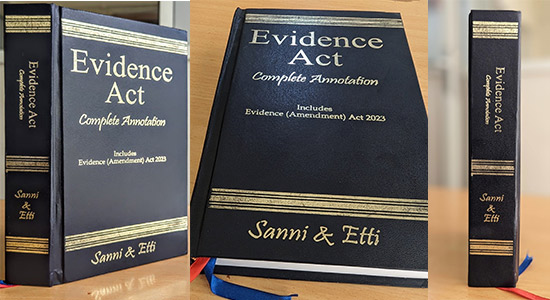
Available now for NGN 40,000 at ASC Publications, 10, Boyle Street, Onikan, Lagos. Beside High Court, TBS. Email publications@ayindesanni.com or WhatsApp +2347056667384. Purchase Link: https://paystack.com/buy/evidence-act-complete-annotation
______________________________________________________________________ “Enhance Legal Practice With Authoritative Reports” — Alexander Payne Offers Comprehensive Law Reports, Spanning Over A Century Of Nigerian Jurisprudence Interested buyers are encouraged to place their orders and enquiries via:
0704 444 4777, 0704 444 4999, 0818 199 9888
Website: www.alexandernigeria.com