NBA Warri Branch, Mr. John O. Bello Esq has written an open letter to the President of the Nigerian Bar Association, A.B. Mahmoud (SAN) on the crisis generated by Article 6(3) of the NBA Uniform Bye-Laws, and the finality of the powers of branch Electoral Committees. Citing from the NBA Constitution and other decided cases, the bar man gave his insight into the issue bothering on the said provision. Below Reads The Open Letter AN OPEN LETTER TO THE PRESIDENT OF THE NIGERIAN BAR ASSOCIATION, A.B. MAHMOUD (SAN) ON THE CRISES GENERATED BY ARTICLE 6(3) OF THE NBA UNIFORM BYE-LAWS, AND THE FINALITY OF THE POWERS OF BRANCH ELECTORAL COMMITTEES. Dear Sir, A lot of controversies have been birthed by the retrospective interpretation of Article 6(3) of the NBA uniform Bye-laws, which came into effect on 27th of August, 2015. For ease of reference, infra is the said Article 6(3) in extensio: “No member of the Branch shall occupy the same office for more than two (2) years (one term); and any member who has held elective offices as a Branch officer for two (2) terms shall not be eligible to contest for a Branch office until at least five (5) years after his/her last term of office. I gathered that the National Executive Committee (NEC) of the NBA at its Jos meeting in 2015 gave a rather shocking interpretation of this Article 6(3) by holding that it should be interpreted retrospectively, against all known rules and cannons of interpretation of laws, statutes and written documents. Besides, when did the NEC of the NBA become a court of law, empowered to interpret its constitution? Well, this is a matter for another day; I elect not to deviate from the burning issues. Sir, as I was saying, this rather ridiculous interpretation of Article 6(3) has ignited the flame of crises in some local branches of the NBA. First in time was in the Ikeja Branch of the NBA, sometime in 2016, the election of Adesina Ogunlana Esq., as Chairman of the Branch, was nullified by the NEC in its Benin meeting of 16th of June, 2016, on the ground of reliance on the retrospective interpretation of same Article 6 (3), Mr. Adesina Ogunlana, having held over two offices in the past. He chose the path of peace by heading to the courts to challenge this rather unfortunate and preposterous nullification by NEC, resulting in an impasse in the administration of the Branch for close to a year. Sir, however, suffice it to state that when you took over the reins of office, your administration took a different and matured look at the situation, disagreeing with the injustice inherent in the retrospective interpretation of Article 6(3), instructing the current 3rd Vice President, Ben Orji Esq., to head the Ikeja Branch in an interim capacity, and to organize and conduct elections into various offices of the Branch – which he did, albeit, successfully. It is worthy to commend your wise leadership and intervention, which enabled the displacement of that spectre of injustice, leading to the return of peace and tranquillity to the Ikeja Branch. Unfortunately, regardless of your efforts to put the issue of the retrospective interpretation to rest by the steps taken in Ikeja Branch, crisis currently looms at the Warri Branch of the NBA. What crisis? Yet another faulty interpretation of Article 6(3) of the Bye-laws, by the Ama Etuwewe-led Electoral Committee, orchestrated by the Branch Chairman, G.O.K. Ebowe Esq., Gweke Akudihor Esq. and certain other persons who are under the impression that the Branch exclusively belongs to them. On the 21st day of May, 2018, a chairmanship aspirant in the Branch elections, Oghenero Okoro Esq. was informed vide a letter from the Committee that he had been disqualified from contesting in the elections having been caught by the provisions of Article 6(3) of the Bye-law. Suffice it to add that upon an application to the same committee for a review of its decision, pursuant to Article 17(2) of the Bye-laws, he was also informed that he stood disqualified. It is imperative to state at this juncture that Oghenero Okoro Esq. was Branch Publicity Secretary (2008-2010), Branch Secretary (2010-2012), and Branch Vice Chairman (2016-2018). Assuming but not conceding that the said Article 6(3) is retrospective in application, how does it bar Oghenero Okoro Esq. from contesting for the chairmanship position? The second limb of the provision states: “and any member who has held elective offices as a Branch officer for two (2) terms shall not be eligible to contest for a Branch office until at least five (5) years after his/her last term of office.” (Emphasis mine) A cursory look at the underlined portions would mean that for the purpose of this law, for an aspirant into elective office in an NBA Branch, an election circle is two terms, after which five years must pass before another circle of two terms commences for that individual. The underlined “for two (2) terms” if read in conjunction with “his/her last term of office” clearly shows for the purpose of this Article, the last term in office is with reference to the second term in office. Not the third, the fourth, fifth or hundredth, but the second term! It therefore follows that Oghenero Okoro Esq., having served in three previous official capacities listed supra, is currently in the second term of his second electoral circle, entitling him to a second bite at the cherry, to enable him complete the second term of the second electoral circle, before being barred for 5 years. Why then should he be caught by Article 6(3) of the Bye-law? Is it not curious and strange that the current Chairman of the Branch, G.O.K. Ebowe Esq., had also served in three previous capacities as Publicity Secretary (2002-2004), Secretary (2004-2006), Vice Chairman (2012-2014), yet he was deemed qualified to vie for the chairmanship position in 2016, a year after the Bye-law came into effect, and the said resolution of the aforementioned Jos NEC meeting in 2015? The question now is that why would the Warri Branch deem G.O.K. Ebowe Esq., as qualified in 2016 while Oghenero Okoro Esq. is not qualified in 2018 under same provisions? Sir, perhaps at this point you may be getting quite dizzy by the reeling out of all these numbers, figures, and dates and the sheer ridiculousness and absurdity associated with a manifestly absurd interpretation and application of Article 6(3). My head is also dizzy, but Sir, exercise some patience, the curtain will soon be drawn. The end is near. I guess it is time to clear our heads with a better law, and the erudite interpretation. The 1999 Constitution has a similar provision, the Supreme Court had in a replete of authorities held its provision not to be retrospective even when the then Attorney General of the Federation, had attempted to stop some State Governors – Audu Abubakar, Rev. Jolly Nyame, Segun Osoba – from vying for a second term in office, in 2003, contending that just because they had been Governors in 1991/1992, they were barred from seeking a further term in office in 2003, after holding office from 1999 to 2003, which he further contended would amount to seeking a third term in office, negating the express provisions of the Constitution. In its ruling, the apex court held that the said provisions of the Constitution could not be held to be retrospective, but prospective, and that only acts done after the coming into effect of the Constitution, could be affected by its provisions. On whether laws can be said to be retrospective, the Supreme Court had pronounced in Ojokolobo v. Alamu (1987) NWLR (Pt.61)377; (1987) 7 S.C (Pt I) 124, thus: “It is a well settled principle of law that an Act of Parliament cannot be construed as having retrospective effect unless there are express words in the enactment showing such an intention. This is based on the presumption that the legislature does not intend what is unjust. Statutes are construed as operating only in cases or on facts which came into existence after the statutes were passed unless a retrospective effect is clearly intended. One of the more well known statements on this rule is that of Wright, J. in Re Athlumney (1898) 2 Q.B. 551 at 551,552 where he said- “Perhaps no rule of construction is more firmly established than this – that a retrospective operation is not to be given to a statute so as to impair an existing right of obligation, otherwise than as regards matter of procedure unless that effect cannot be avoided without doing violence to the language of the enactment. If the enactment is expressed in language which is fairly capable of either interpretation, it ought to be construed as prospective only” Also, in Olaniyi v. Aroyehun (1991) 5 N.W.L.R. 652 at 691, Per Nnameka-Agu JSC, as he then was, stated the law particularly with regard to the interpretation and application of the provisions of the Nigerian constitution, as follows – “First the Constitution was not made to have retrospective effect. A Constitution like other statutes, operates prospectively and not retrospectively unless it is expressly provided to be otherwise. Such a legislation affects only rights which come into existence after it has been passed. See on this Smith v. Callander (1901) A.C. 297; also Re Snowdon Colliery Co. Ltd. (1925) 94 L.J. Ch. 305. Secondly, it is a fundamental principle of our law that rights of parties in an issue in litigation are decided on the basis of the substantive or organic law in force at the time of the act in question.” The vexed issue of the finality of the decisions of the Electoral Committee under the Uniform Bye-law! Article 18(5) of the Bye-law states that: “To the extent of their functions, the decision of the Election Committee shall be final”. It is imperative to state that the rationale behind the finality powers of the Electoral Committee, as envisaged by the drafters of the law is to ensure the independence of the umpire, in order to avoid interferences and manipulations by external forces in their work. However, the snag becomes, who checks the Electoral Committee, in a bid to avoid an abuse of the exclusivity of their powers? In the event that the Committee engages in an apparent abuse of powers, by disqualifying otherwise qualified candidates while clearing candidates who fail to meet the stipulated requirements, what are the remedies in store for aggrieved candidates, and against the committee, especially in the face of the provisions of Article 17(2) that gifts the powers of review of the committee’s decisions to the same committee? With all due respect to all members of this noble profession in Nigeria, I have never come across a constitution, especially one made by lawyers, that is this incongruous, mischievous and laughable. For instance, in the Warri Branch context, how do you explain that Oghenero Okoro Esq., was held to have been caught by the provisions of Article 6(3) of the Bye-law, and disqualified, yet Emmanuel Uti Esq., a Vice-chairmanship candidate was cleared to run when he was nominated by Sunny Emuveyan Esq., the current Secretary of the Branch, who would not be qualified to vie for the position under the same retrospective interpretation of Article 6(3), and the prospective interpretation of Article 15(1) of the Bye-law., which provides thus: Article 15 (1): “To be eligible to stand for election into an office, a member must:
- Be validly nominated in writing by two members who are eligible to vote herein and who must themselves be qualified for the particular office as provided for in these Bye-laws:”


Get your copy today and take the first step toward financial growth:👉 https://selar.co/4f16676016
_______________________________________________________________________ The Law And Practice Of Redundancy In Nigeria: A Practitioner’s Guide, Authored By A Labour & Employment Law Expert Bimbo Atilola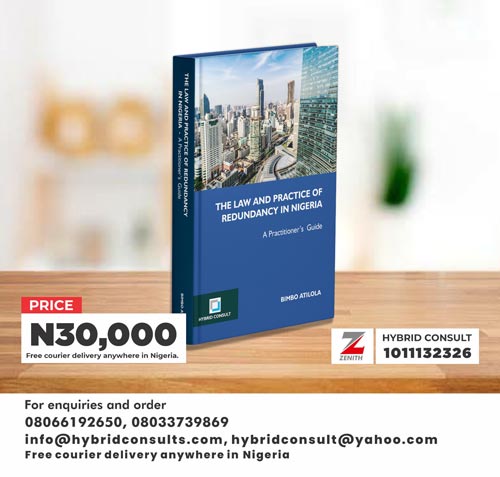 _______________________________________________________________________
[A MUST HAVE] Evidence Act Demystified With Recent And Contemporary Cases And Materials

Available now for NGN 40,000 at ASC Publications, 10, Boyle Street, Onikan, Lagos. Beside High Court, TBS. Email publications@ayindesanni.com or WhatsApp +2347056667384. Purchase Link: https://paystack.com/buy/evidence-act-complete-annotation
______________________________________________________________________ ARTIFICIAL INTELLIGENCE FOR LAWYERS: A COMPREHENSIVE GUIDE
Reimagine your practice with the power of AI “...this is the only Nigerian book I know of on the topic.” — Ohio Books Ltd
Authored by Ben Ijeoma Adigwe, Esq., ACIArb (UK), LL.M, Dip. in Artificial Intelligence, Director, Delta State Ministry of Justice, Asaba, Nigeria.
Bonus:
Get a FREE eBook titled “How to Use the AI in Legalpedia and Law Pavilion” with every purchase.
ARTIFICIAL INTELLIGENCE FOR LAWYERS: A COMPREHENSIVE GUIDE
Reimagine your practice with the power of AI “...this is the only Nigerian book I know of on the topic.” — Ohio Books Ltd
Authored by Ben Ijeoma Adigwe, Esq., ACIArb (UK), LL.M, Dip. in Artificial Intelligence, Director, Delta State Ministry of Justice, Asaba, Nigeria.
Bonus:
Get a FREE eBook titled “How to Use the AI in Legalpedia and Law Pavilion” with every purchase.
How to Order: 📞 Call, Text, or WhatsApp: 08034917063 | 07055285878 📧 Email: benadigwe1@gmail.com 🌐 Website: www.benadigwe.com
Ebook Version: Access directly online at: https://selar.com/prv626