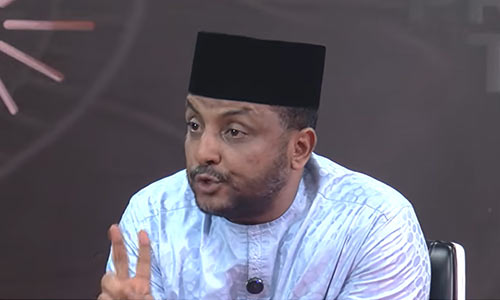
A spokesman for the All Progressives Congress (APC) Presidential Campaign Council, Mr. Alwan Hassan, has cited the case of an orphaned student in Niger State who diverts a portion of her monthly student upkeep allowance to her mother as evidence that the Tinubu administration’s education intervention is reaching the poorest Nigerians.

Speaking in a television interview in which he was pressed repeatedly on the gap between macroeconomic indicators and the lived experience of ordinary Nigerians, Hassan, who is the second spokesperson for the campaign council, offered the account as a direct answer to the question of what the party would place before a voter who says they are poorer today than before the government came in.
“Charles, I’ve seen a child, an orphan in Niger,” Hassan said. “She was explaining how she never thought she was going to go to the tertiary institution. She said when her first alert came for feeding, 25,000 naira, she cried. And in that 25,000 naira, she sends 10,000 to her mother to feed every month.”
The anecdote was offered in support of his wider claim about the Nigerian Education Loan Fund (NELFUND), which he described as the clearest expression of the administration’s social intervention.
The account, however, raises a question the spokesman was not asked in the studio and did not address.
The sum he describes is the monthly upkeep allowance paid to NELFUND beneficiaries, a component distinct from the institutional fee loan that covers tuition and charges payable to the institution. On the spokesman’s own account, the student is not spending forty per cent of that allowance on herself. She is remitting it to her mother as household feeding money.
Whether that is a success story or a warning depends entirely on what the upkeep component is designed to do. If the allowance exists to keep a student fed, housed and in class for the duration of a semester, then a beneficiary who routes N10,000 of N25,000 out of the campus economy every month is, by definition, meeting her own subsistence needs on N15,000. If the allowance is intended more broadly as a poverty transfer attached to a student, the remittance is unremarkable.
The Student Loans (Access to Higher Education) Act, which establishes the fund and governs disbursement, draws the distinction between the institutional loan and the student upkeep component precisely because they answer different needs, and the fund’s own guidelines set the terms on which the upkeep sum is paid. Nothing in the spokesman’s account suggests the student has breached any condition, and there is no indication that NELFUND has raised any question about her conduct. But the anecdote was advanced as proof that the intervention is working. It is equally capable of being read as evidence that a stipend calibrated for one student’s feeding is being stretched across a household because nothing else in that household is working, which is the precise point the interviewer spent the segment putting to him.
Asked how he would convince a Nigerian who says they are poorer today than before the administration took office, Hassan said the answer lay in the government’s record.
“Nobody doubts that the macro economy is doing very well in Nigeria today under President Tinubu. Nobody does that. Our stock market is one of the best, if not the best, in the developing economy. Nobody argues about it,” he said. “Then the question people ask is the micro. How does it touch the people? So there is a lot to say, from education to health to security. Efforts have been made, things have happened, and they are still happening.”
Put to him that he was asking Nigerians to vote on macroeconomic indicators rather than lived experience, and that gross domestic product figures do not pay a market woman’s food bill, he said that was precisely why he wished to begin with education.
Hassan said the student loan scheme is now servicing more than 1.3 million students across over 350 federal and state owned tertiary institutions, covering both tuition and monthly upkeep.
“The president is paying university school loans for over 350 tertiary institutions, federal owned and state owned. Over 350. Kids that could not go to school or might have dropped out are being given loans for their tuitions and stipends at the end of the month to feed. This is servicing over 1.3 million students.”
He said a further tranche is in the pipeline: “It’s something we have achieved in just two years, Charles. Over 200,000 have registered and they’re undergoing vetting by the university and by NELFUND. By the time they come up you have 1.7 million on the payroll of NELFUND.”
Challenged that the number reached is small against the national population, he cited admission figures: “As at January, the NUC said the amount of intake of students in tertiary institutions are between 2.5 to 3 million every year. So if you have the opportunity to first get 1.7 in just two years, if we add two years, we’re getting like 3 million. So at least anybody that comes in as a new student will have that loan to access in federal and state tertiary institutions.”
The spokesman said the President visited 18 tertiary institutions across the six geopolitical zones last year and made direct grants to their medical schools.
“He went to their medical school. Gave every medical school in the 18 tertiary institutions 4 billion naira to renovate their workshop and their science lab. After that he gave the schools 1.5 billion, the 18 selected across the six geopolitical zones, 1.5 billion naira to build more rooms, that’s more hostels, so as to get more doctors and more nurses that can still come to school, to double the intake.”
“Then this year the same president approved 250 billion naira to the same medical schools, 18 in 18 tertiary institutions, for the schools to buy equipment. You think that is not touching the lives of the poor?”
He added that the beneficiaries of federal institutions are not the wealthy: “The rich don’t take their kids to the federal universities, to the tertiary institutions.”
On technical and vocational education, he said: “Today, every technical school that is federal is free in Nigeria. Vocational schools, training schools are free in Nigeria. What you need to do is to take your child to a technical school with the clothes you wear and they will give them stipends of 22,500 naira. It is happening. You can fact check me.”
Confronted with data showing rising poverty, including the figure of more than 130 million Nigerians assessed as multidimensionally poor, Hassan rejected the statistics and the institutions behind them.
“I don’t agree with that,” he said. Asked whether he disputed the World Bank and the National Bureau of Statistics, he replied: “I don’t agree with a Canadian sitting in Canada or someone sitting in Switzerland counting poor people in Nigeria. Do you know the people they call poor? They are those villagers that live in their villages that have vast lands, that farm in their lands, and at the end of the season they cultivate and take some to go to the market to sell.”
Asked whether he meant the farms ravaged by insecurity, he said: “Not all the farms are. For example, Kano doesn’t have an issue with going to farm. A lot of states like Kaduna today, people are going to the farm and people are planting a lot of things.”
Told of an interview with a major, politically unaffiliated farmer operating across northern Nigeria whose assessment of the situation was described as extraordinary, Hassan conceded the fear but pivoted to the security response: “So people are scared in that area, Charles, but what has the government done on that?”
Setting out the security record, the spokesman said: “This president has approved the employment of more than 28,000 military personnel to add up to the security. This same president has bought about four surveillance helicopters now presently in the northeast. Then two attack helicopters added to the fleet.”
He said troop welfare had been improved: “He has increased the welfare of the boots on ground, from a colonel down at 50 per cent, from a brigadier up at 30 per cent. This is boosting their morale.” He also referred to the recruitment of 9,000 forest guards.
On the foreign exchange reform and the removal of the petrol subsidy, Hassan defended both as necessary and framed the alternative in class terms.
“Do you want us to subsidise dollars for the rich men to go abroad, go on vacation, pay for their kids?” he asked. “The currency, Charles, we have to devalue. We won’t be subsidising dollars for rich men.”
Told that the purchasing power of the N25,000 stipend he had cited was being erased by the consequences of subsidy removal, he replied: “You’re talking about one isolated incident. I’m telling you what we have done to cushion the effect, and I’m starting from education.”
Turning to health, Hassan said the administration had subsidised dialysis and expanded cancer treatment.
“Do you know that in health alone, when Tinubu came in, dialysis was 75,000 naira? This president subsidised it to 15,000. 60,000 naira of that. Who goes to the government hospitals for dialysis? It’s the poor, Charles, it’s the poor. There are private hospitals that the rich go to, or some even go abroad.”
On oncology, he said: “Six cancer centres in the six geopolitical zones, one in Katsina, one in Edo, and one in Enugu, have been launched and they are in service now.”
He also claimed extensive work on primary care: “This same government has revitalised over 4,000 primary health centres that were dilapidated, abandoned. They renovated over 1,000 primary health centres with supplies of medication.”
When it was put to him that these were assertions rather than verified facts, and that a fact checking operation was being prepared to test such claims instantly, he said he welcomed the scrutiny.
Asked to name the one policy achievement the opposition would find hardest to attack, Hassan named the subsidy removal and argued that his opponents had effectively conceded the point.
“I’m happy for subsidy removal and none of them, Atiku and Obi, are arguing. They’re saying the same thing. One is saying he’s bringing it back, and Atiku a week later said he was not going to bring it back, that he was going to talk with the economists then he will find a way of seeing if he’s to leave it or bring it back. Those are rhetoric.”
He argued that a change of government would cost the country years of progress: “If we give up President Bola Ahmed Tinubu in 2027 with all the reforms he has done, it’s as if we were going back to 10 years, because anybody that comes in, you’ve heard him saying he’s going to loan money to subsidise.”
He further alleged that opposition opposition to the policy is financially motivated: “Let me tell you why he’s saying that. The people benefiting from the subsidy, the marketers, are getting the money of subsidy to go and import fuel. They used to be his donors in the campaign and they are no more today. That’s why he’s hungry.”
Asked directly where he privately accepts the APC is vulnerable, he did not name an area, saying instead: “Every party and government that is in government has challenges. How they tackle the challenges and what they do to cushion the effect of those.” He added: “Our party APC and the government in place is still the best.”
Invited to compare the quality of life and purchasing power of Nigerians between 1999 and 2007 with today, Hassan rejected the premise of the comparison.
“If I tell you that there is a country that is still in 2007, including the biggest economy, America, you laugh at me.”
Told that the difference elsewhere is that salaries rise with inflation, he pointed to the minimum wage: “This president has increased 70 per cent. 100 per cent of salary. When he came in, from 30,000 minimum wage to 70,000. That’s 100.”
He conceded that the increase has not restored disposable income: “You have money in your hands and when you go to the market you can afford at least to buy a meal, to buy food. That extra that used to happen is not there. But things are coming up.”
He summarised the party’s message as: “We are on reform to prosperity, and will not allow anybody to backtrack on it.”
Asked how the APC justifies bringing serving heads of institutions such as the Nigerian Revenue Service and the National Identity Management Commission (NIMC) into partisan campaign roles, when the credibility of those bodies rests on perceptions of neutrality, Hassan said the distinction being drawn does not exist.
“Charles, anybody, whether you call him technocrat or not, that comes here to say he’s not a politician, once you take an appointment with a democratically elected government, you have become a political appointee. Whether he’s involved by a listing in that list or he is not on the list, whatever role the government wants him to play, he will play in the campaigns. So seeing a name in the PCC list does not make any difference.”
He extended the argument to the entire executive: “How many ministers have you seen in that list? No more than 10. But every minister will participate. How many government appointees have you seen in that list? Every government appointee will participate in one way or the other, because they must come out to tell the people what they have done for Nigerians in the last three and a half years in their offices. So they are political appointees and they must participate in this campaign.”
Pressed that perception matters regardless, he was dismissive: “I don’t think so.”
He acknowledged the specific concern that then arises: “People see it like he’s going to bring the revenue of the people to the campaign,” before arguing that the same objection would apply to an incumbent president seeking re election. “A sitting president always has the opportunity by our constitution to sit on that throne and contest a second term. It’s the same with having a name on the campaign council, any appointee. It’s the same.”
Responding to complaints from APC loyalists that the council is dominated by political patronage and that influential party figures have been sidelined, Hassan said the list is deliberately incomplete and that additions are coming.
“We are co-opting people in the list and there is going to be a supplementary list out soon. We’re co-opting politicians. We’re co-opting people. You can’t bring out names. I don’t think it has happened before that you bring out all the names at once. Usually we bring out the names of the heads, then they co-opt members who happen to be the politicians you’re talking about.”
He said the scale of the country makes a larger structure unavoidable: “The party after announcement will of course sit down and increase the numbers in the list, co-opt members, add members to contact and mobilisation. You can’t have just 10 or five people doing contact and mobilisation in 36 states, a population of almost 130 million voters. Election planning committee. There are committees there that we have to get people on ground in every state.”
On the role of the Minister of the Federal Capital Territory, Nyesom Wike, who has indicated he will play a major role in delivering Rivers State despite operating outside the formal campaign structure and belonging to another party, Hassan said no conflict arises.
“Nobody says the campaign must be run by just the campaign list or the presidential campaign council. No one says so. The states will go and do their own campaign councils, and that is what we would do. You can’t take that away from him.”
He cited the minister’s electoral record: “Even when he was our opposition in 2015, he defeated Amaechi as an incumbent. Won the state over Amaechi. In 2019 we were government, we wanted Rivers State. Amaechi couldn’t take it from him. You can’t take that away from Wike. He promised delivering Rivers State for us in 2023 and he did. And he’s promised again in 2027. He might. Every possibility shows, because he has said it before and he has delivered. It doesn’t make any difference if he’s not in our party.”
He said other opposition governors were making similar commitments: “Today, Soludo is saying he’s going to campaign for Tinubu and vote for him. The same Osun State governor that just won election is saying he’s going to campaign for Tinubu and make his people vote for him.”
He questioned why the scrutiny falls on one man: “Why is the eye only on Wike? These are sitting governors of a different political party, opposition. One is APGA, one is Accord party. He has promised that he’s going to deliver the state for APC presidential, a sitting government.”
Asked what worries the APC more, a united opposition or a dissatisfied electorate determined to punish the incumbent regardless of opposition fragmentation, Hassan said the party is prepared for both.
“We’re ready for everything or anything they want to do. Charles, we’ve defeated them in 2023. The same set of people are back again telling Nigerians that they will defeat us in 2027. As a candidate, Tinubu in 2023 defeated all of them.”
Reminded that the President was not then in office and is now being judged on his record, he replied: “How do you judge someone that has done a lot, that has made a difference? It’ll be up to the Nigerian people to make that decision.”
Put to him that the opposition will argue many more Nigerians have been impoverished by the administration’s policies, Hassan countered that the social register itself shows upward mobility.
“Some that were poor before 2023 are now well to do. I’ll tell you how we got it. The register that we used in giving stipends, the World Bank register, if you remember, was revalidated, and what they found out while doing the validation was that a lot of people have changed address. Three reasons in that register. One, some people have changed address and when you follow up the address they are living better. Secondly, some don’t need that 5,000 naira we were giving because they are richer. Third, some have lost their lives.”
“So I’m telling you that some people are better after 2023. You can’t tell me everybody has become poor.”
In the closing exchange, the spokesman was asked repeatedly to give one compelling reason why a Nigerian who is struggling today should grant the administration another four years, with the interviewer expressly excluding the student beneficiary he had cited.
“Charles, I want the Nigerian people to know that Tinubu is the best president for them among every one of them that is contesting,” he said.
Asked again what he would say to a person poorer today than in 2023, he returned to his earlier point: “There are more people that are richer today that were poor before.” Pressed a third time, he said: “There are instances that you see people that were poor before Tinubu and they have made it today and they are voters.”
When it was put to him that he effectively had nothing to say to such a voter, Hassan closed with the campaign’s slogan: “If there’s anybody in Nigeria passing through any challenge based on the reforms of this government, I’m telling him, and we are telling him, that it is reform to prosperity. Give hope a chance and there will be a stable Nigeria.”
[A MUST HAVE] Evidence Act Demystified With Recent And Contemporary Cases And Materials

Available now for NGN 40,000 at ASC Publications, 10, Boyle Street, Onikan, Lagos. Beside High Court, TBS. Email publications@ayindesanni.com or WhatsApp +2347056667384. Purchase Link: https://paystack.com/buy/evidence-act-complete-annotation
______________________________________________________________________ “Enhance Legal Practice With Authoritative Reports” — Alexander Payne Offers Comprehensive Law Reports, Spanning Over A Century Of Nigerian Jurisprudence Interested buyers are encouraged to place their orders and enquiries via:
0704 444 4777, 0704 444 4999, 0818 199 9888
Website: www.alexandernigeria.com
Interested buyers are encouraged to place their orders and enquiries via:
0704 444 4777, 0704 444 4999, 0818 199 9888
Website: www.alexandernigeria.com