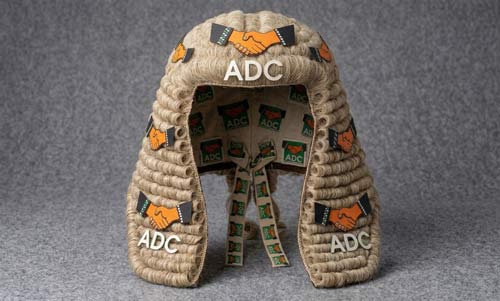
*Rules Nafiu Gombe Never Resigned From ADC, Says Exhibit ADC 1 Is “Fictitious or Fabricated”

The Federal High Court sitting in Abuja has delivered a judgment raising fundamental questions about internal democracy in Nigerian political parties, particularly whether a political party can rely on resolutions of its National Executive Committee (NEC) and recognition by the Independent National Electoral Commission (INEC) to constitute its national leadership without conducting an election.
In a judgment delivered on November 5, 2026, Justice Peter O. Lifu held that the emergence of former Senate President David Mark and former Minister of Interior Rauf Aregbesola as national officers of the African Democratic Congress (ADC) at its 99th NEC meeting on July 29, 2025, had not been shown to comply with the mandatory requirement of democratic election under Section 82(3) of the Electoral Act 2022.
The court also rejected an alleged resignation letter attributed to Hon. Nafiu Bala Gombe, describing the document tendered by the defendants as “fictitious or fabricated” after examining and comparing the signatures before it.
Justice Lifu further held that INEC’s attendance at the meeting, its monitoring report and its subsequent recognition of the disputed leadership could not validate a process that had not been shown to satisfy the requirements of the Constitution and the Electoral Act.
Consequently, the court set aside the resolutions through which Mark, Aregbesola and other persons emerged as members of the party’s National Working Committee (NWC).
It also restrained INEC from recognising or dealing with them as national officers and restrained the affected persons from acting or presenting themselves as officers of the party.
The judgment was delivered in Suit No. FHC/ABJ/CS/1819/2025, Hon. Nafiu Bala Gombe v. African Democratic Congress & 4 Ors.
Beyond the immediate leadership dispute, the decision raises wider legal questions about the limits of party autonomy, the evidential requirements for establishing the resignation of a political office holder, the distinction between notification of INEC and the conduct of an actual election, and the consequences of invalidating decisions taken by a disputed party leadership.
It also leaves important questions concerning the plaintiff’s own tenure, the scope of some of the reliefs granted and the practical administration of the party following the judgment.
The Parties And The Origin Of The Dispute
The plaintiff, Hon. Nafiu Bala Gombe, instituted the action against the African Democratic Congress as the first defendant, Senator David Mark as the second defendant, Rauf Aregbesola as the third defendant, INEC as the fourth defendant and Chief Ralph Nwosu as the fifth defendant.
Mark and Aregbesola were sued both personally and in representative capacities on behalf of persons who emerged as NWC members at the party’s 99th NEC meeting.
Gombe was represented by Robert Emukpoeruo, SAN, L. O. Fagbemi, SAN, and Luka Musa Haruna, SAN, alongside other counsel.
S. E. Aruwa, SAN, appeared for the ADC; Dr. Suleiman Usman, SAN, represented Mark; M. E. Sheriff represented Aregbesola; Hassan Aminu Adamu Bello appeared for INEC; and Edun Kehinde represented Nwosu.
Ali C. Orji also appeared for an applicant seeking to be joined in the proceedings.
The dispute arose from events preceding and following the ADC’s 99th NEC meeting held on July 29, 2025.
Gombe maintained that he was elected Deputy National Chairman of the party on October 12, 2022, for a four-year tenure scheduled to expire on October 11, 2026.
He relied on his membership card and INEC Form EC 16G(iii) as evidence of his election and status within the party.
According to him, the National Chairman and members of the NWC resigned on July 24, 2025, creating a leadership situation that required compliance with the party’s constitution and the applicable electoral laws.
He contended that rather than conduct a democratic election to fill the resulting vacancies, the party’s 99th NEC meeting purportedly appointed or ratified Mark, Aregbesola and 49 other persons as national officers.
Gombe argued that such an arrangement was inconsistent with the mandatory requirements governing the election of political party executives.
What Gombe Asked The Court To Determine
In an Amended Originating Summons filed on May 11, 2026, Gombe presented seven questions for determination and sought ten reliefs.
His case was principally founded on Sections 82(1), 82(3) and 82(5) of the Electoral Act 2022; Sections 223(1)(a) and 228(a) and (b) of the 1999 Constitution, as amended; and paragraphs 14 and 16 of the applicable 2022 INEC Guidelines.
He asked the court to declare that INEC was under a legal obligation to ensure compliance with those provisions before recognising persons who emerged as members of the party’s national executive.
He also sought declarations invalidating INEC’s recognition of the outcome of the July 29 meeting, setting aside the resolutions that produced the disputed national officers and nullifying actions undertaken by them.
In addition, Gombe sought recognition as the only elected member of the NWC whose tenure, according to his case, had not been terminated by a valid resignation or other lawful process.
He requested perpetual injunctions restraining INEC from recognising Mark, Aregbesola and the other affected officers, and restraining those persons from acting or presenting themselves as national officers of the ADC.
A central aspect of his complaint concerned the procedure adopted by the NEC.
He argued that the July 4, 2025 notice and July 22, 2025 correspondence relating to the meeting were defective because they did not contain the necessary agenda or identify the relevant committees.
Click here to download in PDF format.
He further maintained that INEC’s subsequent participation in the meeting and recognition of its outcome could not replace the democratic election required by law.
Gombe supported his originating summons with a 43-paragraph affidavit and Exhibits NBG 1 to 12, alongside further affidavits filed on September 14, 2026.
The Defence: Alleged Resignation, NEC Powers And INEC Recognition
The defendants disputed Gombe’s claims and maintained that the ADC had acted within its internal constitutional framework.
Their principal contention was that Gombe had already resigned his position by a letter dated May 17, 2025, tendered as Exhibit ADC 1, together with a forwarding letter marked Exhibit ADC 2.
On that basis, they argued that he could not challenge the subsequent reorganisation of the party’s leadership as though he remained in office.
The ADC also relied on Article 19(14) of its Constitution, which it maintained conferred broad powers on the NEC to act between national conventions.
It further relied on Article 24 concerning caretaker arrangements.
According to the defence, the decisions of the 99th NEC were consistent with resolutions taken at the party’s 97th NEC meeting on March 27, 2025, and its 98th NEC meeting on May 15, 2025.
The defendants contended that those preceding decisions provided the foundation for the dissolution of the former NWC and the constitution of a new leadership, with Mark emerging as National Chairman, Aregbesola as National Secretary and Nwosu as National Organising Secretary.
They also relied heavily on INEC’s involvement in the process.
According to them, the commission received 25 days’ notice of the meeting, attended and monitored the proceedings, prepared a report and subsequently recognised the outcome.
Exhibits ADC 6 and ADC 8 were among the documents relied upon in support of those assertions.
The defendants also referred to a change of venue to Chelsea Hotel, Abuja, and argued that INEC’s withdrawn affidavit to show cause amounted to an admission relevant to the dispute.
Aregbesola separately filed a counterclaim, seeking declaratory reliefs and ₦50 million in costs.
He contended, among other things, that Gombe had failed to renew his party membership and had not exhausted the internal dispute-resolution procedures prescribed by Articles 21 and 22 of the ADC Constitution.
INEC, for its part, left the determination of the dispute to the court’s discretion.
Preliminary Objections: Why The Court Assumed Jurisdiction
Before considering the substantive claims, Justice Lifu addressed preliminary objections challenging the competence of the action.
The objections raised questions concerning Gombe’s legal standing, the existence of a reasonable cause of action, alleged abuse of court process, failure to exhaust internal party remedies and whether the dispute was an internal party matter beyond judicial intervention.
The court dismissed the preliminary objections.
On locus standi, Justice Lifu held that Gombe had demonstrated sufficient interest to challenge the process, particularly because his alleged resignation was disputed.
The judge recognised that a mere denial of a signature would not automatically establish forgery, but equally held that the tendering of a disputed resignation letter could not conclusively determine the plaintiff’s status without proper examination.
The court also rejected the argument that the action disclosed no reasonable cause of action or constituted an abuse of judicial process.
On the requirement to exhaust internal remedies, Justice Lifu considered the constitutional guarantees of access to court and fair hearing under Sections 6(6)(b) and 36(1) of the Constitution.
The central jurisdictional issue, however, concerned whether the dispute was merely an internal affair of a political party.
The court distinguished ordinary questions of party administration from allegations that a political party had violated mandatory constitutional and statutory requirements governing the election of its officers.
It held that where such a breach was alleged, the court was entitled to examine the process.
In reaching that conclusion, Justice Lifu relied on the principle stated in PDP v. Sule Lamido that internal party democracy “is not a slogan; it is a legal imperative.”
The significance of this finding is that a political party’s constitutional power to regulate its affairs does not necessarily exclude judicial scrutiny where the complaint concerns compliance with an express provision of electoral law.
First Major Finding: The Alleged Resignation Letter Was “Fictitious Or Fabricated”
One of the most consequential aspects of the judgment concerned the letter by which the defendants claimed Gombe resigned on May 17, 2025.
The court treated the question as fundamental because the defendants’ argument that Gombe had ceased to hold office depended substantially on the authenticity of that document.
The ADC maintained that the resignation letter, being a certified document, should be preferred to the plaintiff’s denial.
Justice Lifu rejected the proposition that certification alone established the authenticity of the signature attributed to Gombe.
The court explained that certification might establish that a copy corresponds with a document held by the certifying authority, but that it did not necessarily prove that the disputed signature was genuine.
The judgment stated that certification “does not necessarily establish the authenticity of the disputed signature.”
The judge then considered the court’s power to compare disputed handwriting and signatures.
Relying on Section 101 of the Evidence Act and judicial authorities including Ishaq & Anor v. INEC & Ors (2008) LPELR-4336 (CA), Momah & Anor v. Egwuawa (2022) LPELR-59819 (CA), Mobil Producing (Nig.) Unltd v. Hope (2016) LPELR-41191 (CA), and Adenle v. Olude (2002) 18 NWLR (Pt. 799) 413, the court held that a judge could compare a disputed signature with signatures admitted or otherwise established to be genuine.
According to the judgment, expert evidence was not invariably indispensable in every dispute involving handwriting or signatures.
Justice Lifu nevertheless acknowledged the seriousness of an allegation of forgery.
He warned that a court must not automatically accept the allegation merely because a person denies signing a document, just as it must not treat the production of that document as conclusive proof that the person signed it.
Applying that approach, the judge compared the signature appearing on Exhibit ADC 1 with Gombe’s signatures on documents executed before a Commissioner for Oaths and other documents whose execution was not disputed.
He found that the signatures differed in their structure, style, formation and general manner of execution.
The court described the differences as clear and material, emphasising that its conclusion arose from an independent examination rather than solely from Gombe’s denial.
Justice Lifu consequently held:
“The alleged resignation letter, that is, Exhibit ADC 1, is fictitious or fabricated. I so hold.”
The judge subsequently conducted a further comparison involving signatures on Gombe’s witness statements on oath and again found material differences.
He concluded that the defendants had failed to establish a valid resignation and could not rely on Exhibit ADC 1 as proof that Gombe had relinquished his position.
This finding was important because it removed a central factual foundation of the defence.
However, the judicial finding concerning the authenticity of the document should not be confused with a criminal conviction for forgery. The court determined the evidential question arising in the civil leadership dispute.
Second Major Finding: Notice To INEC Is Not The Same As Conducting An Election
The second major issue concerned the legal distinction between notifying INEC of a political party meeting and democratically electing party officers.
Justice Lifu examined Section 223(1)(a) of the Constitution, which requires political party constitutions to provide for periodic election, on a democratic basis, of principal officers and members of executive committees.
The court also considered Section 228(a) of the Constitution, dealing with legislative measures intended to ensure internal democracy in political parties.
Of particular importance were Sections 82(1), 82(3) and 82(5) of the Electoral Act 2022.
Section 82(1) concerns the requirement for a political party to give INEC at least 21 days’ notice of a convention, congress, conference or meeting convened for the purpose of electing members of its executive or other specified governing bodies.
Section 82(3) addresses the manner in which such elections must be conducted.
It requires a democratic process that allows members of the political party or their duly elected delegates to vote.
Section 82(5) concerns the legal consequences of failing to provide the required notice.
The court held that notification and democratic election were “related but distinct obligations.”
It explained that evidence showing that INEC received notice of a meeting and attended the proceedings might establish compliance with the notification requirement.
That evidence, however, would not automatically establish that a lawful election had taken place.
Justice Lifu stated that evidence of INEC receiving 25 days’ notice and monitoring the ADC’s 99th NEC meeting “may be relevant to compliance with the notice requirement; it does not, without more, establish that the officers who emerged were democratically elected.”
The court therefore rejected the proposition that INEC’s presence at a party meeting automatically validated whatever leadership arrangements emerged from it.
The critical question was not simply whether the meeting was properly convened or monitored, but whether the procedure adopted to produce the national officers complied with the mandatory requirements of the law.
Why The Court Rejected Appointment Or Ratification As A Substitute For Election
Justice Lifu accepted that a political party may organise its affairs in accordance with its constitution and that the powers conferred on its NEC are relevant to determining how the party operates.
However, the court held that those powers remained subject to the Constitution and applicable legislation.
It found that the ADC could not rely on the broad powers of its NEC under Article 19(14) to avoid the democratic election required by Section 82(3) of the Electoral Act.
The court drew a distinction between the NEC’s authority to convene meetings and take administrative decisions and its ability to constitute elected offices through a process satisfying statutory requirements.
According to the judgment, there was no satisfactory evidence that Mark and Aregbesola emerged from an election in which eligible members or duly elected delegates had an opportunity to vote.
Justice Lifu stated that there was “no evidence before the Court establishing that the emergence of the 2nd and 3rd Defendants was preceded by, or resulted from, a democratic election conducted in accordance with section 82(3).”
The court also held that it could not presume compliance with a mandatory statutory requirement merely because the NEC met and adopted resolutions.
It described a democratic process as one involving genuine participation by eligible party members or duly elected delegates, who must be allowed to vote for candidates of their choice.
Consequently, the court held that an appointment or ratification unsupported by evidence of such an election could not be treated as the legal equivalent of a democratic election.
To hold otherwise, Justice Lifu reasoned, would permit an internal party arrangement to override an express statutory obligation.
This was the principal legal basis for setting aside the resolutions through which the disputed national officers emerged.
Third Major Finding: INEC’s Recognition Cannot Cure An Unlawful Leadership Process
The judgment also examined INEC’s constitutional responsibility to monitor the organisation and operation of political parties.
Under paragraph 15(c), Part I of the Third Schedule to the Constitution, INEC exercises a monitoring function in relation to political parties.
The defendants relied on this function, together with the commission’s attendance at the meeting and subsequent recognition of its outcome, to support the validity of the disputed leadership.
Justice Lifu held that monitoring and recognition were not substitutes for legal compliance.
“Monitoring is an important regulatory function, but it does not confer power to dispense with a mandatory legal requirement,” the court stated.
The judge explained that INEC’s report could provide evidence of what happened at the meeting, but the commission’s administrative recognition could not make lawful an arrangement that failed to satisfy mandatory requirements.
The court maintained that the legality of a political party’s leadership process remained a judicial question, to be resolved by reference to the Constitution, the Electoral Act and the evidence.
The implication is that INEC’s recognition of a party leadership cannot, by itself, answer a legal challenge concerning the manner in which that leadership emerged.
Equally, the judgment does not mean that INEC’s monitoring role is irrelevant. Rather, it establishes that monitoring is one aspect of compliance and cannot replace proof of the election required by law.
The Plaintiff’s Claim To Leadership And The Limits Identified By The Court
An important aspect of the judgment concerns Gombe’s assertion that, having not validly resigned, he remained the only elected member of the ADC’s NWC and was entitled to supervise the party’s affairs.
The court distinguished between proving that the disputed leadership process was invalid and establishing an independent entitlement to occupy or exercise a particular office.
Justice Lifu observed that Gombe’s position as an elected officer who had not been shown to have resigned might support a claim to supervise the party’s affairs.
However, the judge also stated that entitlement to act as a national officer required support from the party’s constitutional arrangements, the evidence and applicable laws.
The distinction is legally important.
A finding that the process producing Mark and Aregbesola was unlawful does not necessarily determine every question about who should exercise the party’s leadership functions.
Nevertheless, as discussed below, the wording of the court’s eventual declaration concerning Gombe creates a question about how that distinction is to be reconciled with the final orders.
Aregbesola’s Counterclaim Dismissed
The court also considered Aregbesola’s counterclaim, which challenged Gombe’s continuing membership and complained that he failed to exhaust the internal remedies provided by the party’s Constitution.
Aregbesola sought declaratory reliefs and ₦50 million in costs.
Justice Lifu held that the counterclaimant had not established an independent legal entitlement to the reliefs sought.
The court explained that the failure of a plaintiff’s claim, or the rejection of part of that claim, would not automatically entitle a defendant to judgment on a counterclaim.
The judge consequently dismissed Aregbesola’s counterclaim in its entirety.
The Orders Made By The Federal High Court
Following its determination of the issues, the court made orders whose substance included the following:
- INEC’s statutory duty: A declaration that INEC must ensure the ADC complies with the applicable constitutional and statutory provisions in constituting its executive or governing bodies.
- Invalidity of non-compliant meetings: A declaration that INEC cannot validate or give effect to the outcome of an ADC meeting conducted contrary to those requirements, including the disputed 99th NEC meeting.
- Nullification of INEC’s recognition: A declaration that INEC’s attendance, report and recognition of Mark, Aregbesola and the persons represented by them were wrongful, null and void, on the grounds stated in the judgment concerning notice and the absence of an election.
- Nullification of subsequent actions: A declaration invalidating actions, decisions and steps taken by the disputed NWC leadership from July 29, 2025.
- Recognition of Gombe: A declaration that INEC was bound to recognise Gombe as the only elected NWC member whose four-year tenure remained in effect and who was legally entitled to supervise the party’s affairs.
- Setting aside the NEC resolutions: An order setting aside the decisions and resolutions of the 99th NEC through which Mark, Aregbesola and the other affected persons became NWC members.
- Injunction against INEC: A perpetual injunction restraining the commission from recognising or dealing with those persons as officers or members of the NWC, NEC or another governing committee of the ADC.
- Injunction against the affected officers: A perpetual injunction restraining Mark, Aregbesola and the persons they represented from acting or parading themselves as officers or members of the affected party bodies.
- Dismissal of counterclaim: An order dismissing Aregbesola’s counterclaim in its entirety.
- Costs: No order as to costs, with the court observing that the parties belonged to the same political family.
Taken together, the orders address not only the circumstances in which the disputed leadership emerged but also the legal recognition of that leadership and the validity of actions subsequently taken in its name.
Their practical effect, however, depends on their precise wording, any applicable subsequent court orders and the status of any appellate proceedings.
LEGAL IMPLICATIONS OF THE JUDGMENT
1. Internal Party Democracy Is Not Merely An Administrative Choice
The central legal principle emerging from the judgment is that political party autonomy must operate within constitutional and statutory limits.
Although political parties are entitled to regulate their internal affairs, that authority does not permit them to dispense with mandatory election requirements for offices that the law requires to be filled democratically.
The judgment therefore distinguishes between the power to manage party affairs and the obligation to elect party officers through a legally compliant process.
A party may establish broad NEC powers under its constitution, but those provisions cannot automatically validate appointments or ratifications where the Electoral Act requires an election.
2. INEC Notification And Democratic Election Must Be Proved Separately
The judgment’s distinction between Sections 82(1) and 82(3) is particularly important.
Giving the required notice to INEC addresses one procedural obligation.
Holding an actual democratic election addresses another.
Consequently, a party seeking to defend the validity of its national leadership cannot rely exclusively on correspondence notifying INEC of a meeting or on evidence that INEC officers attended the event.
It must also establish that the procedure used to produce the officers complied with the applicable legal requirements.
The absence of proof of an election was decisive in the court’s reasoning.
3. INEC’s Monitoring Function Does Not Replace Judicial Scrutiny
The judgment reinforces the distinction between administrative recognition and judicial determination of legality.
INEC’s monitoring report may be relevant evidence, but the court held that it cannot confer validity on a process that has not met mandatory statutory requirements.
This principle places emphasis on the underlying conduct of party elections rather than simply on the official recognition subsequently accorded to their outcomes.
It also suggests that parties should maintain adequate records demonstrating how their officers were elected, rather than relying solely on NEC resolutions and correspondence with the electoral commission.
4. Certification Of A Document Does Not Necessarily Prove Its Signature Is Genuine
The finding concerning Exhibit ADC 1 raises a separate evidential issue.
The court held that the certification of a document is not necessarily conclusive proof of the authenticity of a disputed signature appearing on it.
It also relied on the power of a judge, under the applicable law of evidence and cited authorities, to compare a disputed signature with admitted or established signatures.
At the same time, the judgment recognised that neither a bare denial nor mere production of a document should automatically determine such a dispute.
Whether the procedure used in this particular case was sufficient, given the seriousness of the allegation and the conflicting affidavit evidence, is a distinct question that may arise if the judgment is challenged on appeal.
QUESTIONS THE JUDGMENT LEAVES OPEN
While the reasoning establishes several important principles, aspects of the final orders raise questions that could become central in appellate proceedings.
The Finding Of Fabrication On Affidavit Evidence
Justice Lifu relied on his examination of the disputed signature alongside signatures regarded as genuine.
Although the judgment cited authorities supporting judicial comparison, the defendants could question whether the factual dispute was suitable for final determination on affidavit evidence without oral testimony or expert examination.
That would not automatically render the finding wrong. The issue would be whether the court’s approach was justified in the particular evidential circumstances.
The Burden Of Proving That No Election Took Place
The court held that there was insufficient evidence of a democratic election.
A possible appellate question is how the burden of proof should operate where the plaintiff alleges that no election occurred and the defendants rely on NEC resolutions and an INEC monitoring report.
The issue would be whether the evidence required the defendants to establish the actual voting process and whether the documents produced sufficiently addressed that obligation.
The fact that a meeting occurred does not necessarily prove an election, but the proper assessment of the evidence and the applicable burden remain important.
The Apparent Inconsistency Concerning Notice To INEC
One particularly notable issue arises from the relationship between the court’s reasoning and the wording of its third order.
In the reasoning, Justice Lifu acknowledged evidence suggesting that INEC received 25 days’ notice of the meeting, although he held that such notice did not establish that a democratic election occurred.
However, the supplied wording of Order 3 states that no requisite notice was given.
If accurately reproduced, the apparent difference between the reasoning and the order requires clarification.
The question is whether the court found the notice legally defective notwithstanding the period given, or whether the final order extends beyond the finding expressly explained in the reasoning.
This distinction matters because non-compliance with the notice requirement and failure to conduct a democratic election are separate legal defects.
Gombe’s Four-Year Tenure Had Reached Its Stated Expiry Date
Another issue concerns the relief granted in Gombe’s favour.
According to his own case, he was elected on October 12, 2022, for a four-year term ending October 11, 2026.
The judgment was delivered on November 5, 2026, after that stated expiry date.
Yet the supplied wording of the final order declares him the only elected NWC member whose four-year tenure remained in effect and who was entitled to supervise the party’s affairs.
This creates a question about the temporal basis of the declaration and the practical effect of recognising a tenure which, on the dates pleaded, would ordinarily have expired before judgment.
It also raises the issue of how that declaration should be reconciled with the court’s earlier observation that the invalidity of Mark and Aregbesola’s emergence was separate from Gombe’s entitlement to exercise a particular office.
The Scope Of The Order Nullifying Subsequent Actions
The court’s reasoning questioned the legal sustainability of actions depending on the disputed leadership’s emergence.
However, the supplied wording of the fourth order appears to nullify all actions, decisions and steps taken by the affected officers since July 29, 2025.
That is potentially broader than a declaration limited to actions directly dependent on the invalid leadership arrangement.
Questions could arise concerning decisions affecting third parties, internal party administration, earlier political arrangements and any steps taken in reliance on the disputed leadership.
The practical consequences would depend on the scope of the order as interpreted and any subsequent judicial clarification.
The Position Of Other NWC Members
The proceedings were brought against Mark and Aregbesola in representative capacities in relation to other persons who emerged through the 99th NEC meeting.
The orders also extend to those represented persons.
A possible issue is whether the representative proceedings and the evidence justified relief affecting all those persons, particularly where their individual interests or circumstances might differ.
The outcome would depend on the procedural basis of the representative action and the terms of the judgment.
Who Administers The ADC Following The Orders?
The court set aside the resolutions that produced the disputed leadership and restrained the affected officers from exercising their positions.
However, the judgment summary does not provide a comprehensive arrangement for administering the party following those orders.
The declaration concerning Gombe does not eliminate the questions raised by the stated expiry of his tenure or by the court’s discussion of the requirements for assuming a particular office.
Accordingly, the judgment leaves a practical leadership question whose resolution may depend on the ADC Constitution, applicable laws, any subsequent party decisions and further judicial proceedings.
POSSIBLE CONSEQUENCES FOR THE 2027 ELECTIONS
The judgment could have important implications for the ADC’s preparations for the 2027 elections if its operative orders remain in force.
The principal concern is the legal standing of decisions taken by persons whose emergence as national officers was invalidated.
Questions could arise concerning party administration, the convening of meetings, the authorisation of political activities and the conduct of future nominations or primaries.
However, the judgment should not be interpreted as automatically invalidating every future nomination or electoral activity associated with the ADC.
Such consequences would depend on the specific acts concerned, their legal foundation, the wording and continued operation of the court’s orders, and any subsequent proceedings.
The broader effect is therefore a matter requiring careful legal analysis rather than an assumption that all activities undertaken in the party’s name are necessarily void.
The supplied analysis also identifies an earlier Federal High Court decision associated with Justice Liman in Abejide, reportedly delivered on July 2, 2026, concerning the ADC leadership.
Any assertion that the two decisions conflict would require examination of their respective parties, issues, findings and orders.
Where judgments of courts of coordinate jurisdiction raise potentially inconsistent legal positions, the proper appellate process may be necessary to clarify the governing position.
No conclusion about such a conflict can safely be reached without examining the earlier judgment.
Click here to download in PDF format.
CONCLUSION
The Federal High Court’s decision in Gombe v. ADC & 4 Ors rests on three principal findings.
First, the court rejected the alleged resignation letter attributed to Gombe after comparing the disputed signature with other signatures before it.
Second, it held that the ADC had not established that Mark, Aregbesola and the other affected officers emerged through the democratic election required by Section 82(3) of the Electoral Act 2022.
Third, it held that INEC’s notification, attendance, monitoring and recognition could not replace compliance with the mandatory electoral process.
These findings led the court to set aside the disputed NEC resolutions and issue injunctions concerning the recognition and activities of the affected officers.
The judgment consequently reinforces the principle that political party autonomy is subject to constitutional and statutory requirements, particularly where the election of party executives is concerned.
Nevertheless, the possible inconsistencies between some aspects of the reasoning and the final orders, the stated expiry of Gombe’s tenure, the court’s finding concerning the disputed signature and the breadth of the reliefs granted raise legal questions that may require further judicial consideration.
The central lesson of the judgment is that the legality of political party leadership cannot rest solely on internal resolutions or administrative recognition.
Where the law requires democratic election, the party must be able to establish that such an election actually occurred.
Judgment referenced: Hon. Nafiu Bala Gombe v. African Democratic Congress & 4 Ors, Suit No. FHC/ABJ/CS/1819/2025, Federal High Court, Abuja, per Hon. Justice Peter O. Lifu, delivered November 5, 2026.
[A MUST HAVE] Evidence Act Demystified With Recent And Contemporary Cases And Materials

Available now for NGN 40,000 at ASC Publications, 10, Boyle Street, Onikan, Lagos. Beside High Court, TBS. Email publications@ayindesanni.com or WhatsApp +2347056667384. Purchase Link: https://paystack.com/buy/evidence-act-complete-annotation
______________________________________________________________________ “Enhance Legal Practice With Authoritative Reports” — Alexander Payne Offers Comprehensive Law Reports, Spanning Over A Century Of Nigerian Jurisprudence Interested buyers are encouraged to place their orders and enquiries via:
0704 444 4777, 0704 444 4999, 0818 199 9888
Website: www.alexandernigeria.com
“A Comprehensive Guide To Evidence Law” — Releases Second Edition In Three Volumes, Covering 4,051 Cases
For enquiries and orders, contact: 08035526491 Email: jerryamadisilk@gmail.com
 Prof. Jerry Amadi’s Evidence Law, Second Edition (2026), contains 3,314 pages in three volumes, covering the Evidence Act 2011, its 2023 amendment, and 4,051 Nigerian and English cases.