By Sylvester Udemezue (Udems)

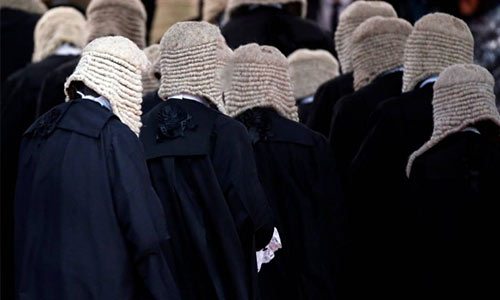
Following a news report that “34 Lawyers Fail NJC Integrity Test for Appointment as Judges,” and the intense debate it provoked within the legal community, a very senior lawyer and former Attorney-General of a Nigerian state suggested that “any person who fails the integrity test is not qualified to be a lawyer, ab initio.” That assertion raises serious questions which deserve careful, sober, and dispassionate interrogation.
With the utmost respect, that conclusion cannot be accepted without qualification. Its validity depends heavily on context, process, and the standards applied.
INTEGRITY: ESSENTIAL, YES, BUT HOW DETERMINED?
There is no dispute that integrity is indispensable to the legal profession. It is foundational both for those who practise law and for those who sit in judgment. However, integrity (particularly as assessed in the context of judicial appointments) often rests substantially on the opinions and perceptions of assessors. In such circumstances, integrity becomes a subjective determination, shaped by institutional priorities, human discretion, and sometimes opaque considerations. That reality demands caution before sweeping consequences are attached to the outcome of such assessments. Before it can be validly asserted that a person has failed an integrity test to the extent of being disqualified from legal practice, the process must, at the very least, be public, transparent, anchored on the reasonable-person standard, rather than the subjective preferences of a select body whose mandate is to choose candidates for judicial office.
Most importantly, any such integrity test must be applied uniformly to all practicing lawyers (whether applying for judicial appointment or not) and serving judges. It is neither fair nor equitable to disqualify lawyers whose alleged integrity deficiencies surfaced only because they applied for judicial office, while sparing others who may equally lack integrity but have simply not sought appointment.
JUDICIAL APPOINTMENT INTEGRITY TESTS ARE NOT UNIVERSAL VERDICTS
A lawyer may fail the integrity screening of the National Judicial Council for purposes of appointment as a Federal High Court judge and yet remain a person of transparent personal and professional integrity.
Failure of such a test, without more, should not automatically translate into a universal and permanent finding that the individual lacks integrity for all purposes, particularly for continued legal practice. Judicial appointment standards are context-specific, not existential verdicts on professional worth.
A NECESSARY QUESTION: WHAT OF SERVING JUDGES?
This discussion inevitably raises a further and more troubling concern: when will integrity testing be extended to serving judges? If integrity assessments are to carry such far-reaching consequences, fairness demands consistency. Consider, for example:
(a). Would a judicial officer who allows political or executive influence to shape decisions pass an integrity test?
(b). What of judges who habitually issue conflicting orders or abuse ex parte powers?
(c). Would a judge who permits matters to stagnate in court for five to ten years meet any reasonable integrity benchmark?
Unfortunately, these examples are not hypothetical. The list is long, and well known.
THE DANGER OF SWEEPING CONCLUSIONS
Before one can validly declare that “any person who fails an integrity test is not qualified to be a lawyer,” it is essential to interrogate the yardsticks applied, and the motivations underlying the findings of the appointing body; and the objectivity, transparency, and public verifiability of the process, particularly within our national context. Absent such interrogation, sweeping conclusions risk collapsing due process into institutional fiat.
AN ANALOGY FROM COMPANY LAW
The danger of overreach is well illustrated by company law. Section 330(2) of the Companies and Allied Matters Act (CAMA), 2020 (Nigeria) provides that the secretary of a private company need not be professionally qualified; the board may appoint anyone it considers capable. If the board of ABCD Nigeria Limited rejects Mr. Jim’s application on the ground that it does not consider him capable, does that rejection objectively establish (ab initio) that Mr. Jim lacks capacity? Clearly not. He may well be appointed by XYZ Nigeria Limited, whose board forms a different assessment. The decision reflects institutional judgment, not an absolute truth.
SUBJECTIVITY, FAIRNESS, AND DUE PROCESS
Beauty, as they say, lies in the eye of the beholder. Integrity assessments are no different. Numerous variables (some legitimate, others less so) may influence such determinations. If integrity assessments are to be relied upon to disqualify lawyers from practice, then fairness demands an independent, transparent process guided by clear, objective, and publicly verifiable standards.
By analogy, would anyone seriously contend that the Legal Practitioners Privileges Committee’s failure to appoint a lawyer as a Senior Advocate of Nigeria automatically means that the lawyer is unqualified, undeserving, or professionally deficient? Of course not. The Proper Course
In my respectful view, the appropriate path forward is clear:
(1). If lawyers are to be disqualified from legal practice on the basis of a judicial-appointment integrity test, they must first be subjected to a confirmatory assessment: public, transparent, and grounded in the reasonable-person standard.
(2). Any such integrity assessment, if it is to exist at all, must apply uniformly to all lawyers and judges, not selectively to only some. What’s sauce for the goose is sauce for the gander. Equality is equity.
(3). Most consistent with due process (and this is my most preferred recommendation), any person who believes that any lawyer or judge lacks the integrity required for legal practice or judicial service should invoke the established disciplinary mechanism by petitioning the Legal Practitioners Disciplinary Committee, where allegations can be tested according to law and fair procedure.
Final Words
Integrity is indispensable to the legal profession. On that, there is no disagreement. But we must be careful not to sacrifice objectivity, transparency, and due process on the altar of subjective assessments, however well-intentioned they may appear. The rule of law demands nothing less.
Respectfullly,
Sylvester Udemezue (Udems)
Proctor, The Reality Ministry of Truth Law and Justice (TRM).
08021365545.
udems@therealityministry.ngo.
(01 January 2026)
 Reimagine your practice with the power of AI “...this is the only Nigerian book I know of on the topic.” — Ohio Books Ltd
Authored by Ben Ijeoma Adigwe, Esq., ACIArb (UK), LL.M, Dip. in Artificial Intelligence, Director, Delta State Ministry of Justice, Asaba, Nigeria.
Bonus:
Get a FREE eBook titled “How to Use the AI in Legalpedia and Law Pavilion” with every purchase.
Reimagine your practice with the power of AI “...this is the only Nigerian book I know of on the topic.” — Ohio Books Ltd
Authored by Ben Ijeoma Adigwe, Esq., ACIArb (UK), LL.M, Dip. in Artificial Intelligence, Director, Delta State Ministry of Justice, Asaba, Nigeria.
Bonus:
Get a FREE eBook titled “How to Use the AI in Legalpedia and Law Pavilion” with every purchase.
How to Order: 📞 Call, Text, or WhatsApp: 08034917063 | 07055285878 📧 Email: benadigwe1@gmail.com 🌐 Website: www.benadigwe.com
Ebook Version: Access directly online at: https://selar.com/prv626
______________________________________________________________________ "You Don't Need To Be Rich, You Just Need To Start" — Victoria Ezeigwe, Esq Launches Investment Handbook For Nigerians Starting With ₦5,000
Get your copy today and take the first step toward financial growth:
_______________________________________________________________________ [A MUST HAVE] Evidence Act Demystified With Recent And Contemporary Cases And Materials
 _______________________________________________________________________