*Says “There Are Too Many People Around the President Giving Him a Rosy Picture of a Country That Does Not Exist”

John Cardinal Onaiyekan, Archbishop Emeritus of the Catholic Archdiocese of Abuja, has said the Catholic Bishops’ Conference of Nigeria left the Presidential Villa convinced that the Federal Government is “bent on winning by all means” in the 2027 elections, and that the means at its disposal are being deployed in a manner that could render the votes of Nigerians meaningless “even if we had a free and fair election.”
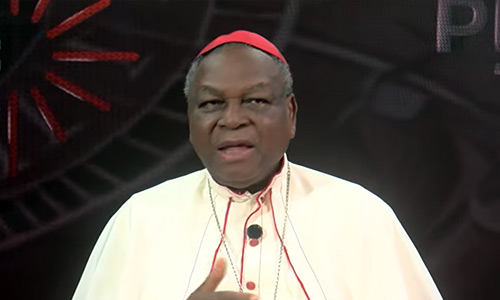
The Cardinal, who was among the senior bishops who met President Bola Ahmed Tinubu at the Villa, spoke on Arise News in an interview with Charles Aniagolu.
Asked about the robust and critical statement read to the President by the Conference President, Bishop Dagoso, Onaiyekan first established its provenance.
“That statement read by our president was not just put together at random. It was carefully prepared, and with wide consultation. The Bishops Conference is bigger than the group of us that went there, but it’s very representative of the Bishops Conference,” he stated.
“First, we had our administrative board, which is representative, and to make sure that it’s even more representative, we ensured that every archbishop, we had nine archbishops, would be there too. So it is the Catholic Bishops Conference that produced that document. Wrote, rewrote, wrote and rewrote,” Onaiyekan stated.
“It was not done at random, nor did we deliver it with levity,” he added.
Onaiyekan restated the basis on which the bishops intervene in public affairs.
“As bishops we have no ambitions to take Mr Tinubu’s job or anybody else’s job. We are not politicians running for office. We are first and foremost religious leaders who feel we have a duty not just to preach our religious doctrines but also to address the lives of our people, both those who are our members and those who are not our members,” he stated.
Asked whether this amounted to liberation theology, he rejected the label: “No, not at all. Liberation theologians can be considered more or less ideological, which we are not.”
On the President’s reaction as the statement was read, Onaiyekan was candid.
“I was not surprised that he was not looking very happy. No, even his colleagues who were there. We knew that this is different from the kind of statements that our president keeps receiving from all kinds of people,” he stated.
“And that is one of the things that worries us. That there are so many people hanging around Mr President giving him a rosy picture of what the country is, which it is not. And we felt that we have no duty to do that. Indeed, we have the obligation to help him to appreciate the reality of the situation in which we find ourselves,” Onaiyekan stated.
“And that is the reality that we painted, which I know is not the kind of thing that he wanted to hear. And the reply shows very clear,” he added.
Asked whether the meeting was frosty, given that Nigerians have become accustomed to polite exchanges between religious and political leaders, the Cardinal did not soften it.
“When the nation is bleeding, you can’t expect a polite meeting with the head of state. We need to let him know. And his reply is that the nation is not bleeding. We told him our economy is not helping our poor people. He told us the economy is doing fine,” Onaiyekan stated.
“Practically speaking, he told us quite clearly that he did not agree with us. Again, I said, we’re not surprised. We didn’t expect him to agree with us. We have done our duty. We have delivered our message. And we have a feeling that somehow along the line somebody will show him a few of the things we said,” he stated.
Asked whether the President had listened without hearing, Onaiyekan drew a distinction.
“He heard it. And he tried to tell us that he heard us, which is precisely why he replied the way he replied, replied to the points we raised but disagreed with them. So he must have heard it,” he stated.
“The only question now is, is this disagreement his final position, or will there be people around him whose job it is to draw his attention that, listen to these guys who came here in white garments, they have not made any personal request for oil wells or any particular personal things, maybe we should listen to what they are saying,” Onaiyekan stated.
“I think we believe one of the problems with our government is there are not too many people telling him the truth, which is a pity. Whether in terms of economy or in terms of insecurity, and above all the area of political climate,” he stated.
On the President’s response to the bishops’ warning against the creeping danger of a one-party dominant state, Onaiyekan quoted him directly and rejected the proposition.
“The position of Mr President came very clearly in that statement that he made. In politics all is fair. Is that true? If that is what politics is, that in politics everything can be done provided you win election,” Onaiyekan stated.
Told that the proposition was clearly not correct, he agreed: “That is not correct. That is what was said, then it is certainly not correct. We heard it. There is propriety in everything.”
“And that is what we are worried about. We are worried about the fact that we see clearly that our government is bent on winning by all means. And unfortunately, they have a lot of means at their disposal to win. And they are deploying all those means in a way that eventually, even if we had a free and fair election, the votes of the people may not count,” Onaiyekan stated.
The Cardinal set out the two warnings the bishops issued.
The first was against the drift toward a one-party dominant state. “The country doesn’t gain anything by a one-party state in a so-called democracy,” he stated.
The second: “If we do not rearrange our election system to make sure that our elections are really free, fair and credible, it can lead to difficulties.”
Onaiyekan clarified what the bishops were and were not asking of the President.
“Of course, we are not expecting Mr President to help the opposition to defeat him. No. But the point we are raising is that even though the president has all the powers of incumbency, in the election, he is a candidate like any other. He is a candidate like any other,” he stated.
On the President’s insistence that INEC is neutral and that he does not interfere, the Cardinal located the problem in the structure rather than in personal conduct.
“Words are not enough,” Onaiyekan stated.
“The Nigerian political system, the way it is now constructed, precisely is leading to a situation where INEC cannot be independent. The chairman and all the members, all the commissioners, have been appointed by the president,” he stated.
“The presumption is that Mr President will appoint independent, impartial, wonderful people. But when we are on ground, we see that all of them are not only politicians, but members of his party,” Onaiyekan stated.
Pressed that the commissioners are not formally members of the ruling party, he redirected the argument to the appointing mechanism.
“Until we find a system where the membership of the Electoral Commission is put together not by Mr President, but by a truly independent entity. That would remove the doubt. And that is not an impossible thing to do. It’s done elsewhere. We could do it if we wanted to do it. And whether our present president is in the mood to go that direction, I don’t know,” he stated.
The bishops had reminded the President of his own record fighting for democracy under military rule and suggested that strengthening democratic institutions could become his greatest legacy.
“We are hoping that that kind of statement challenges him. That you have a reputation to be a democrat. You cannot under your watch watch our democratic structures disintegrate,” Onaiyekan stated.
Told that the President did not respond to that particular point, the Cardinal replied: “Well, can I say here, silence is consent? He must have agreed with what we said there. How he will do it, we don’t know.”
Onaiyekan contrasted Nigerian electoral practice with the democracies Nigeria claims to model itself on.
“We know that in those democratic places that we always look up to, it is a normal thing that you have alternation of one party after the other. And during elections, the onus of proof to the electorate always lies on the incumbent party to prove that we have done well,” he stated.
“Here in Nigeria it is the other way around. If you are not in power, you just have no way to even move. And it just means that we just continue and we’re going to continue like that,” Onaiyekan stated.
Addressing any suggestion that the bishops were acting for a political party, Onaiyekan was dismissive.
“I hope nobody thought that any political party is us. There’s no way any political party can gather that kind of good from different parts of Nigeria,” he stated.
“It isn’t as if bishops have no different political feelings. We do have differences. But when it comes to what is important for Nigeria, when it comes to our existence, when it comes to the life of our people, we are united. We are united that we deserve more than what we are getting now,” Onaiyekan stated.
“And therefore, when the government keeps congratulating itself, we feel that this is misplaced. And because it is not even looking at difficulties, they are not doing enough to address those difficulties,” he stated.
Turning to his role on the National Peace Committee and the peace accord signed by 14 political parties ahead of the August 15 Osun governorship election, Onaiyekan was asked whether such accords have become symbolic public relations exercises.
“Rituals,” he answered.
He then gave a detailed account of the Osogbo visit.
“As we landed in Osogbo, we went straight to the government house to pay a courtesy call to the Governor. And the governor right away fired the salvos. He told us very bluntly, I would not have gone for that charade of the signing of a peace accord if it was not because of the great respect I have for you people in the National Peace Committee. Because you come for it, I will be there,” Onaiyekan recounted.
“He made it very blunt that the ruling party was interfering, not only interfering but making it impossible for his party or him and his party to survive,” the Cardinal stated.
He said he referenced the Governor’s concerns in his own introductory speech, after which the Governor signed along with the rest.
“Then towards the end, we asked the Governor to give us closing remarks. And here he came with five pages of strict, clear accusation, clearly targeted at the party in power, the APC. He is in Accord Party,” Onaiyekan stated.
“He claims that his members are targeted not only for imprisonment but sometimes even for physical elimination. He was particularly livid that the evening before, his Secretary to the Government had been arrested,” he stated, noting that he had since heard the Secretary to the Government had been released.
“That makes the Osun election very interesting, because there the incumbent governor is not of the party of the ruling party. But that is how it should be. There is no reason why the governors must all be of the same party with the president,” Onaiyekan stated.
The Cardinal used the occasion to raise a concern about the National Peace Committee itself.
“On the one hand, the experience I got in Osun State is that people are expecting a lot from this body called National Peace Committee, and because of that I will continue to work there. On the other hand, there’s a feeling that people just come and sign, and they just go their own way and do whatever they like, and therefore it is not worth the trouble,” he stated.
“And there is no better proof of that than the fact that, and I must confess, we were only three members of the council that were there in Osun State. And we are no less than about 18 of us. And the question is, why are a lot of people no longer active in this matter? Is it that most of them feel that it is a waste of time?” Onaiyekan asked.
“My own strong conviction is that it is useful and we must find a way of reviving it, so that next time we are going anywhere, we will not be three of us, we’ll be at least ten of us. I’m making that point clearly to General Abdulsalami, who is very much committed to this, but who unfortunately too has limits in his physical capacity. He was not able to travel with us to Osun State. He was not too strong to travel,” he stated.
Onaiyekan extended the criticism downward through the tiers of government.
“What we are saying about the president and the governors, we must also say is true about the governors and the local governments. The governors even seem to be more guilty in this regard,” he stated.
“We find hardly any state now where the members of the House of Assembly wouldn’t be all members,” he added.
The Cardinal closed on a note of conviction.
“It was one prophet who said, the Lord God said, I send my word, it will go and it will not come back without achieving the reason for which the word is sent out. We have delivered our message and we are quite convinced that it will not go for nothing. It will have a way of making an impact,” Onaiyekan stated.
“At least we have expressed the feelings of many Nigerians who have no way of meeting Mr President, or even talking with Charles,” he added.
The interview was conducted by Charles Aniagolu on Arise News. John Cardinal Onaiyekan is Archbishop Emeritus of the Catholic Archdiocese of Abuja and a member of the National Peace Committee.
[A MUST HAVE] Evidence Act Demystified With Recent And Contemporary Cases And Materials

Available now for NGN 40,000 at ASC Publications, 10, Boyle Street, Onikan, Lagos. Beside High Court, TBS. Email publications@ayindesanni.com or WhatsApp +2347056667384. Purchase Link: https://paystack.com/buy/evidence-act-complete-annotation
______________________________________________________________________ “Enhance Legal Practice With Authoritative Reports” — Alexander Payne Offers Comprehensive Law Reports, Spanning Over A Century Of Nigerian Jurisprudence Interested buyers are encouraged to place their orders and enquiries via:
0704 444 4777, 0704 444 4999, 0818 199 9888
Website: www.alexandernigeria.com
Interested buyers are encouraged to place their orders and enquiries via:
0704 444 4777, 0704 444 4999, 0818 199 9888
Website: www.alexandernigeria.com